



A good fall fitness challenge calendar for women doesn’t need to look punishing. It needs to survive school drop-offs, shorter evenings, work stress, and the odd little slump that shows up when the air gets crisp and the couch starts looking suspiciously inviting.
That’s the part most workout plans miss. They make room for motivation, not for real life.
I’ve always liked fall as a reset point because the weather helps a little. Walking feels easier. Running feels less sticky. Indoor strength work starts to make sense again. But if the calendar is too aggressive — five brutal days, no recovery, no flexibility — it falls apart the first time dinner runs late or your energy tanks at 4 p.m.
The smartest calendars mix walking, strength, mobility, and recovery in a way that feels doable on an ordinary week. That’s the whole game. A plan you can repeat beats a plan that looks impressive on paper and gathers dust by the second week.
1. 30-Day Walk-and-Weights Fall Fitness Challenge Calendar for Women

If you want one calendar that rarely backfires, start here. It’s steady, it’s simple, and it gives you enough variety to stay interested without turning every day into a circus.
This setup works because it leans on two things most bodies tolerate well: brisk walking and basic dumbbell strength. You do not need a fancy program to make progress. You need a rhythm you can keep, and this one has a clean shape.
What the week looks like
- Monday: 30-minute brisk walk
- Tuesday: 25-minute full-body dumbbell circuit
- Wednesday: 15-minute mobility flow
- Thursday: 20-minute walk with 4 short faster intervals
- Friday: 25-minute lower-body strength session
- Saturday: 40 to 45-minute easy walk
- Sunday: Full rest or light stretching
The first week should feel almost too easy. Good. That means you’ll probably finish it. On week two, add 5 minutes to two walks or one extra set on the strength days. By week three, keep the same exercises and slow the lowering phase — three seconds down on squats, rows, and presses will light things up without adding more time.
Use dumbbells that make the last 2 reps feel honest, not heroic. For many women, that means somewhere in the 8-20 pound range, depending on the exercise. A row might take more. A lateral raise takes less. Don’t guess based on ego. Guess based on the last clean rep you can do.
Small tip: keep the dumbbells where you can see them. Hidden equipment gets skipped. Visible equipment gets used.
2. Lower-Body Strength Calendar Built for Stair Climbing and Boot Season
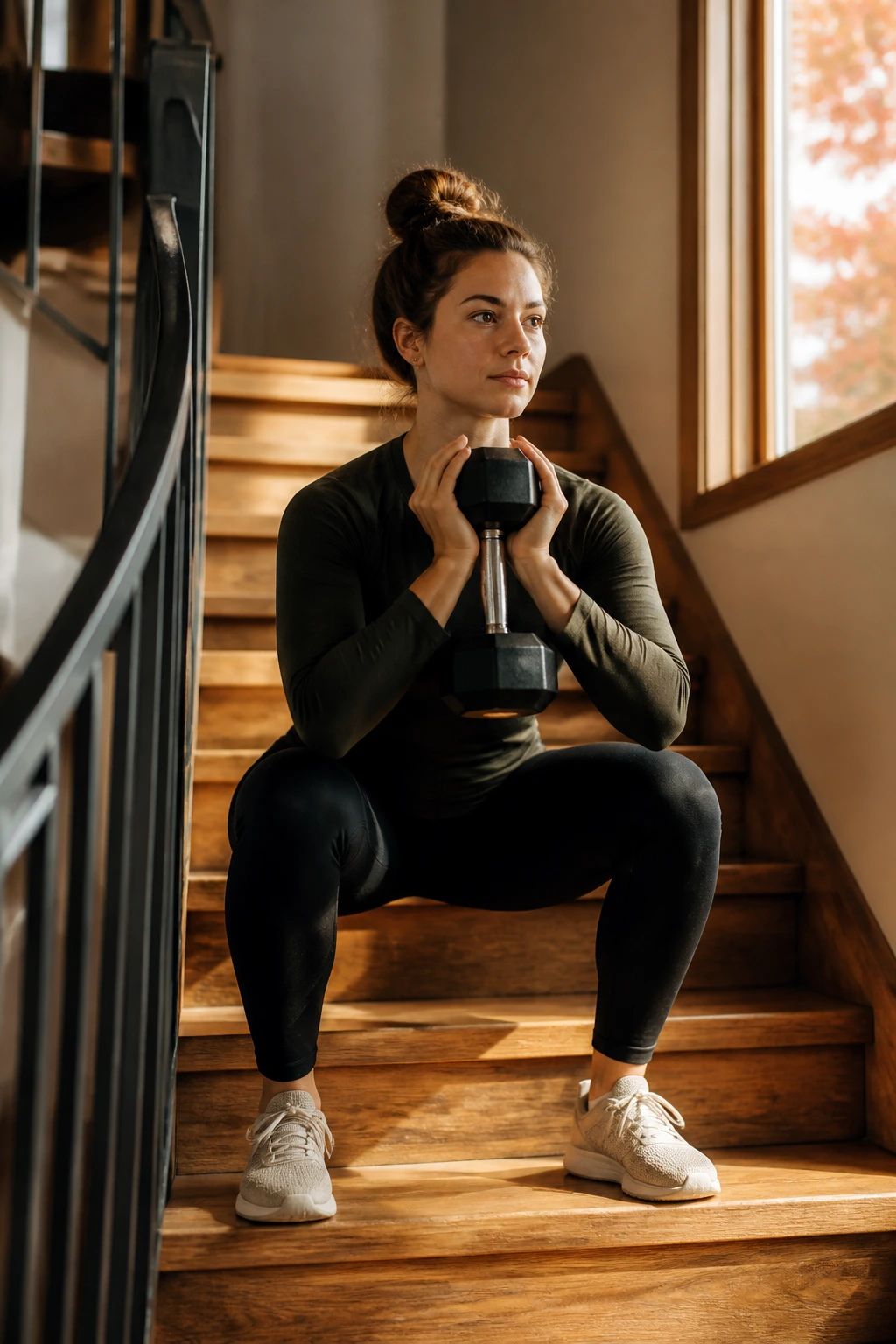
Want legs that feel steadier on stairs and less wobbly after a long day on your feet? This is the calendar I’d hand to someone who wants stronger glutes, better balance, and a little more shape without living in the gym.
Lower-body training is useful because it pays off everywhere. Carrying groceries feels easier. Hiking feels less punishing. Even sitting and standing up a dozen times a day stops feeling like a small chore.
The pattern to follow
You only need three lower-body sessions a week, with one upper-body or walk day tucked between them. Keep the exercises plain and repeat them long enough to notice progress.
- Squat pattern: goblet squat or bodyweight squat
- Hinge pattern: Romanian deadlift or hip hinge with dumbbells
- Single-leg work: split squat or step-up
- Glute focus: bridge or hip thrust
- Calves and finishers: calf raises or short incline walks
Start with 2 to 3 sets of 8 to 12 reps. That range is friendly to beginners, but it still builds real strength when you stay consistent. If your knees complain, shorten the depth on squats and slow the motion. If your lower back takes over on hinges, lighten the weight and keep the dumbbells close to your thighs.
One thing people get wrong: they think lower-body work has to leave them crawling. It doesn’t. A solid session should feel challenging by the end, but you should still be able to walk out of the room like a normal person.
3. Low-Impact Cardio and Core Calendar for Joint-Friendly Momentum

Not everyone wants jump squats at 6 p.m. Some people want sweat without the pounding, and that’s a perfectly sane preference.
This calendar is built for women who want to keep their heart rate up while being kind to their knees, ankles, or hips. Low-impact cardio can still be hard. A fast incline walk or a solid bike interval session will humble you just fine.
A clean weekly rhythm
- Monday: 25-minute bike or elliptical session
- Tuesday: 15-minute core circuit
- Wednesday: 30-minute brisk walk
- Thursday: 20-minute rower or dance cardio
- Friday: 15-minute core plus glute work
- Saturday: 40-minute easy walk or hike
- Sunday: Off
The core work matters more than it gets credit for. A stronger midsection helps keep your back calmer during cardio and makes your posture hold up better when you’re tired. I like dead bugs, side planks, bird dogs, and slow mountain climbers for this kind of calendar because they ask for control, not speed.
If you want to make it harder, do not jump straight to impact. Add resistance first. Raise the bike level. Incline the treadmill. Hold the side plank for 10 extra seconds. Boring little progressions add up fast.
And yes, this plan can burn a fair amount of energy without feeling like punishment. That’s the point.
4. Pilates and Posture Reset Calendar for Long Hours at a Desk
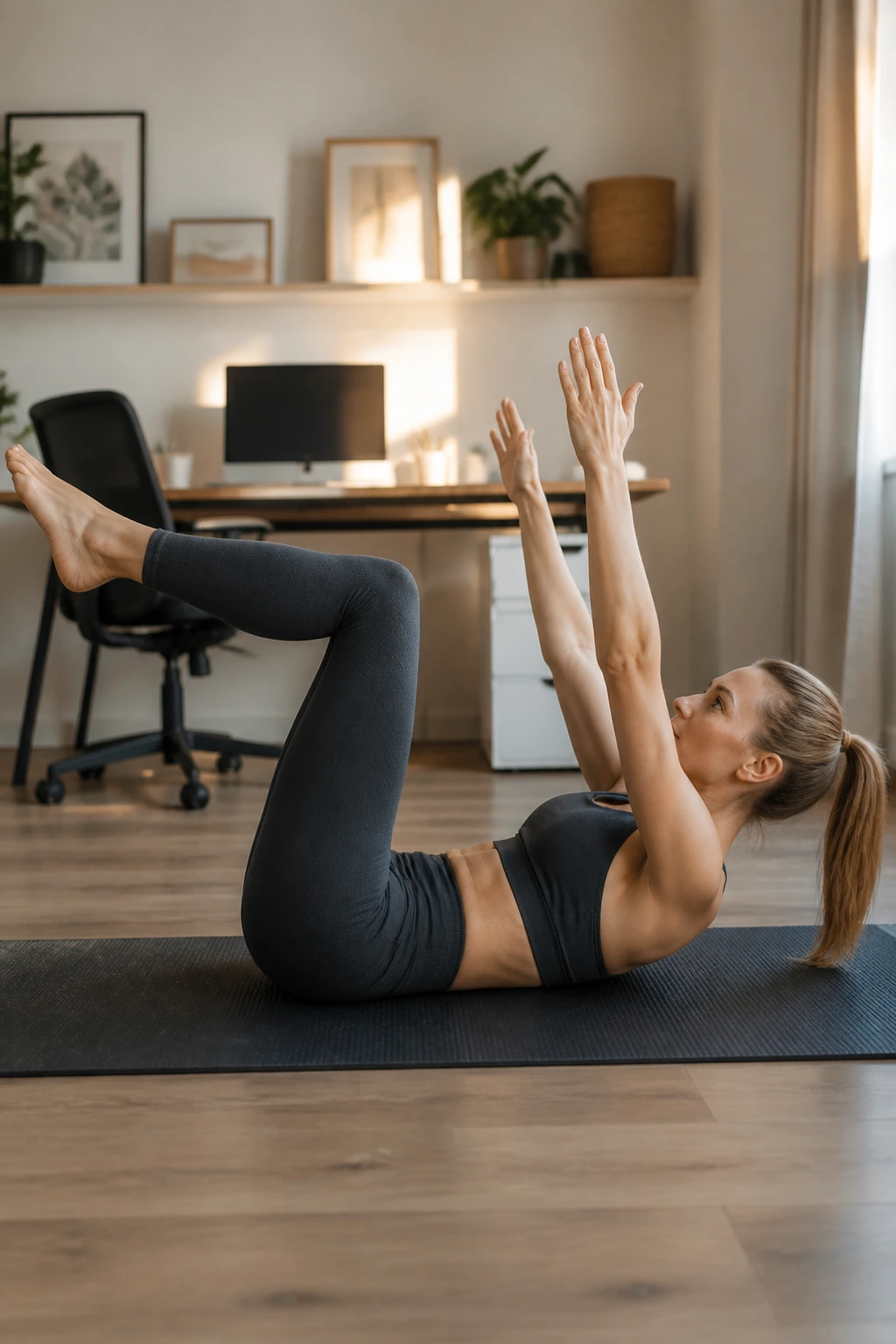
Posture work sounds dull until your neck stops aching.
That’s when it becomes interesting.
A Pilates-style calendar is a smart choice if you spend a lot of time sitting, driving, or hunching over a laptop. It focuses on deep core strength, hip mobility, shoulder control, and the kind of small stabilizing muscles that get ignored in faster workouts.
You do not need to turn every session into a floor routine for an hour. Ten to twenty minutes is enough if you come back to it often. I like a mix of cat-cow, dead bug, glute bridge, side-lying leg lifts, thoracic rotations, and wall angels. Those moves are plain, but they clean up a surprising amount of stiffness.
If you’ve ever stood up after work and felt like your hips were glued in place, this is your calendar. It will not make you sweaty in the same way a circuit does. It will make you feel more assembled.
A lot of people skip this kind of training because it looks too gentle. That’s a mistake. Gentle and easy are not the same thing. Holding a slow hollow body position for 20 seconds while your abs shake can be every bit as serious as a set of squats.
5. Beginner Dumbbell Calendar That Teaches You to Lift Without Guessing
Unlike cardio-only plans, this one changes what you can do with a grocery bag, a suitcase, or a toddler on your hip.
That sounds small. It isn’t.
This calendar is for women who want a straightforward strength plan with no clutter. Three lifting days, two lighter days, and the same handful of movement patterns repeated until they start to feel familiar. Familiar is good. Familiar means you can improve instead of starting over every time.
The weekly structure
- Day 1: Goblet squat, row, floor press
- Day 2: Brisk walk or gentle bike ride
- Day 3: Romanian deadlift, overhead press, carry
- Day 4: Rest or mobility
- Day 5: Split squat, bent-over row, glute bridge
- Day 6: Easy walk or stretch
- Day 7: Rest
Start with 2 sets of 8 reps on everything if you’re new. That’s enough to learn the motions and keep your form tidy. After a week or two, move to 3 sets. The calendar works because it doesn’t keep changing the rules. You can focus on getting a little stronger instead of wondering what exercise comes next.
I like this plan for beginners because it teaches the big patterns: squat, hinge, push, pull, and carry. Those five movements cover a lot of ground. They also make it easier to notice progress, which matters more than people admit.
6. Step Count Fall Fitness Challenge Calendar for Women Who Want a Simple Win
Want the least complicated challenge calendar on the list? This is it.
A step goal looks almost too plain to matter, but it’s one of the easiest ways to build daily movement into fall without carving out a huge workout block. You can stack steps in a parking lot, on a phone call, after dinner, or while the coffee brews. No ceremony needed.
How to use it
- Week 1: Find your normal daily average and add 1,000 steps
- Week 2: Add another 500 to 1,000 steps
- Week 3: Build in one 10-minute walk after lunch or dinner
- Week 4: Add one longer walk on the weekend, around 40 to 60 minutes
You do not need to chase a magic number if that turns the whole thing into a chore. A lot of public-health advice lands around 150 minutes of moderate movement a week, and step goals are just one way to get there. The trick is to make walking part of the day instead of a separate event.
Fall helps here because the weather is usually more forgiving than the heavy heat of summer. Put shoes by the door. Walk while the soup simmers. Loop around the block after a call. Those tiny choices count, and they count more than people think.
If you’re the type who likes checking boxes, this calendar feels satisfying fast.
7. Run-Walk Autumn 5K Calendar for Women Starting From Scratch
The first time you try to run in cool air, your lungs may protest before your legs do.
That’s normal. So is wanting to quit at minute six.
A run-walk calendar is the cleanest way to build a running habit without crushing yourself. It teaches pacing, breath control, and the patience to stop treating every outing like a test. You’re training your body to tolerate running in pieces first, then in longer stretches later.
A simple progression
- Week 1: 1 minute run / 2 minutes walk for 20 minutes
- Week 2: 90 seconds run / 2 minutes walk
- Week 3: 2 minutes run / 90 seconds walk
- Week 4: 3 minutes run / 90 seconds walk
Add a 5-minute brisk walk before every session and a 5-minute cool-down after. That little bit of structure matters. Cold muscles hate surprises.
I also like adding one long easy walk each week, because it keeps your aerobic base moving even when the running is short. If you can, run on a soft path or track instead of pounding pavement every time. Your shins will thank you.
One rule: keep the runs easy enough that you could speak in short sentences. If you’re gasping, you’re not building the habit. You’re just suffering.
8. Ten-Minute Morning Mobility Calendar for Darker, Slower Mornings
Some mornings need less ambition and more motion.
This is the calendar I’d pick for women who wake up stiff, sluggish, or mentally half-asleep and want a way to start moving before the day gets loud. Ten minutes is enough. Really. You’re not trying to earn points here. You’re trying to get your joints unstuck and your body awake.
A good morning mobility flow usually looks like this: neck circles, shoulder rolls, cat-cow, hip circles, ankle rocks, a forward fold, a low lunge stretch, and a few deep breaths. That’s it. No dramatic playlist required. No sweat test.
What makes it worth keeping is the repetition. If you do it often, your body starts to recognize the pattern. Hips loosen faster. Shoulders stop feeling welded. Your first walk of the day feels smoother, and that carries into the next thing you do.
I like this calendar because it works even when the rest of the day is messy. If you miss the workout later, you still did something useful. That sounds modest, but it adds up, especially during fall when routines tend to wobble.
And if mornings are impossible? Move the session to late afternoon. Same calendar. Different clock.
9. The 3-2-1 Full-Body Sculpt Calendar for Women Who Like Structure
Three strength days, two cardio days, one mobility day. That’s the whole skeleton, and it works because it keeps the week balanced without crowding anything out.
The beauty of this setup is that you always know what comes next. That reduces decision fatigue, which is half the battle when life is busy. You do not need to bargain with yourself every morning.
A weekly layout that actually makes sense
- Monday: Full-body strength
- Tuesday: Cardio, 20 to 30 minutes
- Wednesday: Full-body strength
- Thursday: Mobility or yoga
- Friday: Full-body strength
- Saturday: Cardio, 20 to 40 minutes
- Sunday: Rest
On the strength days, use the same core moves each week: squat, hinge, push, pull, and core. Keep the reps in the 8 to 10 range if you want strength with a little muscle-building work. For cardio, choose a pace you can hold without falling apart. Fast walking, cycling, rowing, or an easy jog all fit.
This calendar is plain in a good way. There’s no fluff. There’s no guesswork. And because the pattern repeats, it’s easy to see when you’re getting stronger — the weights go up, the cardio feels smoother, and the recovery day stops feeling like a rescue mission.
10. No-Equipment Home Calendar for Tiny Spaces and Busy Evenings
Unlike bootcamp calendars that assume you own a squat rack, this one needs a mat and about six feet of floor.
That’s one reason I like it. It respects cramped apartments, shared spaces, and evenings when leaving the house feels like too much work. No gear means fewer excuses, but it also means fewer barriers. You can get started before your brain has time to protest.
The structure is simple: three bodyweight strength days, two movement days, and two lighter days. Exercises can rotate through squats, reverse lunges, glute bridges, incline push-ups, planks, dead bugs, and stair climbs. If bodyweight gets too easy, load a backpack with books. That old trick still works.
A lot of people assume no-equipment workouts are light. They’re not, if you do them honestly. A slow split squat with 12 controlled reps per side can light up your legs more than you expected. The key is tempo and range, not gadgets.
This calendar is best for women who want consistency more than novelty. If you’re the type who likes to get home, change shoes, and move without fuss, this one fits.
11. Gym Confidence Calendar for Women Learning the Machines
The gym feels louder when you don’t know where to start.
That’s not weakness. It’s just unfamiliar territory.
This calendar is built to remove that awkward first layer. Instead of wandering around trying to invent a workout, you repeat a short list of machines and dumbbell moves for four weeks. Same room, same equipment, less guessing. That’s the whole point.
Week-by-week rhythm
- Week 1: Treadmill walk, leg press, seated row
- Week 2: Bike, chest press, lat pulldown
- Week 3: Incline walk, dumbbell goblet squat, cable row
- Week 4: Repeat week 3 and add a little weight or one extra set
Each session should take about 30 to 45 minutes, including a short warm-up. Keep a notebook or phone note with the seat settings, pin weights, and how each move felt. That saves you from starting over every time. It also gives you proof that you’re learning.
I’m a fan of this calendar for another reason: it makes the gym less mysterious. Once you know how to adjust the seat on a leg press or set the pulley height on a cable row, the room stops feeling hostile. It just becomes equipment.
You don’t need to love the gym. You only need to know how to use it.
12. Hill Walk and Weekend Hike Calendar for Fresh-Air Motivation
Not every challenge calendar needs burpees.
Some of the best ones ask you to walk uphill, breathe hard, and enjoy the fact that your workout has trees in it. There’s something nice about a fall plan that uses the season instead of fighting it.
Hill walking builds calves, glutes, and lungs without the thud of sprinting. Add a weekend hike and you’ve got a calendar that feels more like an outing than a chore. That matters. If the workout feels like a sentence, you won’t keep it. If it feels like a plan you can look forward to, you probably will.
What the month might include
- Two weekday hill walks of 20 to 30 minutes
- One longer weekend hike of 60 to 120 minutes
- One stair session or incline treadmill session
- One mobility day to keep the calves and hips happy
Good shoes matter here. So do socks that don’t slip and a bottle of water if your route is long. If hills are steep, shorten the stride and lean slightly forward from the ankles, not the waist. Little form tweaks save a lot of wasted energy.
I like this calendar for women who get bored easily. The scenery changes. The terrain changes. The workout changes just enough to stay interesting.
13. Desk-Body Reset Calendar for Tight Hips and Stiff Shoulders
Do your hips feel tight by midafternoon?
That’s usually a desk problem, not a moral failing.
This calendar is built around the movement breaks people actually need when they sit for long stretches. It mixes short resets during the day with a few real workouts in the week, so your body doesn’t seize up between meetings. Think of it as maintenance, not a punishment for sitting.
What to do between meetings
- Stand up every 60 to 90 minutes
- Do 10 bodyweight squats
- Reach arms overhead for 3 slow breaths
- Open the chest against a wall for 20 seconds per side
- Stretch each hip flexor for 30 seconds
- Walk for 3 to 5 minutes whenever you can
Then add three short strength sessions on nonconsecutive days. Rows, glute bridges, split squats, dead bugs, and overhead presses are enough. You don’t need a giant routine. You need your spine, hips, and shoulders to stop living in the same cramped shape all day.
One thing I’ve learned: a “movement snack” works better than a grand evening promise. A few minutes here, a few minutes there, and the body stops feeling locked up by dinner.
That’s the win.
14. After-Work Energy Calendar for Women Who Train in the Evening
It is 6:40 p.m., your bag is still by the door, and the last thing you want is a 60-minute program that eats the whole night.
Fair.
This calendar is for women who work out after work and need the plan to respect their energy. The sessions stay short — usually 20 to 25 minutes — and the week leans on efficient work: compound strength, brisk walks, and one or two conditioning bursts that don’t wreck you.
A realistic weekday layout
- Monday: 20-minute strength circuit
- Tuesday: 25-minute walk
- Wednesday: 20-minute intervals on bike, treadmill, or rower
- Thursday: Rest or mobility
- Friday: 20-minute strength circuit
- Saturday: Longer workout or hike
- Sunday: Easy stretch and planning
Keep a small snack handy if you tend to hit the gym flat. A banana, yogurt, or a piece of toast with nut butter can make the difference between a decent session and a miserable one. Also, change clothes fast. Sitting down “for a minute” is how workouts vanish.
I like this calendar because it removes the all-or-nothing feeling that kills so many evening routines. Short sessions still count. Short sessions are often the only reason a routine survives.
15. Holiday-Prep Fall Fitness Challenge Calendar for Women Who Need Breathing Room
The best calendar before a busy stretch is the one that assumes life will interrupt it.
That’s my blunt opinion, and I stand by it.
This plan is designed for women who know fall tends to get crowded fast. Work events, family plans, school schedules, travel, and random obligations all start stacking up. Instead of pretending the month will be calm, this calendar builds in slack. You train, you walk, you stretch, and you leave room for the week to get weird.
A forgiving weekly template
- 2 strength sessions of 25 to 35 minutes
- 2 brisk walks of 20 to 40 minutes
- 1 mobility session of 10 to 15 minutes
- 1 optional bonus session if energy is high
- 2 lighter days with only easy movement
The strength work should stay basic: squat, hinge, push, pull, core. No need to chase soreness. You want enough stimulus to keep muscle and energy up, not enough fatigue to wipe out your whole evening. Walking fills the gaps nicely, and mobility keeps your back and hips from feeling like they’ve been packed in a suitcase.
If you miss a day, do not cram four workouts into Saturday. That turns a useful calendar into a hangover. Pick up with the next planned session and keep going. Consistency matters more than streaks.
Final Thoughts
The best fall fitness challenge calendar for women is the one that fits your real week, not your fantasy week. That sounds obvious, but it’s where most plans go sideways.
Pick the calendar that matches your energy, your schedule, and the kind of movement you’ll actually repeat. A solid walking plan beats an overbuilt challenge you quit in eight days. A short strength routine beats a dramatic one you keep postponing.
Print the calendar if that helps. Put it where you can see it. And make the first week easy enough that you finish it with some momentum left in the tank. That’s how these things stop being seasonal ideas and start acting like habits.
