



On a park path, two people can move at nearly the same speed and call it different things. One says she’s jogging. The other says he’s running. Both are probably telling the truth.
That’s because jogging vs running is less about a magic speed number and more about feel, effort, and how your body organizes the movement. The difference shows up in your breathing, your stride, how much spring you have off the ground, and how your legs feel ten minutes later. If you’ve ever wondered why one pace feels relaxed while another suddenly turns your calves into cement, you already understand the basic split.
And if your goal is to get started without wrecking your knees, your shins, or your motivation, the details matter. Jogging is often the easier entry point. Running asks more from your body, but it also gives you more speed and a stronger training stimulus. The trick is knowing which one you actually want right now, not which one sounds better on paper.
The line between them is blurry. That’s fine. Blurry is useful.
Jogging vs Running: Why the Line Is Fuzzy
There is no universal speed that turns a jog into a run. That’s the first thing worth saying, because people get stuck arguing about numbers that do not matter much in real life. One runner’s jog is another runner’s run, especially if the first person is tall, light on their feet, or used to moving fast.
A lot of the difference comes down to effort. Jogging usually feels easy enough that you can talk in short sentences without gasping. Running pushes you closer to that edge where your words start getting chopped up. The pace can be the same on paper and feel different in your body, which is why labels are messy.
What the labels usually mean
Jogging often looks like a slower, looser version of running. The steps are shorter. The bounce is softer. Your face stays calmer.
Running tends to look sharper and more deliberate. The stride opens up a little. Your feet spend less time on the ground. Your breathing gets louder, and your body starts asking for a bit more focus.
A one-mile pace can even shift between the two depending on the person. A seasoned runner might call a 10-minute mile a jog. A new exerciser might call the same pace a run because their heart rate says otherwise.
That’s not confusion. That’s normal. The body doesn’t care much about labels. It cares about load.
Why the fuzzy line actually helps you
The fuzzy line gives you room to train by feel instead of chasing a number that may not fit your body. That matters when you’re starting out, because a pace that feels “slow enough” on a watch can still be too hard if your legs aren’t ready for the impact.
It also keeps the conversation honest. People often think they need to “graduate” from jogging to running like it’s a school test. You don’t. You can stay in easy jog territory for months and get fitter, leaner, and more durable. Plenty of strong runners spend most of their time there.
The real question is not “Which word sounds better?” It’s “What pace lets me train often without feeling beat up?”
What an Easy Jog Actually Feels Like

A good jog feels almost rude in its simplicity. You should not be fighting for air. Your shoulders should stay loose. Your hands should not be clenched like you’re carrying something expensive.
The rhythm feels steady and a little forgiving. Your steps land softly enough that the sound is more tap than thud. If you can keep your jaw unclenched and your breathing under control, you’re probably in jog territory.
There’s a quiet bonus here. Easy jogging often gives beginners the one thing they need most: repeatability. You can do it again tomorrow. And again after that.
Signs you’re jogging, not grinding
- You can speak in short sentences without stopping after every few words.
- Your breathing is quicker than a walk, but not ragged.
- Your feet feel like they’re turning over, not slamming down.
- Your arms swing naturally instead of pumping hard.
- You finish feeling warmed up, not destroyed.
That list sounds simple, and it is. Simple is good.
If you’re new to this, easy jogging should feel almost too easy for the first 5 to 10 minutes. That’s often the moment people make a bad call and speed up because they think they’re supposed to work harder. Don’t. Hold the easier pace longer. The benefit comes from stacking time, not from proving a point in minute two.
Why easy pace matters so much for beginners
Your connective tissue — calves, Achilles tendons, feet, shins — adapts more slowly than your lungs do. That mismatch catches a lot of people. They feel fine cardiovascularly, then their lower legs start barking two days later.
Easy jogging lets those tissues catch up. It also gives you a chance to practice form without panic. Once the effort gets too high, everything tightens. Stride gets choppy. Breathing takes over. Technique falls apart.
A lot of people think they need to “push through” to make progress. Bad idea. The easier effort is often the smarter effort, especially early on.
What Changes When the Pace Turns Into Running

Running is not just a faster jog. The mechanics shift a little, and those shifts matter more than the label. Your stride usually gets longer. Your feet leave the ground for a bit longer. Your landing force goes up. So does the demand on your hips and legs.
That sounds dramatic, but you can feel it right away. The movement becomes springier. Your breathing gets louder. Your calves and thighs work harder to keep the pace smooth. If you try to hold that effort too long before your body is ready, the whole thing turns stiff.
A beginner often thinks the answer is to “run slower.” Sometimes. But sometimes the better fix is to shorten the stride and keep the pace easy enough that your form does not fall apart.
The feel of running
Running usually feels more purposeful than jogging. Your arms drive a little more. Your torso leans forward a touch. Your feet spend less time on the ground and more time moving through the air.
That extra air time is part of why running feels harder. It also means the impact when you land is sharper. Not bad, just sharper. Your body has to absorb and redirect that force over and over.
And yes, that’s why a short run can leave you more tired than a longer jog. Speed changes the bill.
What beginners notice first
Most beginners notice the breathing before anything else. Then the calves. Then the quads. The glutes usually show up later, often on hills or when you add a bit more pace.
The funny thing is that many people call their first “run” a jog because it feels too slow to count, even while their body is saying otherwise. Call it whatever you want. The tissue load is real either way.
If your next-day soreness lives in your shins or Achilles instead of your chest, you probably changed pace or volume too fast. That’s a useful clue.
Pace, Cadence, and Stride Length Are Telling You More Than the Word

The watch does not know your effort. It only knows numbers. Your body knows the rest.
Pace matters, but it’s not the whole story. Cadence — how quickly your feet turn over — and stride length can change the feel of a jog or run even if the speed stays the same. A shorter, quicker step often feels smoother and easier on the legs than a long reaching stride. That’s one reason two people at the same pace can look and feel completely different.
When people overstride, they reach their foot too far ahead. That usually creates a louder landing and more braking force. It can make a “comfortable” pace feel clunky fast. Shortening the stride a little and letting the feet land more under the body often makes jogging and running feel lighter.
A quick way to think about cadence
You do not need to count every step unless you enjoy that kind of thing. You just need to notice whether your feet are moving with a quick, relaxed rhythm or whether each step feels like a reach.
A quicker turnover often helps beginners because it lowers the temptation to lunge forward. The body stays a little more stacked over the hips. The motion feels smaller. Less dramatic. Better.
What to watch for
- Loud slapping footfalls often mean you’re reaching too far.
- A long floating stride can feel fast but waste energy.
- Tiny quick steps can feel odd at first, then easier after a few sessions.
- If your hips feel jammed, your stride may be too long.
A lot of form advice gets too fancy. This one does not need to be. If the ground sounds angry when you land, shorten the step. That alone fixes a surprising number of beginner problems.
And if you’re on a treadmill, the same idea applies. Do not grab the handrails and lean back. That changes your stride in the worst possible way and makes your legs work oddly hard in all the wrong places.
Breathing, the Talk Test, and Effort Give Better Clues Than Speed
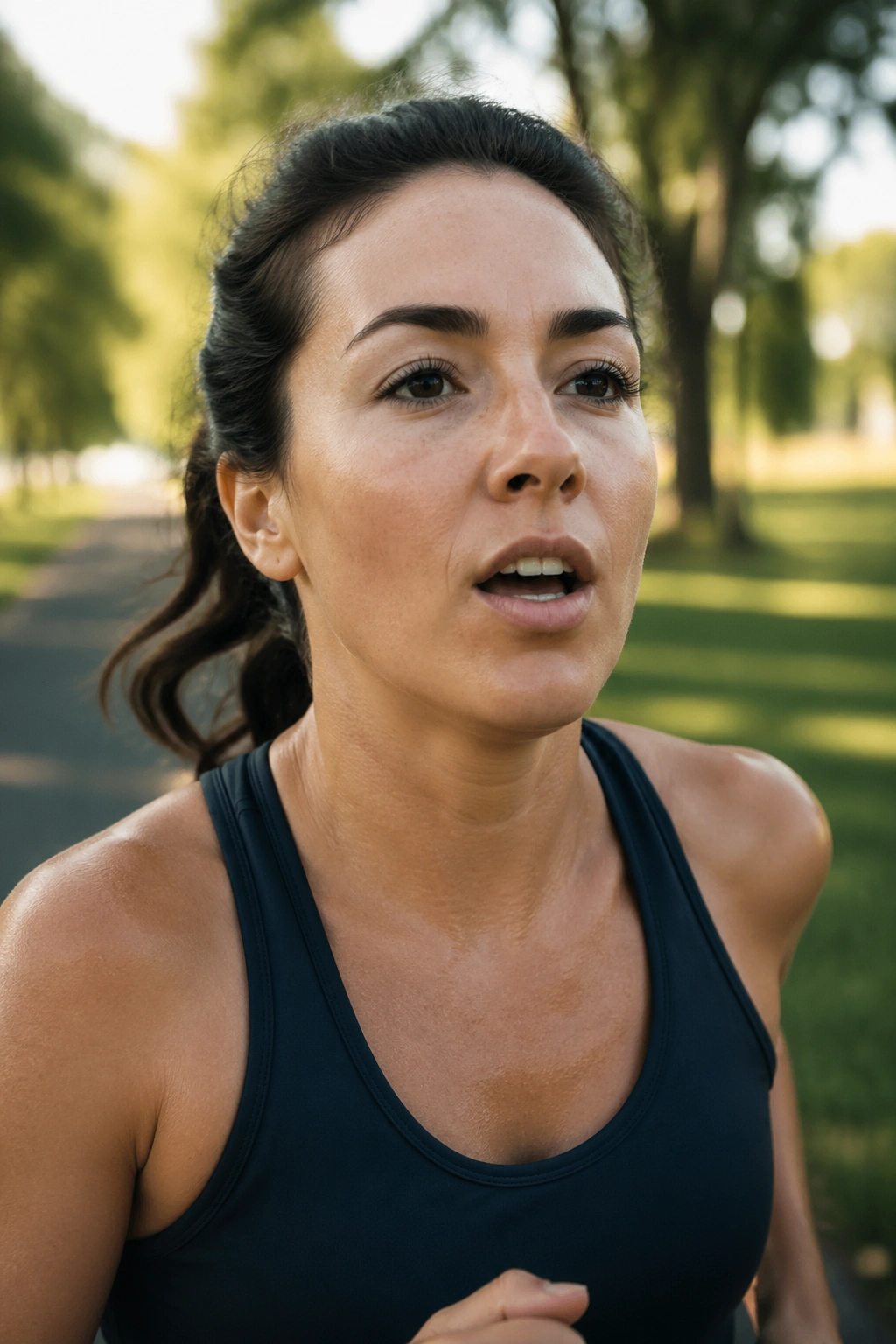
The talk test still works because human breathing is honest. At a jog, you can usually speak in short sentences and recover fast enough to keep going. At a run, you start losing that comfort. You may still talk, but it takes effort, and the sentences get shorter.
That does not mean you should always stay at a jog. It means you should know where you are before you push past it. A lot of beginners spend the whole session at a pace they can barely sustain, then wonder why they dread the next one.
How to use the talk test
Start your session and speak a full sentence out loud. If that feels easy, you’re in an easy zone. If you can say a few sentences with only a modest breath break, you’re probably still jogging. If you’re stopping mid-thought to breathe, you’ve crossed into harder running territory.
You can also use a simple effort scale from 1 to 10. Easy jogging usually sits around a 3 or 4. Running for fitness often sits higher, maybe 5 to 7 depending on the workout. If the number jumps to 8 or 9 and you’re only halfway through, you probably started too hard.
Why this matters for getting started
Beginners often pick a pace that feels “useful” instead of one they can repeat. Useful is not the same as sustainable. Sustainable wins.
Short efforts are fine when they’re planned. A hard burst at the end of a workout is a different thing from making every outing a small battle. The second version tends to chew up confidence and recovery.
Use breathing as a dashboard. It’s not fancy, but it tells the truth fast.
What Jogging and Running Do to Your Glutes and Legs

Your glutes do not sleep during a jog. They help stabilize the pelvis, drive the push-off, and keep your stride from collapsing side to side. Running asks for even more, especially when the pace gets quicker or the route tilts uphill.
That matters if your goal sits in the glutes and legs category. Jogging is fine for building basic endurance and getting your lower body used to repetitive work. Running turns up the demand. The calves work harder. The quads absorb more force. The hamstrings help with drive and leg swing. The glutes help keep the whole thing from wobbling.
What each muscle group is doing
- Glutes: help extend the hip and stabilize each step.
- Quads: absorb landing force and help drive you forward.
- Hamstrings: assist with leg swing and force control.
- Calves: spring you off the ground and handle repeated loading.
- Feet and ankles: keep balance and adjust to every tiny shift in the ground.
That is a lot of work for a simple-looking activity.
If you want stronger legs from jogging or running, pair the cardio with basic strength work. Two short sessions a week can go a long way. Think split squats, glute bridges, step-ups, calf raises, and bodyweight squats. Nothing fancy. Just enough to make your tissues sturdier so your running or jogging feels less fragile.
The part people miss
Running does not build the same kind of muscle as lifting, and jogging alone will not give you the firm, strong feeling many people want from “leg tone.” That comes from a mix of movement, recovery, and some resistance work. The cardio helps. The strength work finishes the job.
If you only run and never train the legs directly, you may end up with good endurance and still feel weak in hills, stairs, or quick changes of pace. That is not a flaw in running. It is just a different tool.
Calories, Fitness, and Weight Goals Are Not the Same Thing
Running usually burns more calories per minute than jogging. Higher pace, higher effort, higher cost. That part is straightforward. But a longer easy jog can still burn more total calories than a short hard run if you can stay out there longer.
This is where people get tripped up. They look for the “best” option as if one of them wins every time. The better question is which one helps you train often enough to matter.
Jogging is often easier to repeat, especially when you are building a habit or coming back after time off. Running is useful if you want to spend less total time to get a strong workout. Both can fit a fat-loss plan. Neither one works alone if the rest of your day is built around sitting and snacking without thinking.
Which one helps with weight goals?
If you need something that feels doable, jogging often wins. People stick with it longer, and consistency matters more than heroic effort. A 30-minute jog done three times a week beats a hard 12-minute run you dread and skip.
If you already have a base and want a more time-efficient session, running can make sense. Hills, intervals, and faster runs can push your heart rate up faster and create a stronger training effect in less time.
But food still matters. More than most people want to admit. Cardio can help create a calorie gap, yet it does not erase a day of overeating. That’s just reality.
A useful way to think about it
- Jogging is often better for building the habit.
- Running is often better for compressing more work into less time.
- Both work best when you can recover and repeat them.
- The plan you’ll actually keep is the one worth choosing.
I have a soft spot for the boring answer here. Start with the pace that lets you show up three times a week. Speed can come later.
Which One Is Gentler on Beginners

Jogging is usually the gentler doorway. The lower pace tends to reduce impact, and the easier breathing pattern helps new exercisers stay relaxed. That matters because tension is the enemy when your joints, calves, and shins are still learning the job.
Gentler does not mean harmless. Even a slow jog can bother someone who ramps up too quickly, wears shoes that are dead flat and worn out, or runs on tired legs every day. But as a starting point, jogging gives beginners a better chance to adapt without feeling punished.
Running tends to ask for more from the same tissues. That’s not a moral judgment. It’s just load. If your body is brand new to impact, you often need a little time in jog territory before you chase speed.
Where beginners tend to get into trouble
The classic mistake is trying to “run” every session at a pace that is too fast to hold comfortably. Another mistake is taking long gaps between sessions, then starting over at the same hard pace. The body likes repeated, moderate stress. It does not love random punishment.
A third issue shows up in the lower legs. Shins get sore. Calves tighten. The Achilles gets cranky. Those signs usually mean the volume or pace moved faster than the tissues could handle.
Safer first steps
- Start with walk-jog intervals instead of continuous running.
- Keep sessions to 20 to 30 minutes at first.
- Leave a full rest day between runs.
- Stop if pain changes your stride.
- Progress one variable at a time: time, speed, or hills, not all three.
That last one matters a lot. Change one thing, watch how your body responds, then move again.
How to Start Jogging Without Burning Out

Start slower than you think you should. That is the plain advice, and it is the one most beginners ignore. A comfortable jog should leave room in the tank. If you need to fold over at the end of the first minute, it is not a comfortable jog.
Begin with a 5-minute brisk walk. Then alternate 1 minute of easy jogging with 2 minutes of walking for 20 minutes total. If that feels too hard, shrink the jog to 30 seconds. If it feels easy, keep the same pattern for a week before changing anything.
A simple first phase
- Walk briskly for 5 minutes.
- Jog easily for 1 minute.
- Walk for 2 minutes.
- Repeat the jog-walk pattern 5 to 6 times.
- Finish with 5 minutes of walking.
That gives you a session that builds fitness without smashing your legs.
If you want a rule for effort, stay around a 3 or 4 out of 10. You should be warm, mildly challenged, and able to recover quickly during the walk breaks. If you finish and feel like you could have done another round or two, that is a good sign, not a failure.
What helps most in the beginning
A flat route is easiest. A soft surface like a track or packed path can feel kinder than concrete. Good shoes matter too, but not in the magical way marketing copy loves to pretend. You want shoes that fit, feel stable, and do not pinch the toes.
And please do not chase speed yet. Beginners often mistake breathing harder for progress. Sometimes it’s just fatigue.
How to Progress From Jogging to Running

You do not jump from jogging to running in one dramatic leap. You nudge the body there in pieces. That can mean adding a little more jogging time, trimming the walk breaks, or making one session a touch faster while keeping the others easy.
A useful progression looks boring on purpose. Boring works.
One steady progression that makes sense
- Week 1: 1 minute jog / 2 minutes walk
- Week 2: 90 seconds jog / 2 minutes walk
- Week 3: 2 minutes jog / 90 seconds walk
- Week 4: 3 minutes jog / 90 seconds walk
- Week 5: 5 minutes jog / 1 minute walk
You do not need to follow that exact pattern forever. It is just a clean way to build tolerance. If a week feels rough, repeat it. If your breathing and legs handle the load easily, move on. The body often tells you the truth before the schedule does.
When you are ready to call it a run
You’re probably ready to shift toward running when your jog intervals feel smooth, your breathing settles quickly after each session, and your lower legs are not complaining for two days after every outing. At that point, try a short run block — maybe 5 to 8 minutes at a slightly faster pace — inside the same workout.
Keep the walk breaks. People throw them away too soon. That’s how a manageable progression turns into a flare-up.
If hills are available, save them for later. Hills make the session harder fast, and they load the calves and glutes more. Good stuff, but not first-week stuff.
Shoes, Surfaces, and Treadmill Settings Change More Than People Think

Good shoes won’t make you fast, but bad shoes can make you miserable. Fit matters more than brand. You want enough room in the toe box, a secure heel, and cushioning that matches your body and route. If the shoe feels sloppy, too stiff, or pinchy in the store, it usually feels worse after 15 minutes.
A lot of runners wear shoes until they’re flattened and then wonder why everything hurts. Many shoes lose a lot of their cushion somewhere around 300 to 500 miles, though the exact point varies by model and how you move. If the midsole feels dead or the outsole is worn smooth in one spot, it may be time.
Surface matters too
- Treadmill: controlled, predictable, easy for pace work.
- Track: smooth and forgiving, though the curves can bother some ankles.
- Packed dirt or gravel: often kinder than concrete if it’s even.
- Sidewalk or concrete: convenient, but less forgiving over long sessions.
- Grass: soft, though uneven footing can be annoying.
I like variety, but not at the expense of predictability when you’re new. Choose the surface that helps you keep your stride calm. If one route makes your ankles do extra work, pick another.
Treadmill notes that help
Set the treadmill around 1% incline if you want a more natural feel than a dead-flat belt. Hold your posture tall. Do not lean on the rails. And if the belt feels too easy, increase time before you increase speed.
A treadmill can be useful for beginners because it removes traffic, weather, and route guesswork. It can also feel boring. That boredom is not a defect. Sometimes boring is exactly what you need to keep training.
Form Cues That Make Both Feel Better

The best form cue for beginners is often the simplest one: shorten the step. Most people reach too far in front of themselves, especially once they start trying to “run.” That reach creates braking force and makes the legs work harder than they need to.
Keep your torso tall. Let the arms swing comfortably near your sides. Aim for a slight forward lean from the ankles, not a bend at the waist. If you look down at your feet and feel like each step lands under you rather than way out ahead, you’re in a better place.
A few cues worth using
Soft landing
Try to land quietly. Not silently, just quietly. Loud footfalls often mean the step is too long or too tense.
Relaxed hands
Open the fists a little. Tight hands often come with tight shoulders.
Quick reset
If you feel yourself getting choppy, slow down for 30 seconds and settle the rhythm before you speed back up.
Eyes forward
Look ahead, not at your shoes. The whole posture gets better when your neck isn’t folded down.
A lot of runners overthink footstrike — heel, midfoot, forefoot, and all the rest. I’d rather you think about where your foot lands relative to your body and how loud the step sounds. That gets you farther faster than arguing over labels in a mirror.
Common Mistakes That Slow Progress

The biggest beginner mistake is treating every outing like a test. If the pace feels hard, people often assume they’re doing it right. They are usually doing too much.
That habit can show up in a few ugly ways. You run too fast on day one, then get sore, then skip a few days, then try to make up for it with another hard session. The cycle repeats. Fitness grows slowly. Frustration grows fast.
Mistakes that show up over and over
- Starting with continuous running instead of walk breaks.
- Increasing pace and distance in the same week.
- Running every day when the legs still feel tender.
- Ignoring calf or shin pain because the lungs feel fine.
- Wearing old shoes with dead cushioning.
- Holding your breath instead of staying loose.
- Comparing your pace to someone else’s.
That last one is poison. A strong runner can cruise at a pace that would flatten a beginner. That does not mean the beginner is doing badly. It means they are somewhere else on the curve.
What to do instead
Keep sessions short enough that you finish wanting a little more. Leave at least one rest day after your first few runs. If something hurts in a sharp, changing way, stop and sort it out. Soreness in the muscles is one thing. Pain in the joint or tendon is another.
And if a session felt too hard, do not fix it by “trying harder” next time. Fix it by slowing down, shortening the intervals, or both.
A Simple Weekly Plan You Can Actually Stick With

Three sessions a week is enough to start. That is the number most beginners can handle while still recovering. More is not better if your legs are always cooked.
Here’s a straightforward pattern that works well for a lot of people:
Week structure
- Day 1: 20 to 25 minutes of walk-jog intervals
- Day 2: Rest or easy walking
- Day 3: 20 to 25 minutes of walk-jog intervals
- Day 4: Rest
- Day 5: 20 to 30 minutes of walk-jog intervals
- Day 6: Optional light strength work for legs and glutes
- Day 7: Rest or easy walking
That’s not fancy. It does not need to be.
What the sessions can look like
First week: 1 minute easy jog, 2 minutes walk, repeated 5 or 6 times.
Second week: 90 seconds jog, 2 minutes walk, repeated 5 or 6 times.
Third week: 2 minutes jog, 90 seconds walk, repeated 5 or 6 times.
If you feel good, keep the last interval of the final session just a touch longer. If you feel off, repeat the same week. Repetition is not failure. It is how the body learns.
Add strength without wrecking recovery
Two short sessions are enough:
- 2 sets of 8 to 12 bodyweight squats
- 2 sets of 8 to 10 split squats per leg
- 2 sets of 10 to 15 glute bridges
- 2 sets of 12 to 20 calf raises
- 1 to 2 planks of 20 to 40 seconds
That little bit of strength work can make jogging and running feel steadier, especially in the glutes, hips, and lower legs. It also helps with the “my legs quit before my lungs do” problem, which is more common than people admit.
Final Thoughts

Jogging and running are not enemies, and they are not separate sports. They’re points on the same line. One is easier to repeat, the other asks more from your body, and both can build real fitness if you treat them with some patience.
If you’re just starting out, I’d take the boring route on purpose: walk-jog intervals, a few times a week, with enough rest to let your calves and shins settle down. That approach feels modest. It works.
And if you already jog comfortably, the jump to running does not need drama. Shorten a few walk breaks. Add a little pace on one session. Keep the rest easy. The body usually responds best to small, steady changes, not a heroic first week.
