



If you’ve got 12 minutes, a timer, and a floor that can handle a few loud landings, HIIT workouts at home can do a lot more than fill a gap between meetings. They can wake your body up fast, clear the fog out of your head, and leave you breathing hard without asking for a treadmill, a rack of dumbbells, or a commute you didn’t want in the first place.
The trick is not “working harder” in some vague, macho sense. It’s timing. Short bursts. Honest rest. Movements that get your heart rate up before your brain has time to start bargaining. A good home HIIT session should feel compact, a little rude, and easy to start. No fiddling. No complicated setup. No twenty-minute warm-up that turns into a cleaning project.
Some days you’ll want something loud and springy. Other days your downstairs neighbor, your knees, or your own mood will call for a quieter version. Both count. Both can work. The best part is that you can swap formats without losing the point: move hard, recover briefly, repeat, and finish with that familiar shirt-to-skin sweat you were after in the first place.
1. Tabata Squat-Jack Burner
A Tabata set is one of the fastest ways to make a small room feel like a serious training space. Use 20 seconds of work and 10 seconds of rest, then repeat for 8 rounds. That gives you a clean, brutal 4-minute block. If you want a full session, do two blocks with 60 seconds of easy marching between them.
Why It Hits So Hard
Squat jacks blend a lower-body load with constant arm and leg movement, so your heart rate climbs fast without needing any gear. The squat keeps your legs honest. The jack part keeps the rhythm moving. It’s one of those workouts that feels almost too simple on paper, then turns your lungs into a problem by round four.
Keep the squat controlled and the landing soft. If your knees start knocking inward or your feet sound like dropped pots, slow down. Quality matters more than speed here.
- 20 seconds: squat jacks
- 10 seconds: rest or slow march
- 8 rounds: one 4-minute block
- Optional second block: repeat after 60 seconds
Pro tip: If jumping bugs your joints, turn the jack into a step-out jack and keep the squat depth shallow but steady.
2. Shadowboxing Knee-Drive Rounds
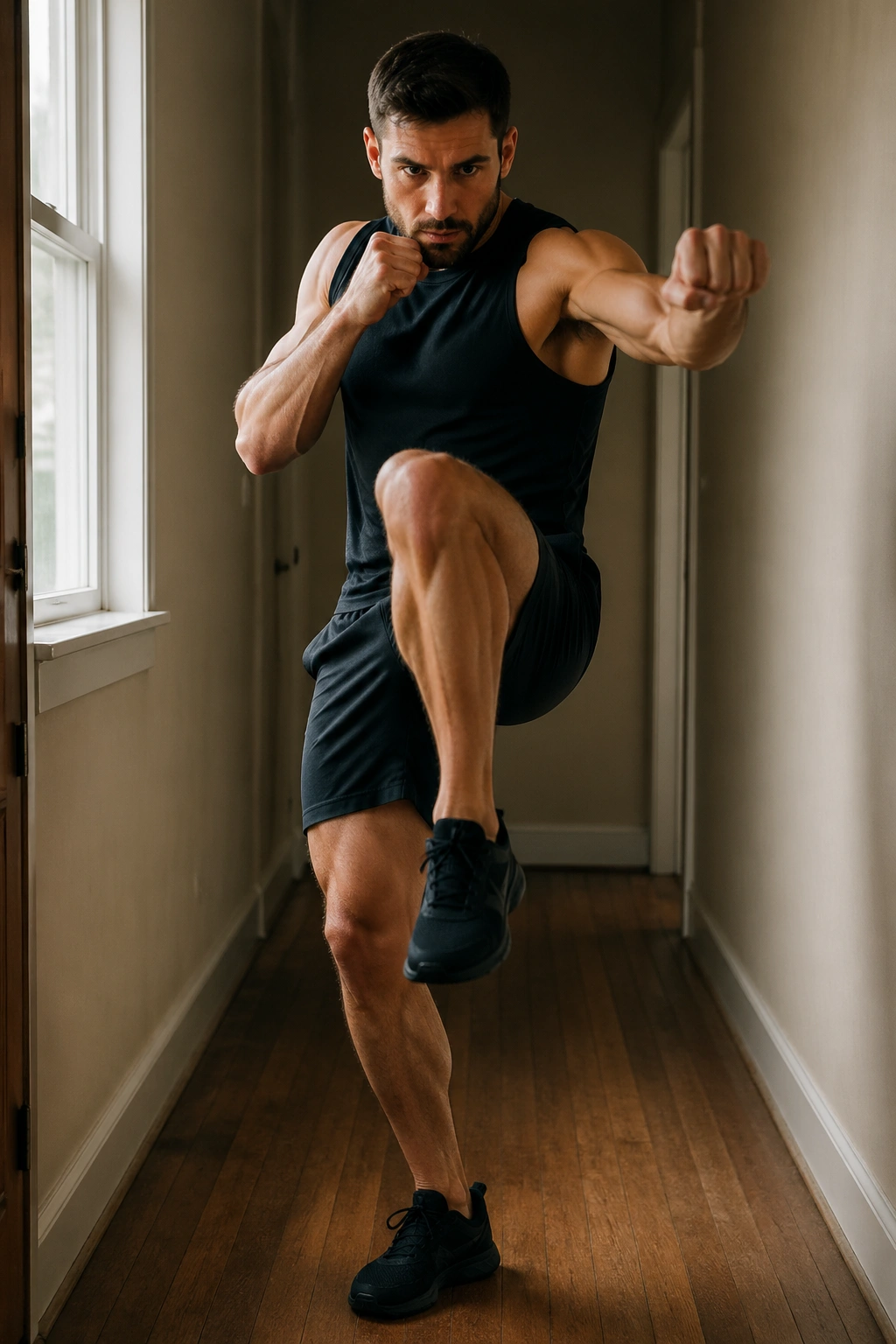
Why does shadowboxing look easy until the third round? Because the arms lie to you. The legs do not. Add knee drives, and the whole thing turns into a full-body grind that works in a hallway, beside a couch, or anywhere you can throw clean punches without hitting a lamp.
Think 45 seconds on, 15 seconds off for 6 to 10 rounds. You can stay with straight punches for one round, then add knees in the next, then mix in hooks or uppercuts if you want more shoulder work. Keep the stance light and springy. Don’t plant your feet like you’re waiting for a bus.
How to Use It
Start with jab-cross-jab-cross for one round. Next round, add a knee every four punches. By the time you get to round four or five, you should be breathing hard enough that your combos start to get a little sloppy. That’s your cue to tighten the form, not rush faster.
A lot of people throw punches with their arms only. Waste of time. Turn the hips a little, rotate through the core, and let the knees drive up sharp. That’s where the heat comes from.
3. Stair Sprint Repeats
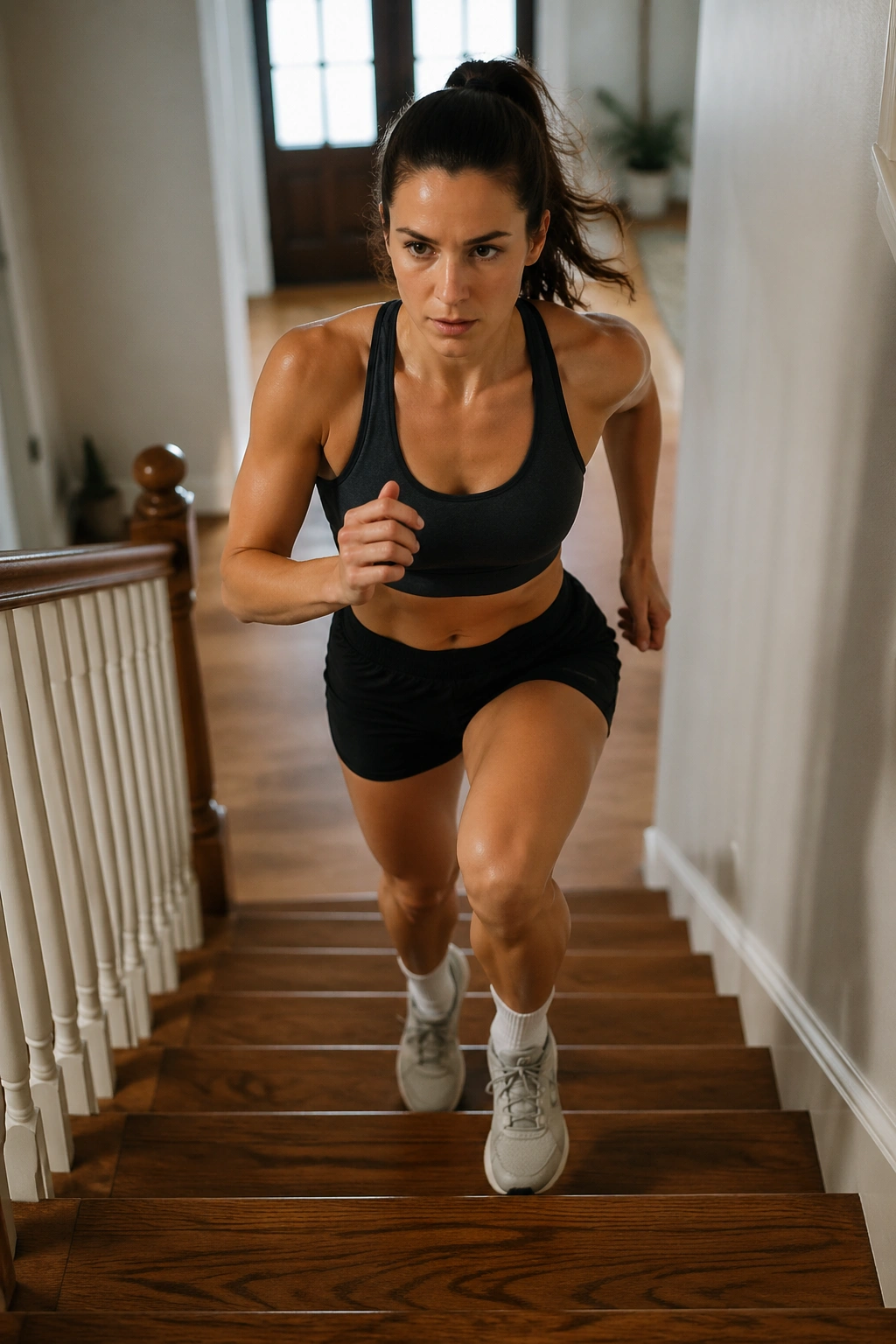
A staircase turns into a private track the second you stop treating it like furniture. Run or power-walk up one flight hard, walk down carefully, and repeat for 8 to 12 rounds. If your stairs are long, even 6 to 8 repeats can leave you drenched.
The beauty of stairs is the built-in resistance. Gravity is doing some of the work against you, which means your calves, glutes, and lungs all get pulled into the deal. And because the recovery happens on the way down, the session never feels endless.
A Tiny Stair Trick
Use the same landing spot at the top every time. Touch the wall lightly if you need balance, then drive the next repeat from the first step with purpose. It sounds small. It isn’t. That little consistency keeps you from drifting into a half-speed jog.
- Sprint up: 1 flight or 10 to 20 steps
- Recover down: walk, don’t charge
- Repeat: 8 to 12 times
- Optional finisher: 30 seconds of fast marching at the bottom
If stairs feel rough on your knees, take them one at a time and keep the pace sharp instead of explosive.
4. EMOM Power Circuit
An EMOM is one of my favorite home formats because it kills the usual excuse-making. Every minute on the minute means you start a set at the top of the minute, finish it, then rest with whatever time is left before the next minute starts. No drifting. No guessing.
Try a 12-minute EMOM with three moves cycled four times. Minute 1: 12 squats. Minute 2: 8 pushups. Minute 3: 16 alternating reverse lunges. Then repeat that pattern three more times. If you finish a set with 20 seconds left, great — you get 20 seconds of rest. If not, the timer will tell you to move faster next time.
Sample Minute Breakdown
- Minute 1: 12 air squats
- Minute 2: 8 pushups
- Minute 3: 16 alternating reverse lunges
- Repeat: 4 total cycles
The point is not to collapse. It’s to keep the work clean enough that the next minute still looks sharp. That edge between “challenging” and “messy” is where EMOM training lives.
If pushups on the floor are a no-go, use a couch edge or sturdy counter. If the lunges feel too easy, hold a backpack against your chest. Small changes. Big difference.
5. Jump-Rope Sprint Blocks
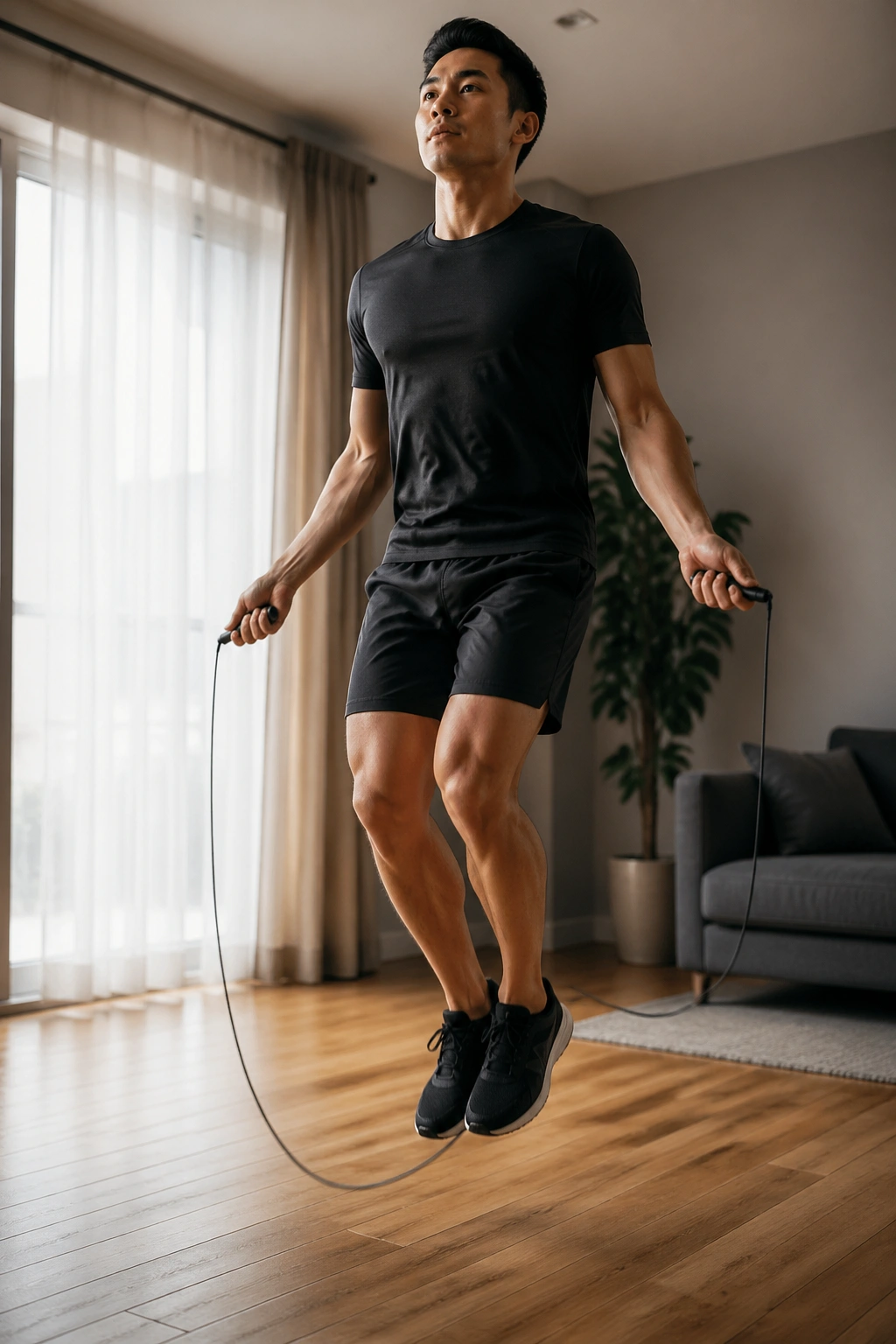
Unlike a slow, steady skip session, jump-rope HIIT works because the rope forces rhythm and the sprints force urgency. Use 30 seconds fast, 30 seconds easy for 10 to 12 rounds. That gives you a session that’s short, ugly in the good way, and easy to scale.
The rope doesn’t need to be fancy. A basic speed rope is fine. If you don’t have one, “ghost rope” footwork works too — same hand motion, same bounce, same timing. The body still gets the message.
What to Watch For
Shoulders should stay loose. Wrists do the turning, not big windmill arms. Land softly on the balls of your feet and keep the bounce low, almost stingy. The higher you jump, the faster your calves will complain. That’s not the goal.
If you trip every third jump, lower the speed and keep the intervals the same. That’s still training. The point of the sprint block is to keep moving under pressure, not to perform a clean demo for a gym mirror.
When I want a short session that feels unmistakably athletic, this is the one I reach for first.
6. Burpee-Mountain Climber Ladder
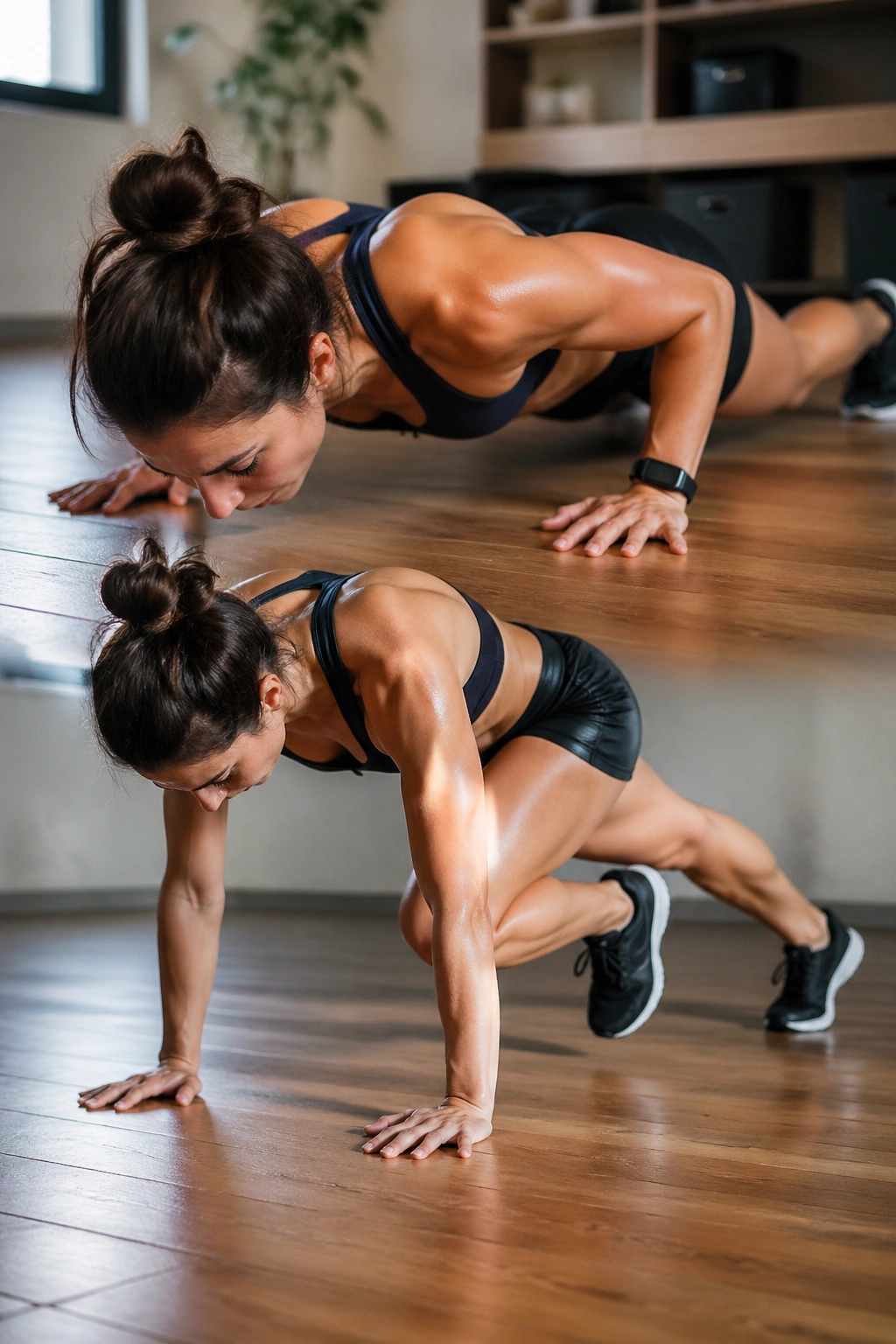
This one gets messy fast. Good. A burpee into mountain climbers is a plain, nasty combo that pushes the heart rate up, then keeps it there while your shoulders and core work to catch up. A ladder structure makes it feel like a game, which helps until your breathing turns shallow and the game gets mean.
Try 2 burpees + 20 mountain climbers, then 4 burpees + 30 climbers, then 6 burpees + 40 climbers, then walk back down the ladder. Rest 30 to 45 seconds between rungs if you need it. If that’s too much, halve the numbers and keep the shape of the workout the same.
Why This Combo Works
Burpees force a full-body transition: stand, drop, plank, pop up. Mountain climbers keep the plank under tension and add a fast, choppy cardio hit. Together, they create a kind of controlled chaos that doesn’t give your body much time to settle.
Wrists and lower backs can get cranky here, so stay honest. Step back instead of jumping if you need to. Bring the knees in fast, but don’t let your hips sag like a tired hammock.
This is not the workout for a half-empty tank. It’s the one you use when you want a session that ends with you leaning on a wall for a minute.
7. Silent Apartment Cardio Circuit
No jumping. No stomping. No complaints from the floorboards. A silent cardio circuit is the move when you want a hard session without making the room sound like a dropped suitcase. Use 40 seconds of work and 20 seconds of rest for 3 to 5 rounds.
The Quiet Swaps
- Marching high knees instead of running high knees
- Step jacks instead of jump jacks
- Fast reverse lunges instead of jumping lunges
- Squat to calf raise instead of squat jumps
- Shadow boxing with quick feet instead of bouncing skips
The workout still gets hot because the pace stays high and the rest stays short. You’re just removing the impact, not the effort.
A lot of people treat low-impact as code for easy. That’s lazy thinking. If the transitions are fast enough, your heart won’t care whether both feet leave the floor. It will be too busy trying to keep up.
I like this format on days when I want to train hard but don’t want the noise, the joint load, or the weird feeling of doing burpees in socks. Small room. Big sweat. That’s the whole point.
8. Backpack Strength Burner
A backpack full of books changes the feel of a home workout in a hurry. It’s crude, cheap, and effective — which is usually a better deal than the polished stuff people chase. Aim for 10 to 20 pounds if you’re new to loaded work, then adjust from there.
Use a 20-minute circuit with 40 seconds on, 20 seconds off. Rotate through backpack squats, bent-over rows, reverse lunges, and push presses. The backpack should stay snug against your body. If it swings around like a wet towel, it’s too loose or too heavy.
How Heavy Should the Backpack Be?
Heavy enough that the last 10 seconds of each set feel slow. Light enough that your back stays flat and your neck doesn’t tighten. That’s the sweet spot. You’re not trying to test your ego. You’re trying to make bodyweight moves behave like loaded ones.
- Backpack squats: hold the bag at chest height
- Rows: hinge at the hips and pull toward your ribs
- Reverse lunges: keep the front foot planted
- Push presses: drive the bag overhead with control
This is one of the better HIIT workouts at home if you want your heart rate up and your muscles a little tired, not just sweaty.
9. Dance Cardio Sprint Intervals
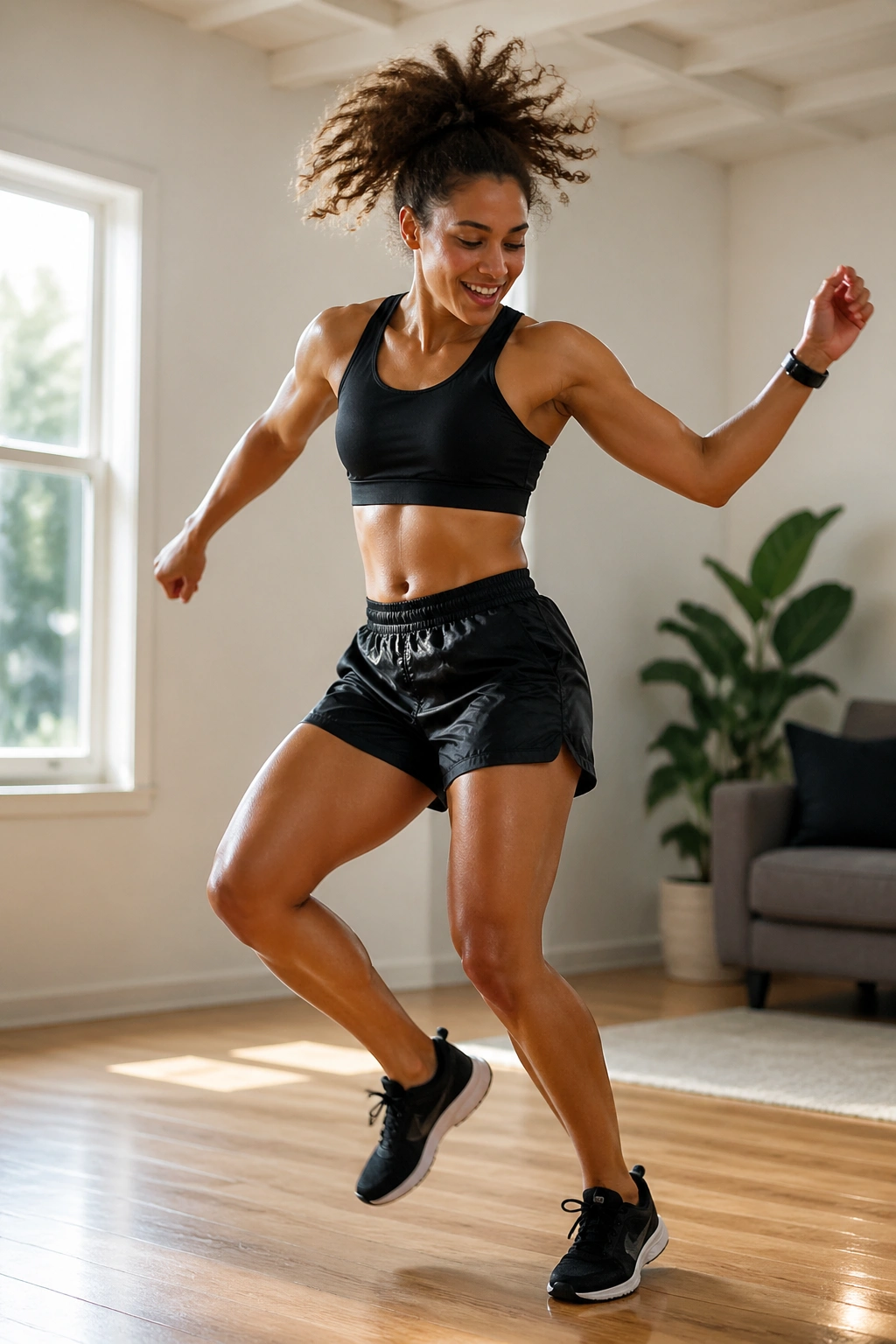
A dance workout sounds soft until the interval clock starts barking at you. Then it becomes a sprint with music. Use 60 seconds of fast dancing and 30 seconds of march-in-place recovery for 10 rounds. No choreography required. Honestly, that’s the charm.
Pick a song and assign one move to each chorus. Side steps. Knee lifts. Grapevine. Fast punches. Turn it into a game: every time the beat hits hard, add bigger arm swings and faster feet. When the music drops, keep moving but cut the impact way down.
Some people freeze because they think dancing has to look good. It doesn’t. It has to keep you moving. That’s it. A little messy is fine. A lot messy is still fine if your pulse is climbing and the timer keeps moving.
This format works especially well if you hate counting reps. The timer carries the load. Your job is to stay honest with the pace and not coast through the easy parts. The easy parts are there to let you survive the next minute.
10. Kickboxing Combination Rounds

What’s different here? The range of motion. Kickboxing makes you turn, snap, pivot, and reset, so the workout feels bigger than it looks. Try 2-minute rounds with 30 seconds of rest, and run 6 to 8 rounds total.
Combo Structure
Use simple combinations and repeat them until the round ends:
- Jab-cross
- Jab-cross-hook
- Front kick + cross
- Knee drive + cross-hook
- Two punches, one kick, two punches
Keep your shoulders loose and your chin tucked. The power should come from the hips and the floor, not from flinging your arms around like you’re swatting flies. That’s a common mistake, and it burns out the shoulders before the lungs ever really get involved.
I like this one because it feels athletic without needing gear. You can do it in a bedroom, a garage, or a tiny patch of open floor. If your balance is shaky, shorten the kicks and keep the pivots small. The sweat still comes. It usually comes faster than people expect.
11. Chair Step-Up Intervals
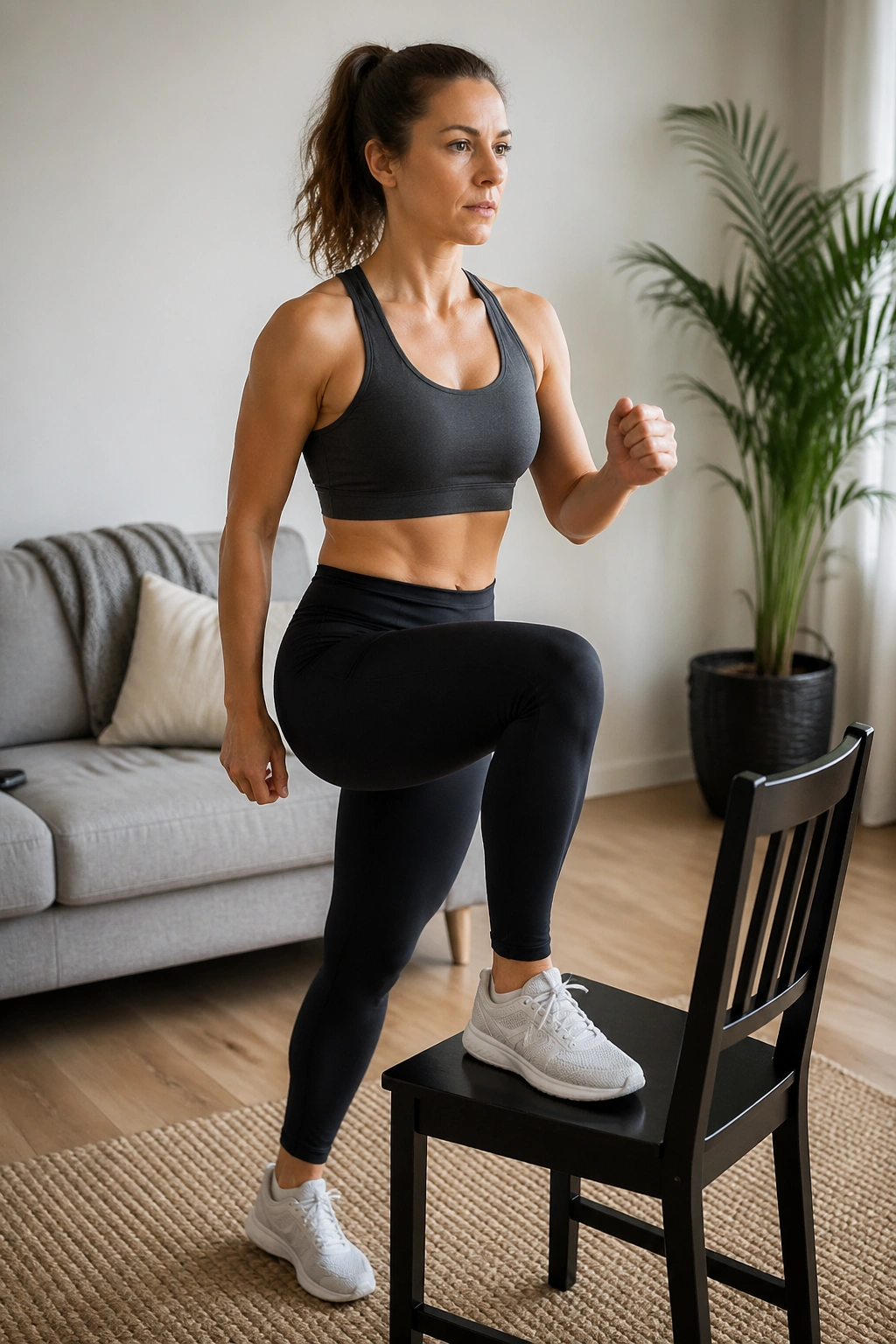
A sturdy chair, bench, or low step can turn into a serious cardio station if you stop treating it like a casual helper. Step-ups are one of the cleanest ways to get the heart rate moving without pounding your joints with jumps. Use 30 seconds of step-ups and 30 seconds of fast knee drives, then rest 30 seconds. Repeat for 8 to 10 rounds.
The quality of the setup matters. The surface needs to be stable, not wobbly. If it shifts, skip it. No workout is worth a sloppy fall. I’d rather see you use a lower step and move well than chase height and wobble around like a baby giraffe.
Easy Versus Hard Versions
The easy version is a plain step-up with a knee lift on top. The harder version is a faster drive with a full arm swing. You can also alternate legs every rep to keep things balanced, or work one leg for 20 seconds and switch halfway through.
This is a smart choice if you want to stay upright, get sweaty, and avoid floor work for a day. It’s also one of the better options for people who get bored with burpees in about 90 seconds.
12. Bear Crawl and Crab Walk Flow
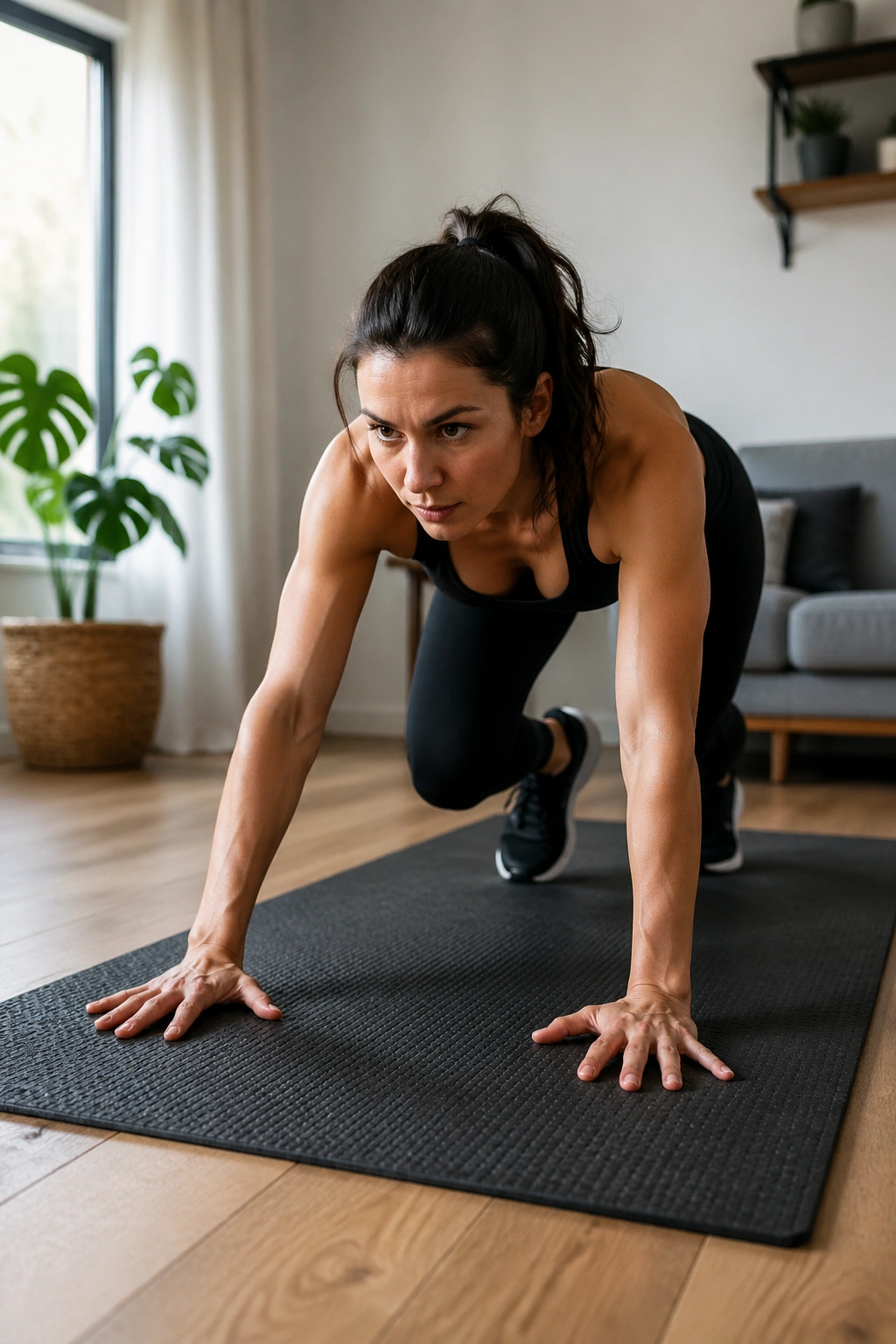
Crawling sounds childish until your shoulders, core, and hips get a hold of it. Then it feels like work in a hurry. Use 20 seconds of bear crawl forward, 20 seconds of crab walk back, and 20 seconds of rest. That’s one round. Do 8 to 12 rounds depending on space.
The movement pattern is awkward at first. That’s normal. Bear crawl wants the knees low and the back flat. Crab walk wants the chest open and the hips lifted. Together, they hit the whole body in a way that regular standing cardio doesn’t.
The Movement Feel
Your hands should press firmly into the floor. Your steps should stay short and controlled. If you start slapping the ground or letting your hips twist wildly, slow the pace down and shrink the distance.
This workout is especially useful in tight spaces because the movements don’t need much room. A mat-length is enough. If you only have a narrow strip beside the sofa, that still works.
People skip crawling because it looks strange. Fine. Strange works. And after a few rounds, the burn in the shoulders and the temperature in your whole body make the point for you.
13. Core Cardio Burner
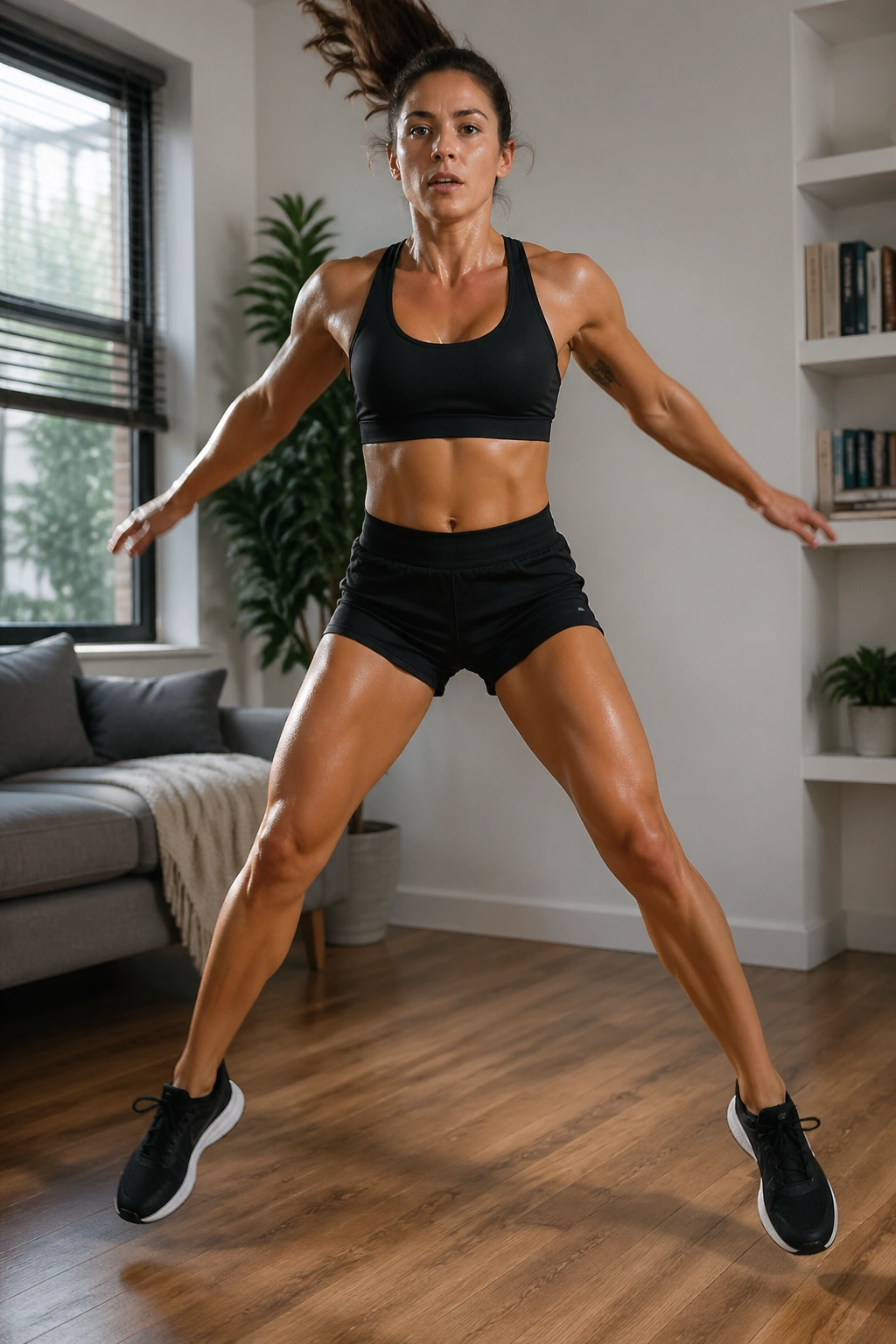
A hard core workout should do more than make your abs tired. It should make you breathe hard. This one does both. Use 40 seconds on, 20 seconds off for 4 rounds of plank jacks, bicycle crunches, dead bug reaches, and V-ups.
The Core Cue
Keep the lower back glued down when it matters. That means the dead bugs and bicycles should be controlled, not flung around. On plank jacks, jump the feet in and out without letting the hips bounce all over the place. On V-ups, reach toward your toes with enough control that your neck doesn’t crank forward.
If you’ve ever done a “core circuit” that felt too easy, the fix is usually pace and minimal rest, not more fancy exercises. Faster transitions make a plain exercise hard very quickly. That’s the part people miss.
I like this workout on days when I want my midsection to work hard without loading the knees much. It’s also a good fit after a run, because the floor work gives the legs a break while the lungs stay busy.
14. Towel-Slide Speed Circuit
A towel on a smooth floor can do a shocking amount of work. Socks on a hardwood floor, a towel on tile, or sliders under the feet all create the same basic effect: your legs have to control movement instead of just bouncing through it. Use 35 seconds of work and 25 seconds of rest for 3 to 4 rounds.
Floor Rules
The floor needs to be smooth enough for the towel to glide, but not so slippery that you lose control. If the room feels slick in a bad way, stop. A hamstring strain is not a souvenir. Also, clear the space. A sliding leg plus a coffee table is a dumb combination.
Moves to use:
- Hamstring slides
- Sliding mountain climbers
- Reverse lunges with a slide-back
- Plank pikes on sliders
The nice thing about this format is that it sneaks in core work, hamstrings, and cardio at the same time. The annoying thing is that it exposes weak control fast. That’s also why I like it. The floor tells the truth.
15. Glute Bridge Sprint Sets
A glute bridge workout doesn’t sound flashy, and that’s fine. Flashy is overrated. Fast bridge work can light up the back side of your body and still push your heart rate up if the rests are short and the transitions are sharp. Try 30 seconds on, 15 seconds off for 10 rounds.
Use a rotation of glute bridges, alternating bridge marches, single-leg bridge holds, and bridge pulses. Keep the ribs down and the feet planted firmly. If your lower back starts doing all the work, you’ve drifted out of position. Reset. No drama.
The payoff here is twofold. Your glutes get real work, and your hamstrings usually wake up hard too. That matters because a lot of home workouts hammer the front of the body and ignore the back half until it starts complaining. This one fixes that.
I reach for bridge intervals when I want something low-impact but still demanding. It’s also a solid choice if you’ve been jumping a lot and need a day that feels hard without more pounding.
16. No-Jump Full-Body AMRAP

AMRAP means as many rounds as possible, and I like it because it strips away the fluff. Set a timer for 12 minutes and cycle through 8 squats, 6 pushups, 10 reverse lunges total, and 20 seconds of fast marching. Keep going until the timer ends.
Simple AMRAP Formula
Pick moves that hit different parts of the body so you don’t torch one area too early. Squats hit the legs. Pushups hit the upper body. Lunges keep the legs under tension. Fast marching keeps the heart rate up without adding impact.
A no-jump AMRAP is a useful option when you want a hard session and the floor noise needs to stay low. It also tends to feel more sustainable than all-out plyometrics. There’s enough variation that you don’t get stuck in one ugly pattern for too long.
If pushups from the floor are too much, use a countertop or wall. If the lunges start wobbling, shorten the step back and keep the torso tall. That’s the line I always go back to: hard enough to matter, clean enough to repeat.
17. Deck-of-Cards Chaos Workout
What happens when a deck of cards runs your workout? You stop negotiating with the timer and start reacting. That little shift changes the whole tone. Assign a movement to each suit, then draw cards for 10 to 15 minutes straight.
Card Map
- Hearts: squats
- Spades: pushups
- Diamonds: mountain climbers
- Clubs: reverse lunges
Number cards equal reps. Face cards can mean 10 reps. Aces can mean 15 reps or 30 seconds of work. Keep the pace brisk and take 30 to 45 seconds between draws if you need it.
This workout feels playful at first and then, around card 10, it stops being playful. That’s fine. The randomness keeps you from coasting, and the quick switches make the whole session feel shorter than it really is.
If you get bored easily, this one is gold. If you hate surprises, maybe not. Still, I’d rather do a chaotic deck workout for 12 minutes than stare at the wall and count to 40 on every set.
18. 1-2-3-4-5 Ladder
A simple ladder can be nastier than it sounds. Start with 1 rep of each move, then 2 reps, then 3, up to 5, and come back down. Use burpees, squat jumps, pushups, reverse lunges, or a mix that fits your space. Keep the rest short — 15 to 20 seconds between rungs is enough.
The reason ladders work is mental as much as physical. The first rungs feel easy, so you stop thinking too hard. Then the upper rungs pile up fast, and suddenly you’re negotiating with your own breathing. That’s the moment the session gets interesting.
I’d keep the movements clean rather than piling on more variety. Too many exercises in a ladder turns it into a mess. Two or three movements are plenty. The cleanest version is often the hardest one to finish, and that’s usually the right sign.
If jumps bother you, swap in step-back burpees and ordinary squats. The ladder still bites.
19. High-Knee Relay Sprints
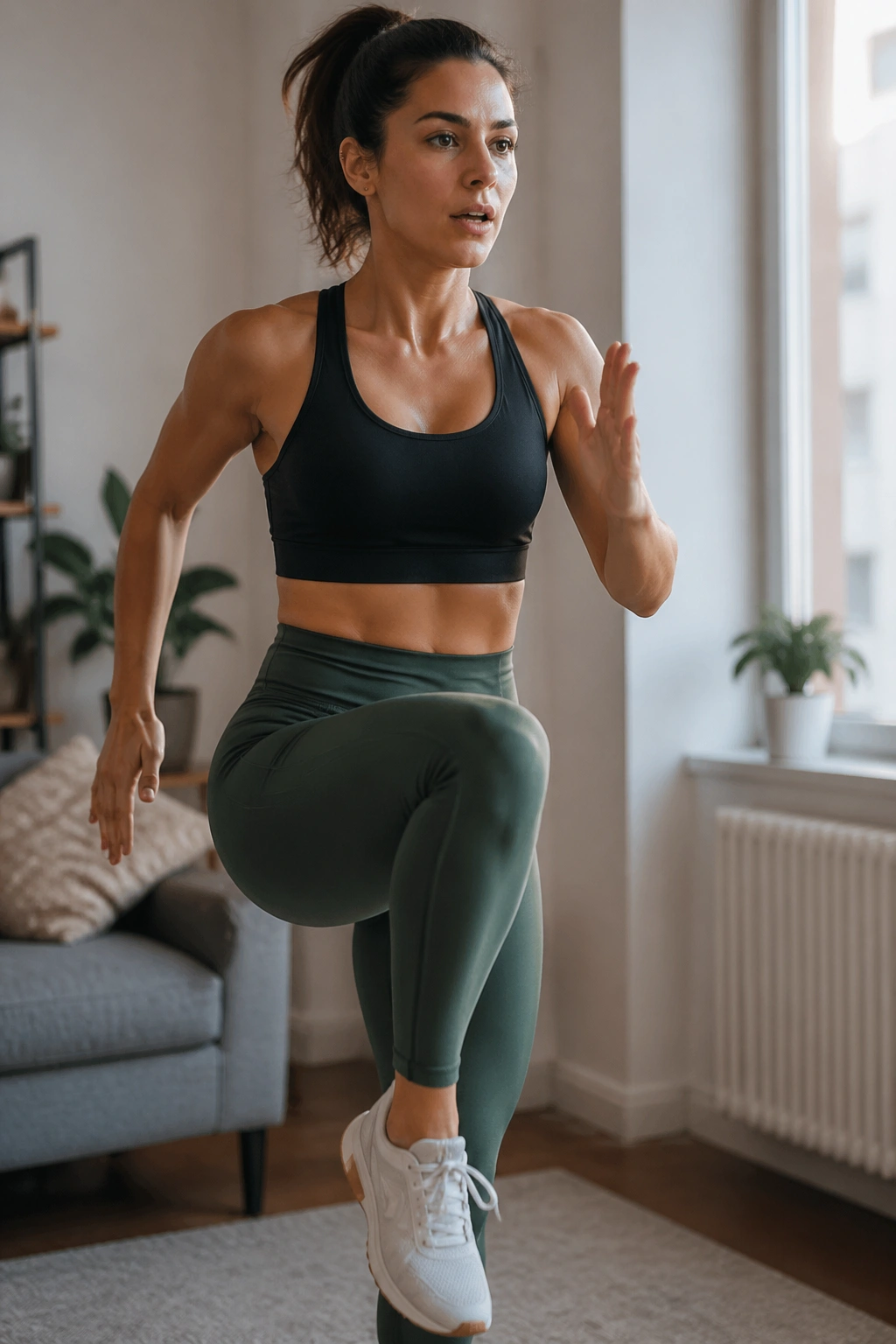
High knees alone are good. High knees mixed with fast switches are better. Set a timer for 20 seconds of high knees, 20 seconds of fast feet, 20 seconds of alternating punches, then 20 seconds of rest. Run that sequence for 8 to 10 rounds.
Make It Harder
- Drive the knees higher in the first block
- Keep the feet light in the second block
- Turn the punches into cross-body reaches in the third block
- Cut the rest to 10 seconds if you want a harder session
The relay style keeps one movement from getting stale. You’re not doing the same thing for a full block, which helps when your brain gets bored before your lungs do. It also works well in a narrow space because none of the moves need much travel.
This is the kind of workout I’d use when I want a clean sweat without complicated thinking. It’s fast, it’s repeatable, and it leaves no doubt that you trained. The legs will feel springy for about a minute afterward. Then they’ll feel honest.
20. Mixed-Modal 15-Minute Finisher
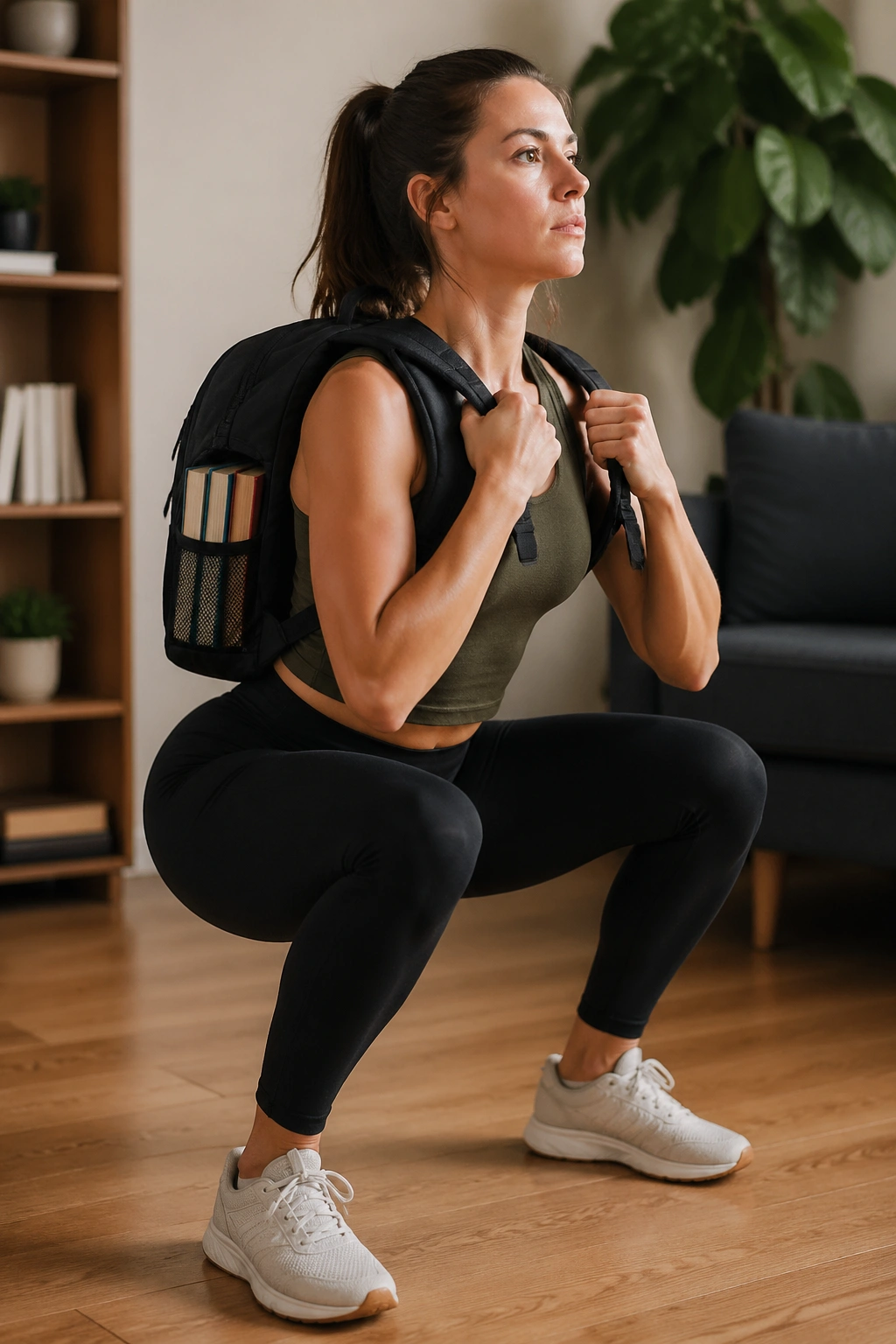
A mixed-modal finisher is what you use when you want one short session that borrows the best parts of the rest of the list. Pick one lower-body move, one upper-body move, and one cardio move, then cycle them for 15 minutes with 30 seconds of work and 15 seconds of rest.
How to Pair the Pieces
A clean trio might look like this:
- Lower body: squat jumps or reverse lunges
- Upper body: pushups or shoulder taps
- Cardio: jump rope, fast feet, or shadowboxing
Another version could be even quieter: step jacks, incline pushups, and marching high knees. That’s the nice part. The format bends to the room you’ve got and the energy you’ve got left.
I like this as a closing workout because it doesn’t demand perfection. It asks for judgment. Pick pieces that fit your joints, your floor, and your mood, then keep the work honest. If one move starts falling apart, swap it out and keep the timer running. That’s not cheating. That’s smart training.
And if all you can handle is a 10-minute version, cut it down and go hard anyway. A short, focused session beats the long fantasy of one every time.
