



The moment you stop running, your body doesn’t magically reset to zero. Adrenaline masks the immediate buildup of lactic acid and the micro-tears you have just inflicted on your muscle fibers. You might feel invincible for about five minutes, but as your heart rate drops and your body temperature returns to baseline, that “stiffening” effect begins. It is a slow, creeping process where your muscles remember every stride, every impact, and every hill you conquered. If you walk straight to your car or sit on the couch immediately, you are essentially freezing that tension into place.
Think of your muscles after a run like a warm rubber band that has been stretched and released repeatedly. If you let it cool down in a knotted or twisted state, it loses its elasticity. You want to guide your body back to a neutral, relaxed state. Stretching isn’t about forcing your body into painful contortions or trying to become a gymnast overnight. It is a communication tool. You are telling your nervous system that the high-stress work is done and it is safe to down-regulate, release, and repair.
The secret to effective recovery lies in the “how” rather than the “what.” Anyone can reach for their toes, but holding that position while breathing shallowly does nothing to calm your sympathetic nervous system. You need to focus on depth, intent, and consistency. When you take the time to lengthen the tissues you just shortened for miles, you decrease the likelihood of tomorrow’s soreness and improve your range of motion for the next run. This list covers the full spectrum of post-run recovery, from the obvious calf tightness to the often-ignored thoracic spine, ensuring you leave no muscle group behind.
1. Standing Calf Stretch Against a Wall
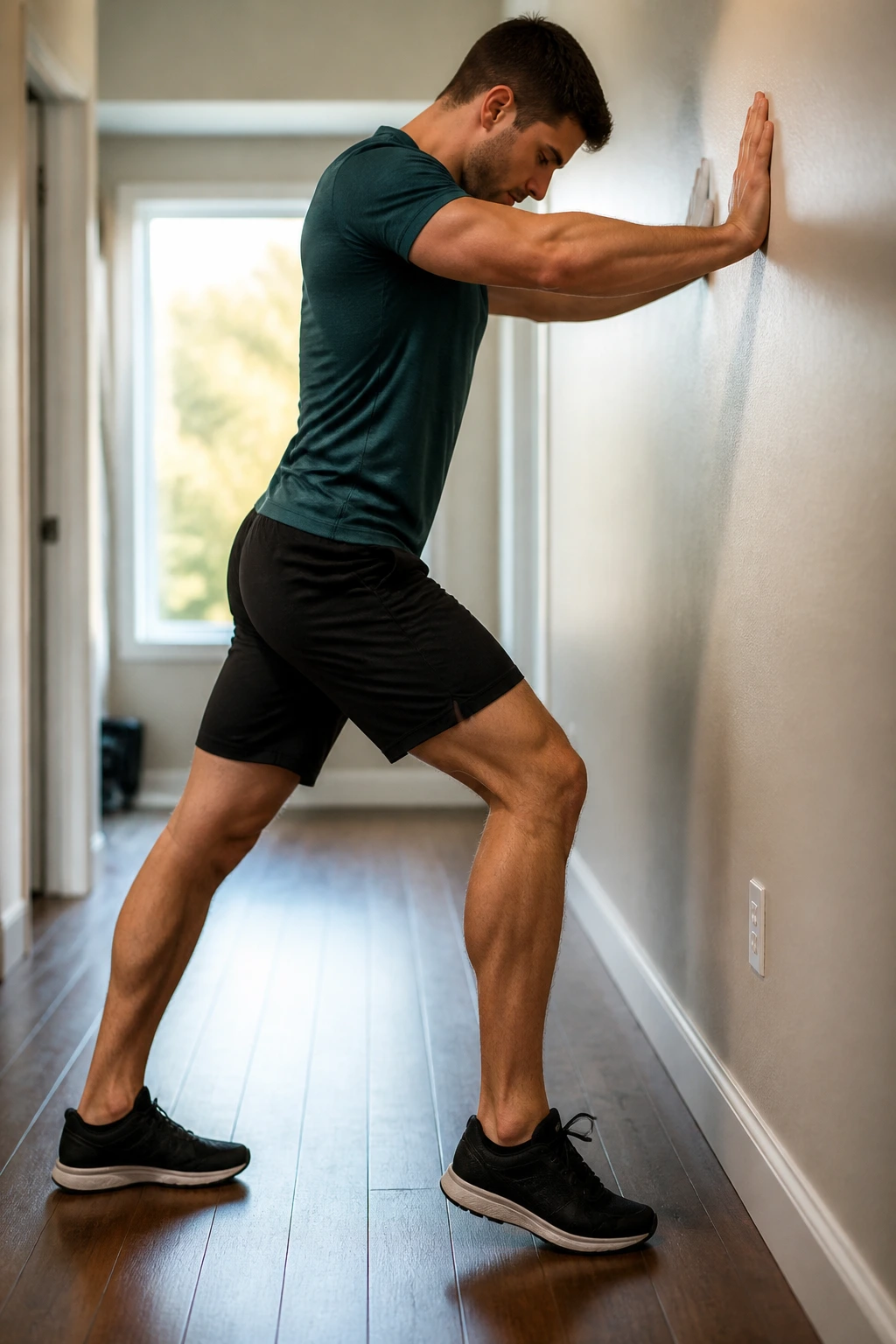
This is the non-negotiable bread and butter of runner recovery. Your calves take a beating with every strike, and if they tighten up, they pull on your Achilles tendon, creating a chain reaction of discomfort. Find a sturdy wall, place your hands at shoulder height for support, and step one foot back.
Getting the Form Right
Keep your back heel pinned to the ground. If that heel pops up, you lose the stretch entirely. Lean forward by bending your front knee, keeping your back leg locked straight. You want to feel a deep, intense pull through the thick part of the calf muscle. If you feel it more in your ankle or the back of your knee, adjust your foot placement. A slight pivot of the back toes inward or outward can also change exactly which part of the gastrocnemius you are targeting. Hold for at least 45 seconds per side. Do not rush this one.
2. Soleus-Focused Calf Stretch
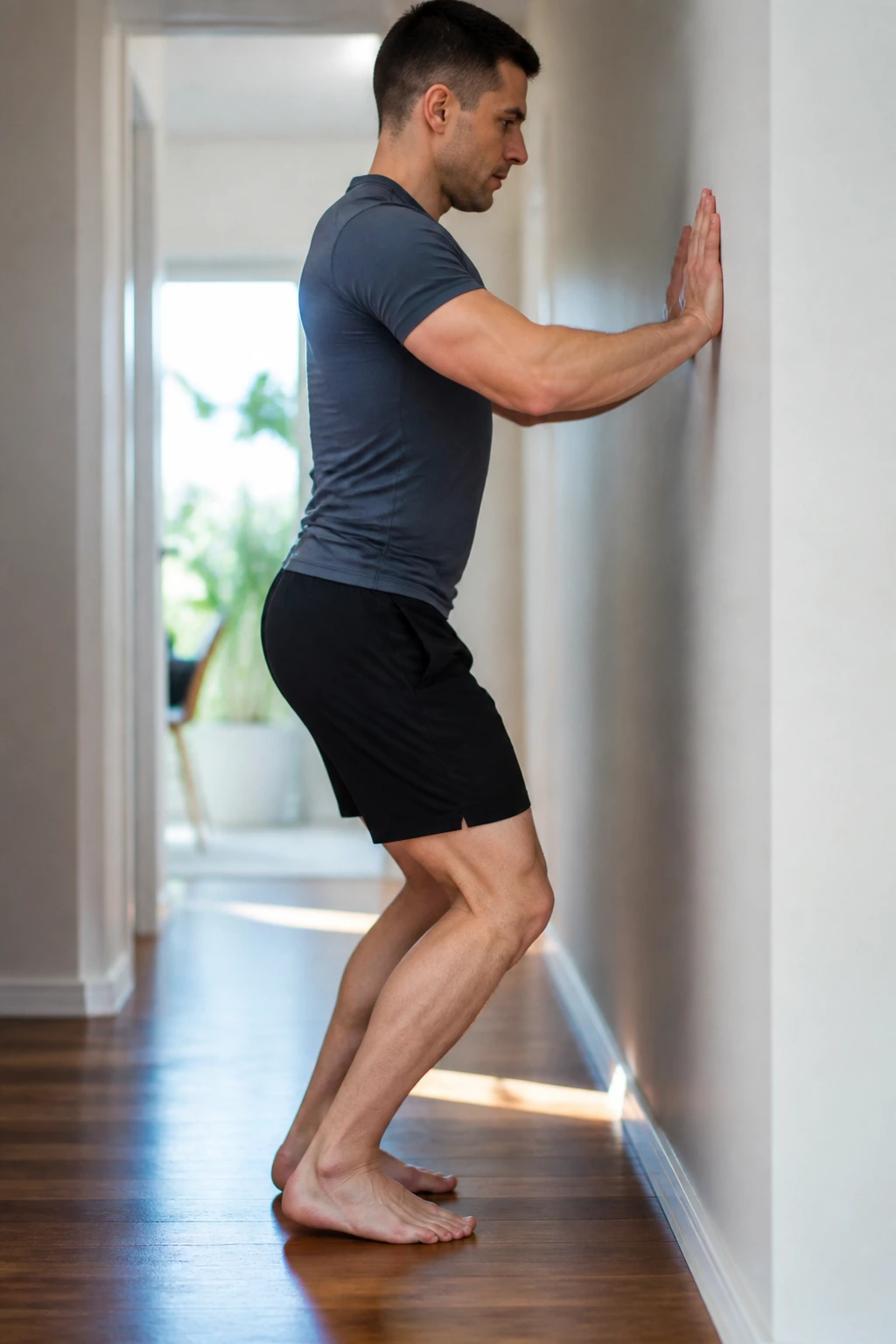
Many runners stop at the standard standing calf stretch, but the soleus muscle sits underneath the gastrocnemius and is a frequent culprit for deep, dull lower-leg aches. Because the soleus attaches below the knee, the standard straight-leg stretch often misses it completely. You need to introduce a bend in the knee to isolate this deeper muscle.
The Subtle Adjustment
Stand in the same position as the previous stretch, but this time, bend both knees slightly. As you sink into the stretch, you should feel the sensation shift lower, closer to your ankle and deep inside the leg. This is the soleus finally getting the attention it deserves. Keep your chest up and your core braced. Since this muscle is a postural powerhouse, it holds a tremendous amount of tension after a long run. Do not bounce; find a steady, uncomfortable-but-safe tension and hold it.
3. Standing Hamstring Reach
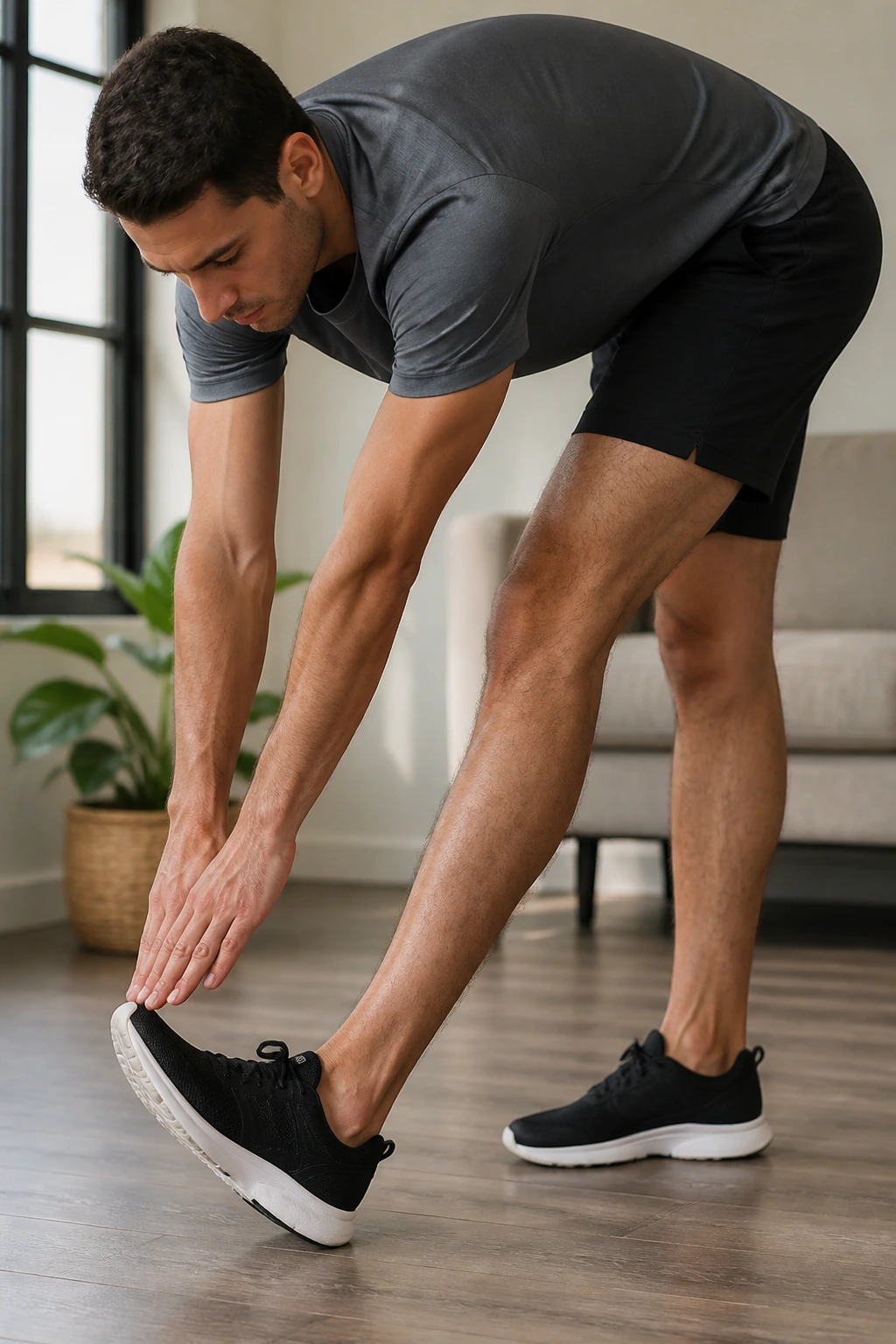
Hamstrings are notorious for feeling “short” after distance running. They work in tandem with your glutes to provide power, and they spend hours in a shortened, contracted state during a run. This simple stretch helps restore their natural resting length. It is deceptively simple, but technique matters.
Why It Works
Stand tall, then place one heel out in front of you, toes pointed toward the ceiling. Keep the leg straight but not hyper-extended. Hinge forward at your hips—think about pushing your butt back rather than rounding your spine down. You want to keep your back flat, almost like you are trying to touch your chest to your thigh rather than your nose to your knee. If you round your back, you are stretching your spine, not your hamstrings. Keep your gaze forward and breathe deeply. You should feel a stretch running from the bottom of your glute all the way to the back of your knee.
4. Seated Wide-Leg Forward Fold
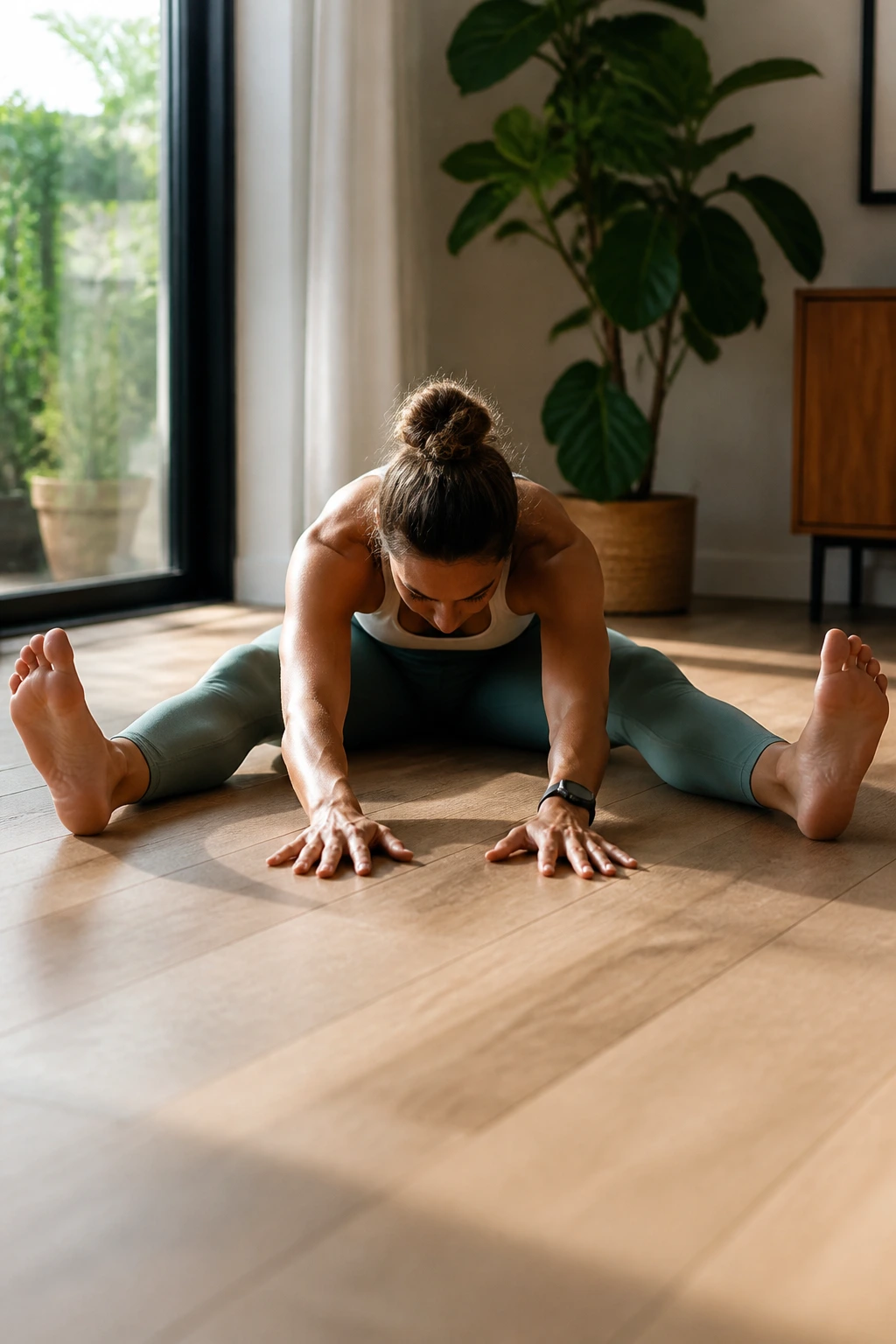
After a long run, your inner thighs (adductors) can become incredibly tight, affecting your stride width and hip alignment. This position allows you to relax your entire upper body while targeting the groin area, which is hard to reach with standing movements. Sit on the floor with your legs spread wide in a “V” shape.
How to Maximize the Stretch
Flex your feet so your toes point up. Place your hands on the floor in front of you. Begin to walk your fingers forward, keeping your spine relatively straight. Do not force your head to the floor. The goal is to feel a gentle tug in the inner thighs. If you have tight hips, this will feel restrictive immediately. Use your breath; as you exhale, see if you can inch your fingers forward just a fraction of a millimeter. Stay here for a full minute to let the tissues slowly yield.
5. Lying Side-Quad Stretch
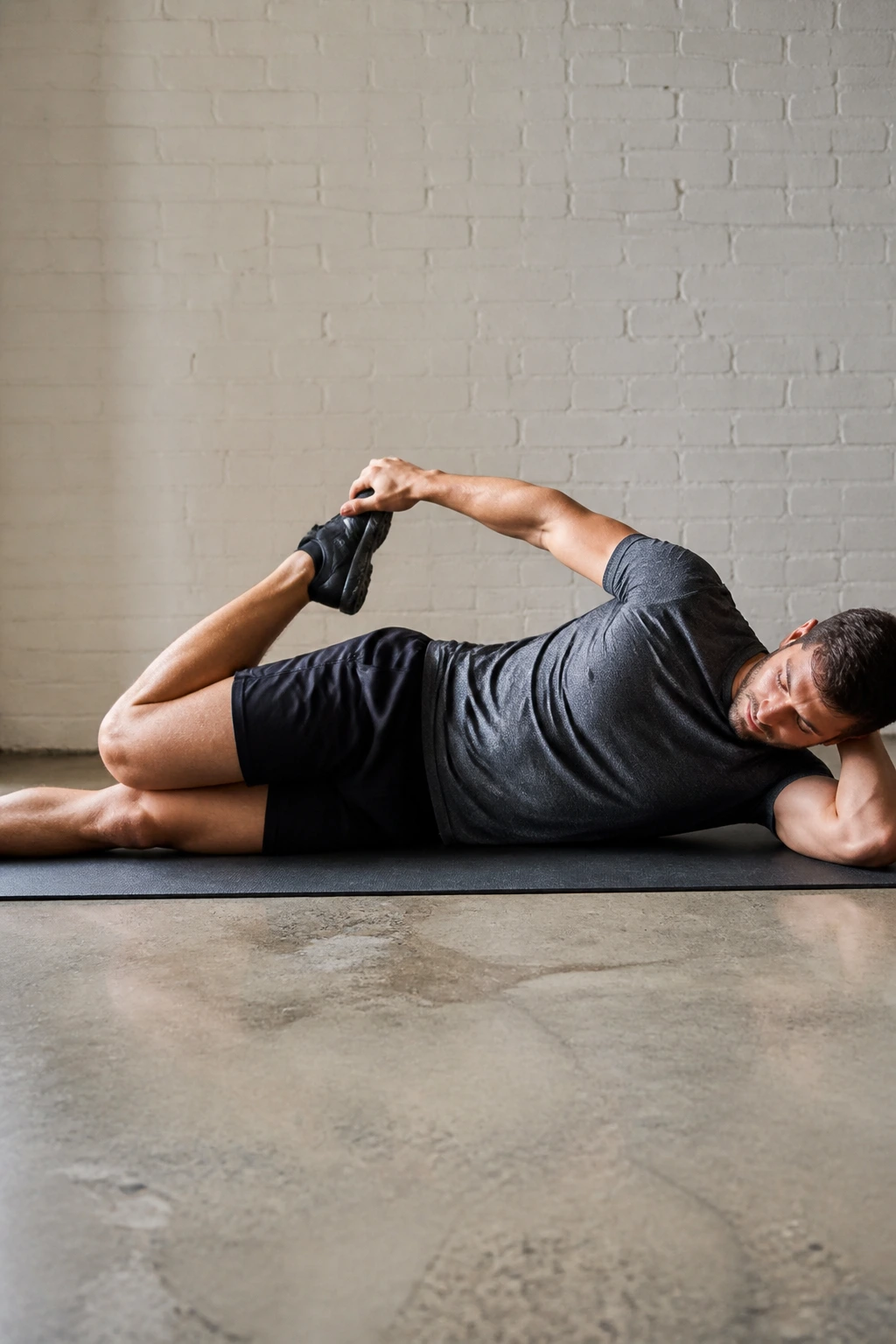
Standing quad stretches are classic, but they often require balance that your tired legs might not have. If you find yourself wobbling or arching your back to get your heel to your glute, you are losing the benefit. The side-lying variation removes the balance challenge, allowing you to isolate the quad muscle completely.
The Execution
Lie on your side with your bottom leg straight and your top leg bent. Grab your top ankle with your hand. The key here is not just pulling the heel back, but actively pushing your hip forward. If you don’t push the hip forward, you are only bending the knee. By engaging your glute and thrusting the hip toward the front, you lock the stretch into the hip flexor and the front of the thigh, where runners need it most. Keep your head rested on your arm.
6. Kneeling Hip Flexor Lunge
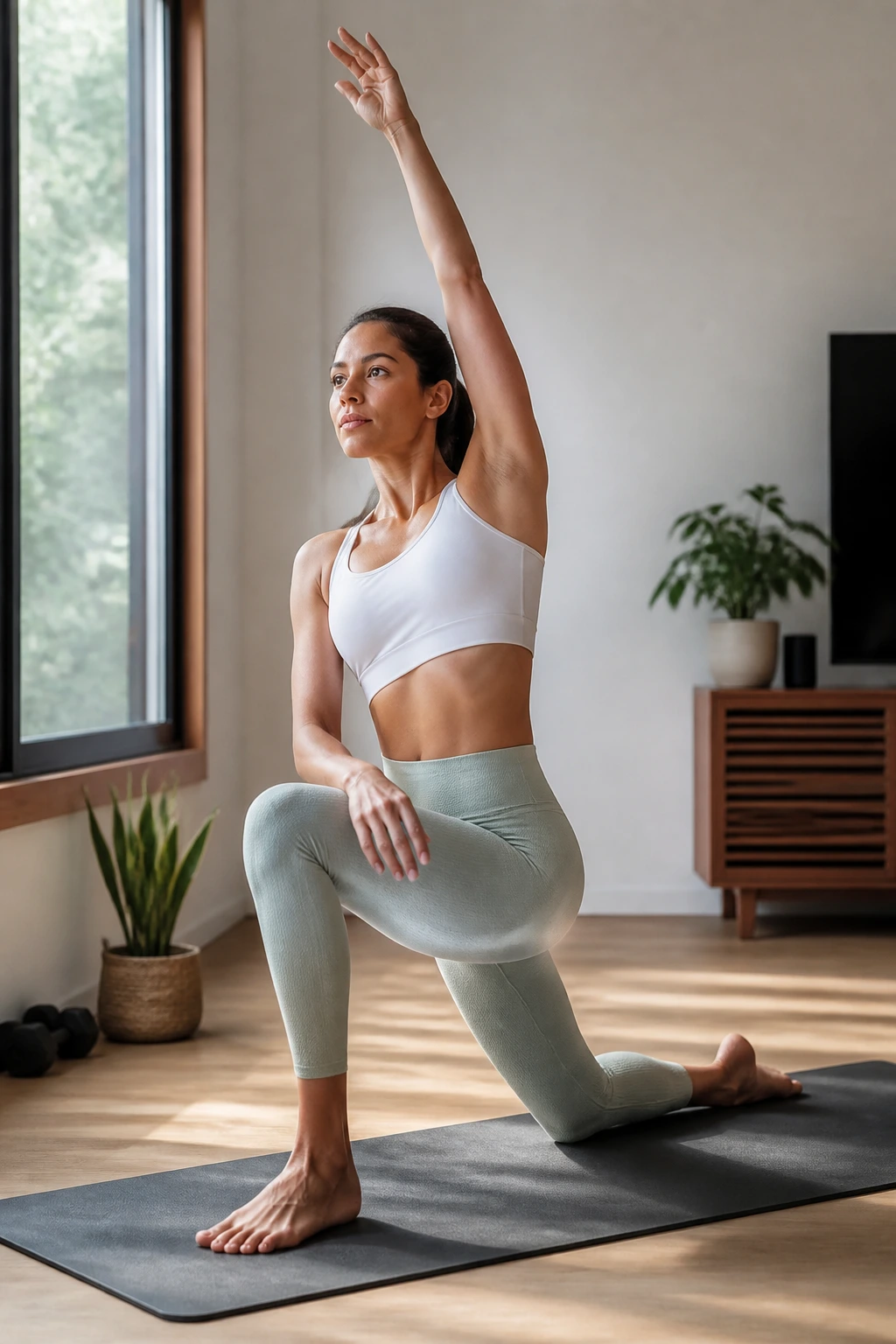
Your hip flexors are the muscles that lift your knees with every stride. They essentially never stop working while you run. If you sit at a desk for work, these muscles are already tight before you even start your run, and the run only exacerbates the issue. This lunge variation is the most effective way to open them up.
Finding the Sweet Spot
Step into a lunge, then drop your back knee to the floor. Place a towel under the knee if you need cushion. Keep your torso upright—do not lean forward. Squeeze the glute of your back leg. That glute squeeze is the secret ingredient; it forces the hip flexor on that side to relax and lengthen. Reach the arm on the same side as the back knee up toward the sky and lean slightly toward the opposite side. You will feel a dramatic opening in the front of the hip.
7. Pigeon Pose
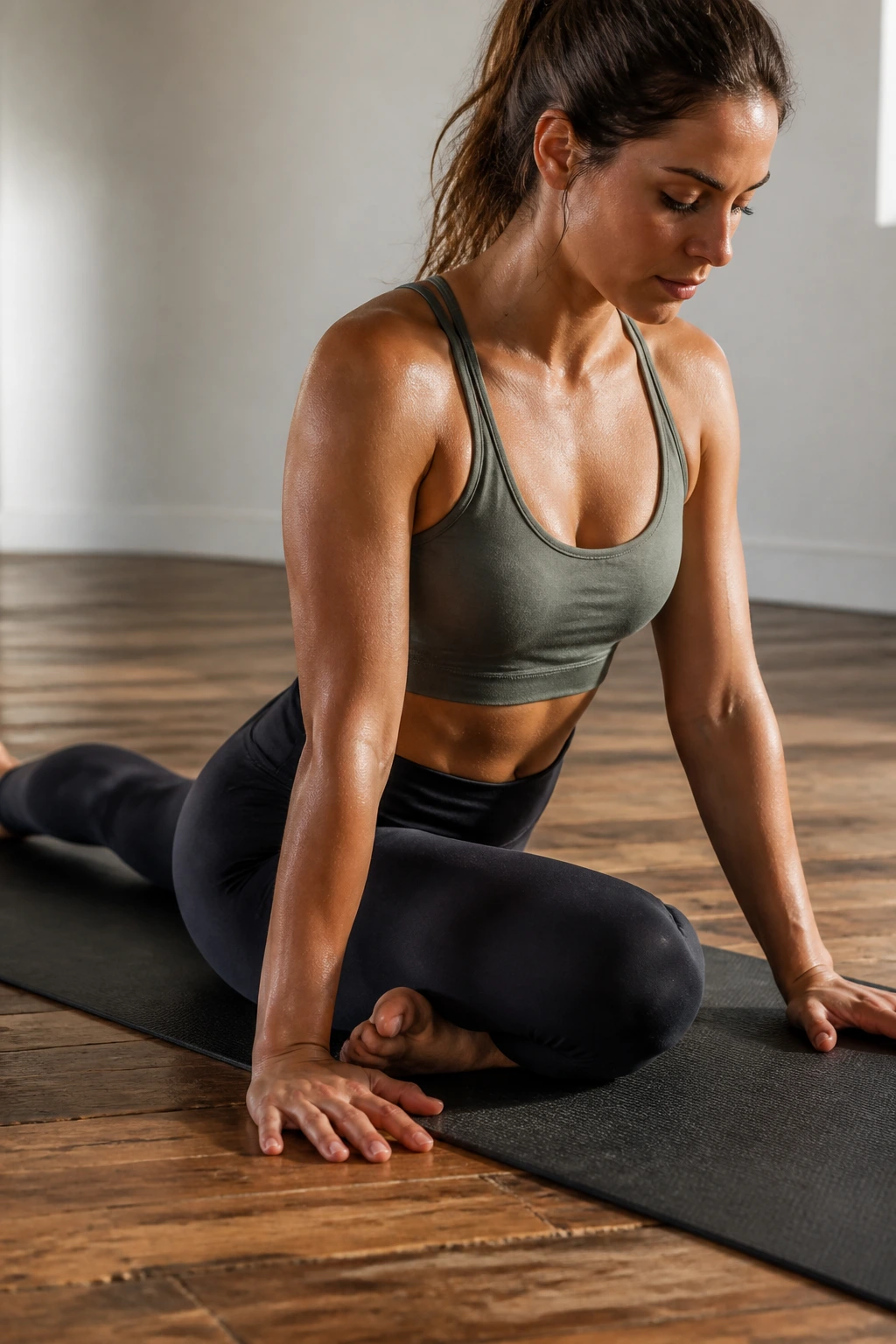
This is the gold standard for deep glute and piriformis relief. If you have ever felt a sharp, stabbing sensation deep in your hip or radiating down your leg, your piriformis muscle is likely the culprit. The pigeon pose gets into that deep, stubborn tissue better than almost anything else.
Safety First
Start in a plank, then bring your right knee forward to touch your right wrist. Angle your shin so your right foot is near your left hip. Extend your left leg straight back behind you. If this puts pressure on your knee, back out immediately. You should feel the stretch in your right hip. Lower yourself onto your forearms if you can. Keep your hips square to the floor—don’t let yourself roll onto the right hip. This is an intense stretch, so focus on slow, calm breathing to convince your nervous system that it is okay to let go.
8. Figure-Four Stretch
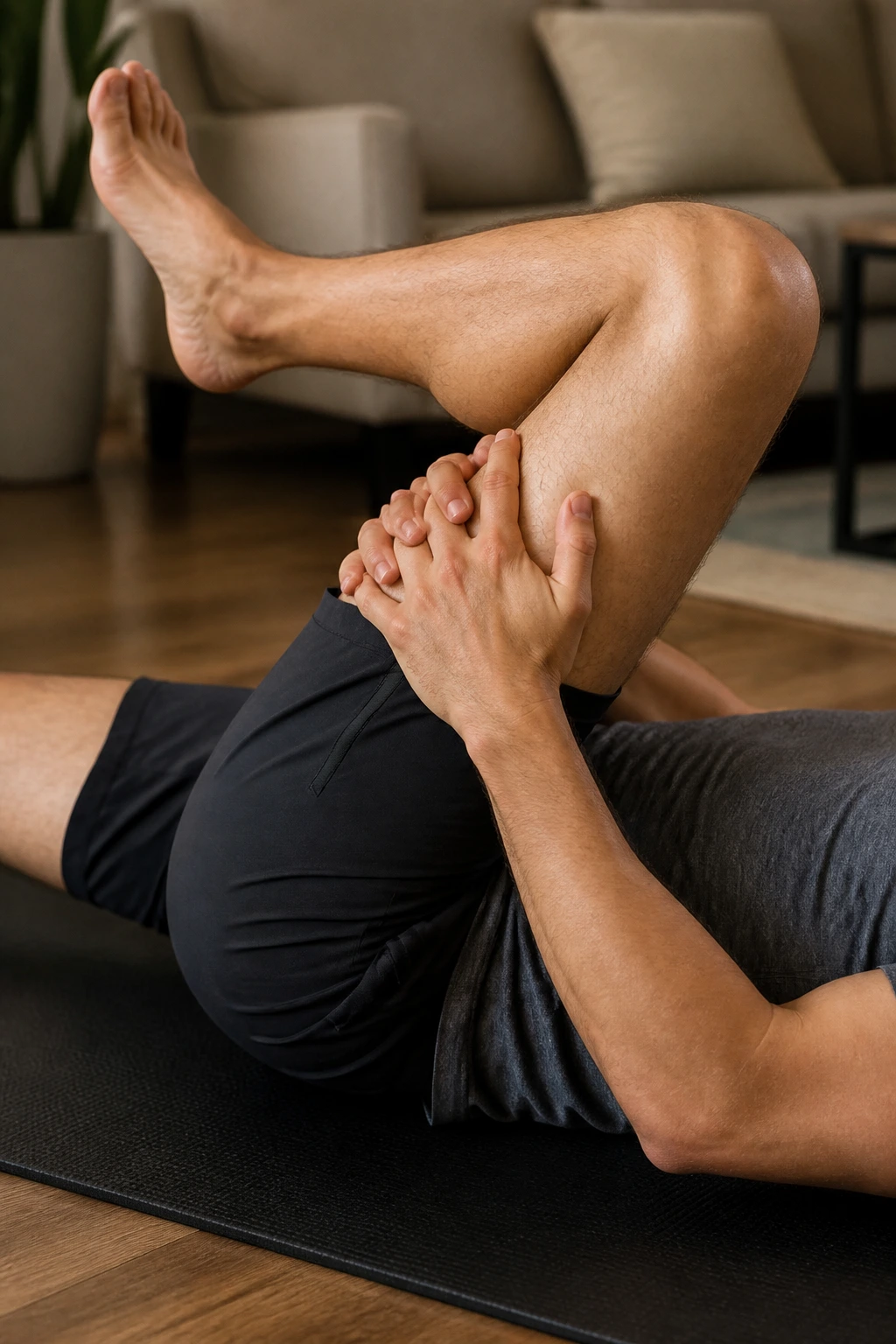
If the Pigeon Pose feels too aggressive or tweaks your knee, the Figure-Four stretch is your best friend. It provides the exact same glute-opening benefits but keeps you on your back, which removes the pressure from your joints and allows your upper body to completely relax.
The Technique
Lie flat on your back with both knees bent and feet on the floor. Cross your right ankle over your left knee. Reach through the gap between your legs and grab the back of your left thigh. Gently pull your left leg toward your chest. You will instantly feel a deep stretch in the right glute. Keep your head and shoulders flat on the ground. If your neck is straining, your grip is too tight or your hips are just too tight—slow down and back off the pull slightly.
9. Butterfly Stretch
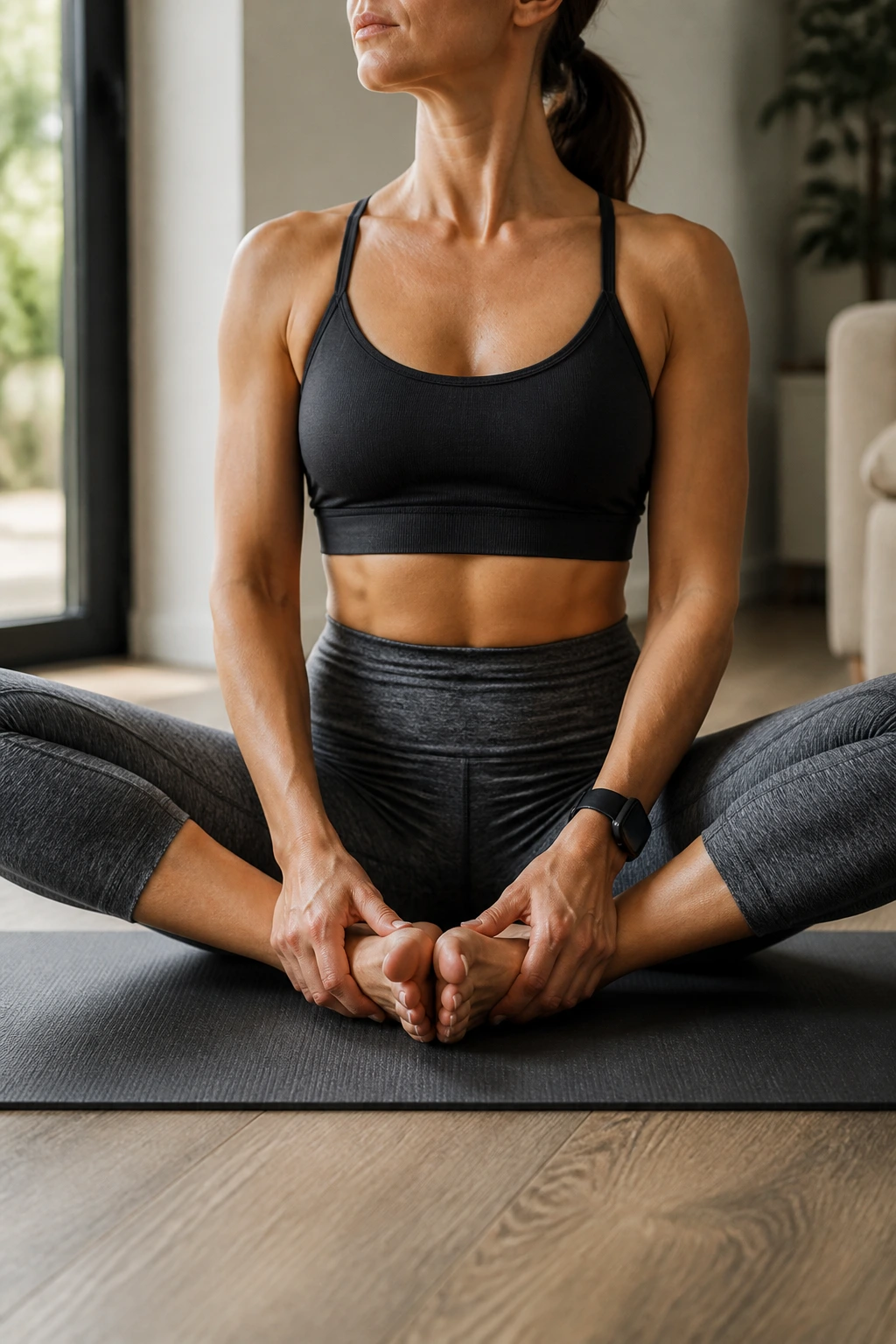
This classic floor stretch targets the adductors and the pelvic floor. Runners often neglect the inner thigh, leading to tightness that can pull on the knees and hips. The butterfly stretch is simple, but its effectiveness depends entirely on your posture while you do it.
How to Do It
Sit with the soles of your feet together and your knees falling open to the sides. Do not pull your feet in so close that you have to hunch your back to hold them. Keep your feet at a comfortable distance. Grab your ankles or feet and sit up as tall as possible. Imagine a string pulling the crown of your head toward the ceiling. Gently press your knees toward the floor using your elbows. Keep your shoulders down and back. This shouldn’t be a straining motion; let gravity do the work as you hold the position.
10. Lizard Pose
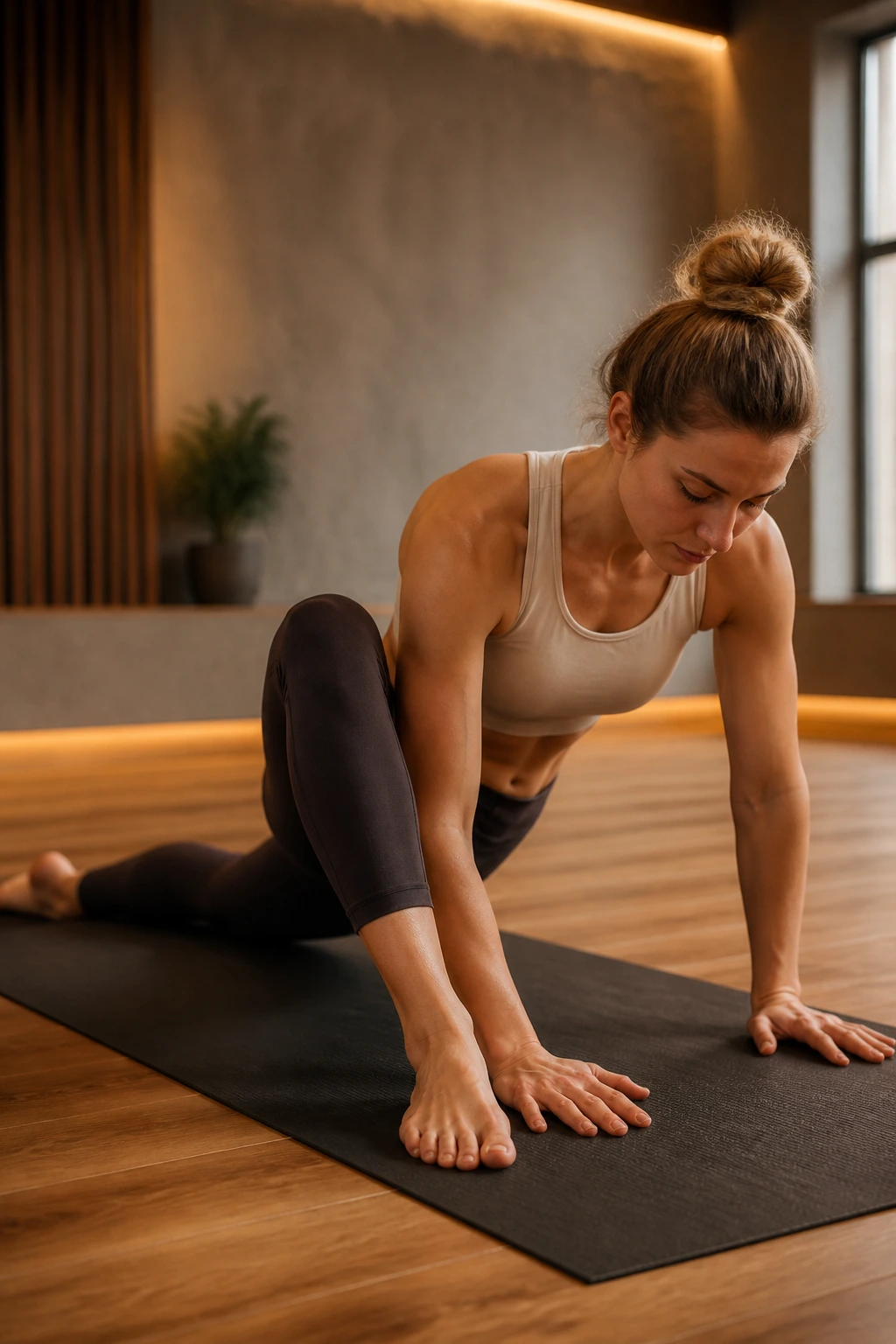
This is a deeper, more aggressive version of the low lunge. It targets not only the hip flexors but also the deep hip adductors and the groin. It is excellent for runners who struggle with tight hips or a short, choppy stride.
The Setup
From a low lunge position with your right leg forward, bring both of your hands to the inside of your right foot. You can stay on your palms or lower yourself onto your forearms. Keep your back knee on the ground for a more restorative stretch, or lift it for a more active one. This position might feel like a lot. Focus on keeping the right knee hugging close to your right shoulder; don’t let it splay out too wide unless you are looking to specifically target the groin. Hold and breathe.
11. Downward Dog
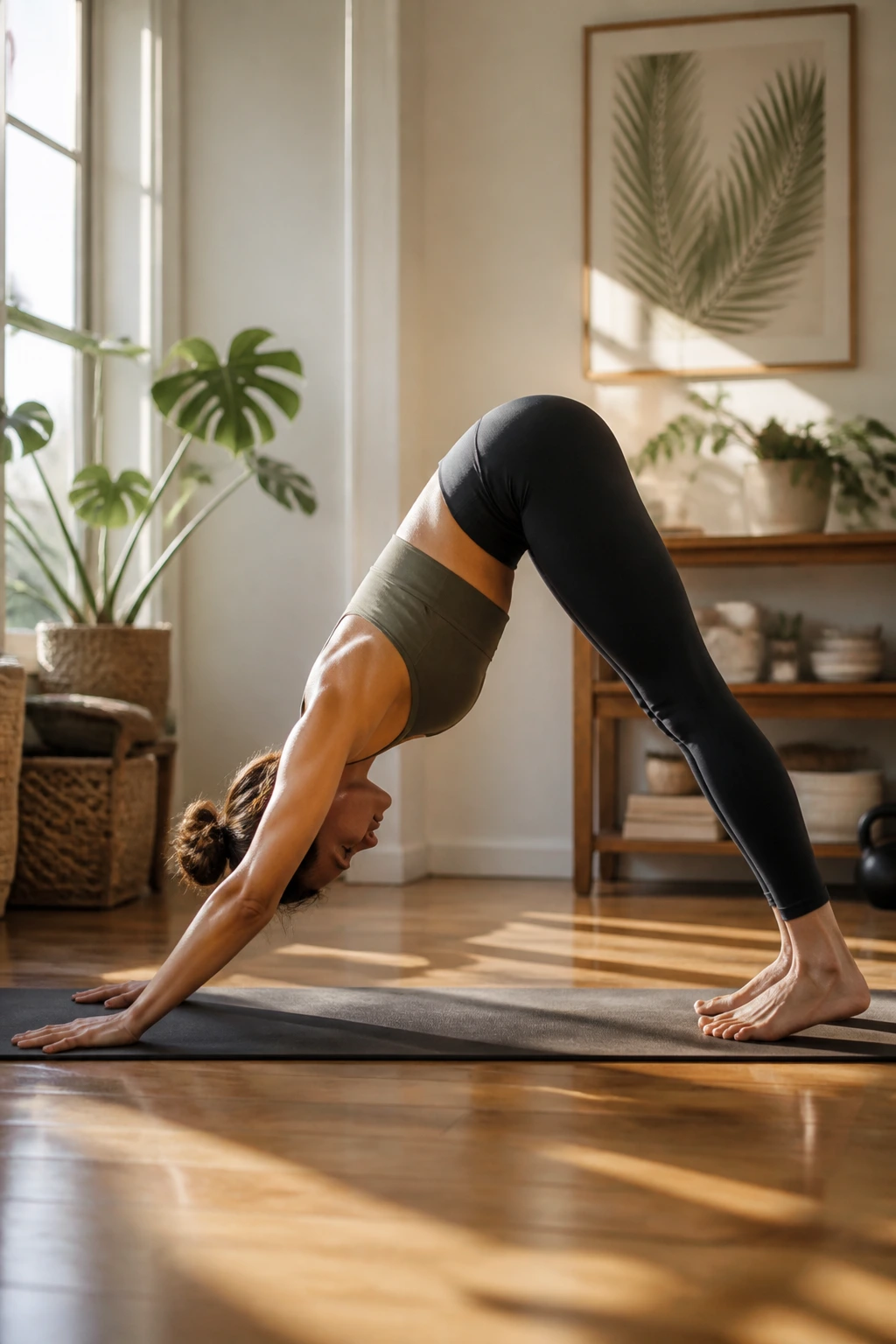
You know it from yoga, but for runners, this is a full-body reset. It hits the calves, hamstrings, glutes, and even the upper back and shoulders. It essentially stretches the entire posterior chain in one go.
Fine-Tuning the Move
Start on your hands and knees, tuck your toes, and lift your hips toward the ceiling. Your body should form an inverted “V.” Do not worry about getting your heels to the floor immediately. Focus on pushing the floor away with your hands and lifting your tailbone high. Pedal your feet out—bend one knee deeply while pressing the opposite heel into the floor—to emphasize the calf stretch. Spread your fingers wide and engage your core to take the pressure off your wrists.
12. Cat-Cow Stretch
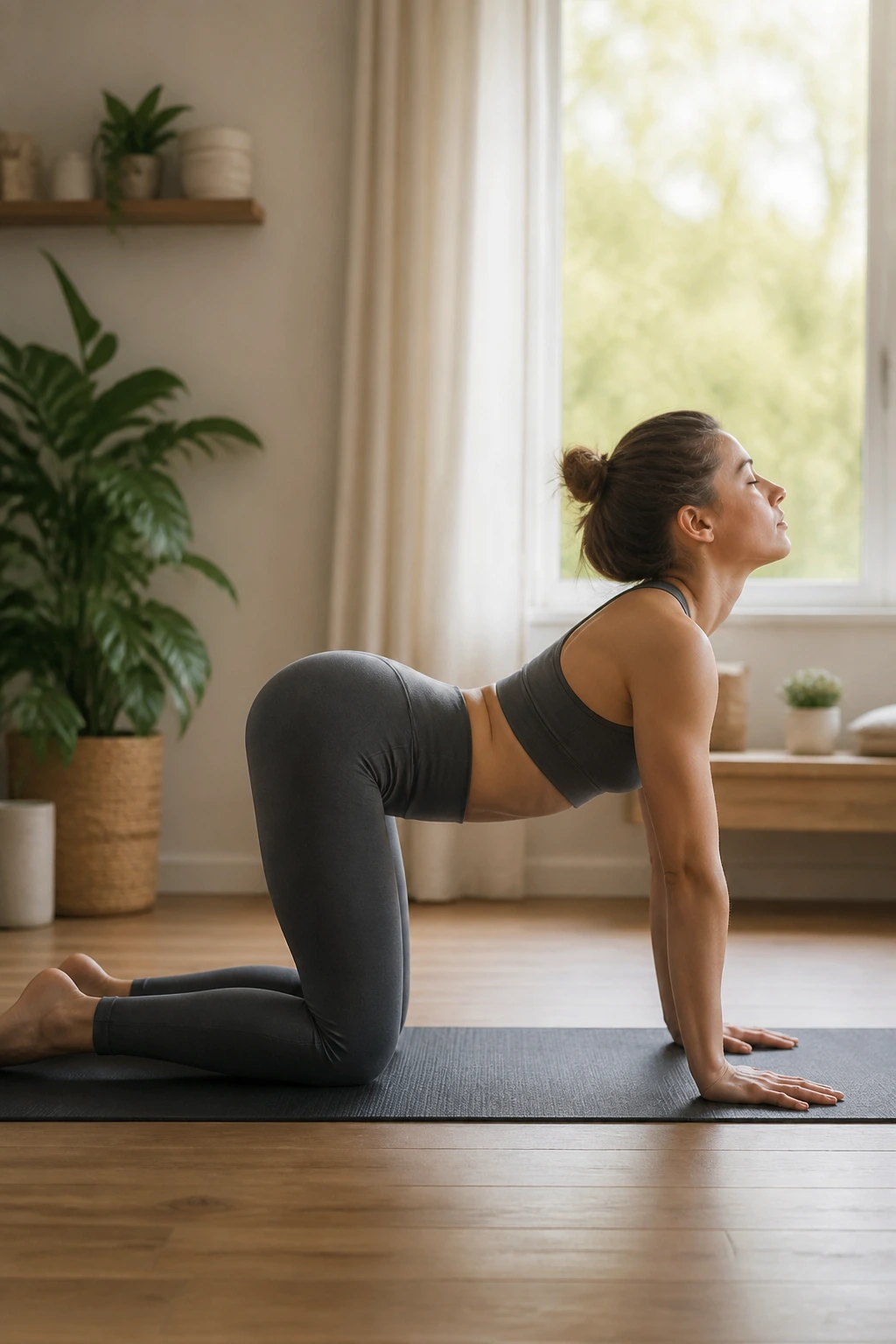
Running involves a lot of impact, and your spine absorbs quite a bit of that shock. Your thoracic spine (the mid-back) can get stiff from the repetitive motion of your arms swinging. This move mobilizes the vertebrae and releases tension across the back.
The Motion
Start on all fours. As you inhale, drop your belly toward the floor, lift your chin, and look up (Cow). As you exhale, tuck your chin to your chest, arch your back like a Halloween cat, and press the floor away (Cat). Move through this sequence slowly, linking your movement to your breath. It is not about how far you can bend, but about feeling each vertebra move individually. This is a great way to “wake up” your spine after a long, repetitive run.
13. Doorway Chest Stretch

Most runners naturally hunch forward as they fatigue during a run. By the end, your shoulders are usually rounded, and your chest is tight. This is a simple, effective way to reverse that posture. You need a doorway or a wall corner for this one.
How to Execute
Stand in an open doorway. Place your forearms on the door frame, elbows at shoulder height. Step one foot through the doorway, keeping your forearms pinned to the frame. Lean forward gently until you feel a stretch across your chest and the front of your shoulders. Do not arch your lower back to get more stretch—keep your core tight. This simple movement helps counteract the “runner’s hunch” and improves your posture for the rest of the day.
14. Cross-Body Shoulder Stretch
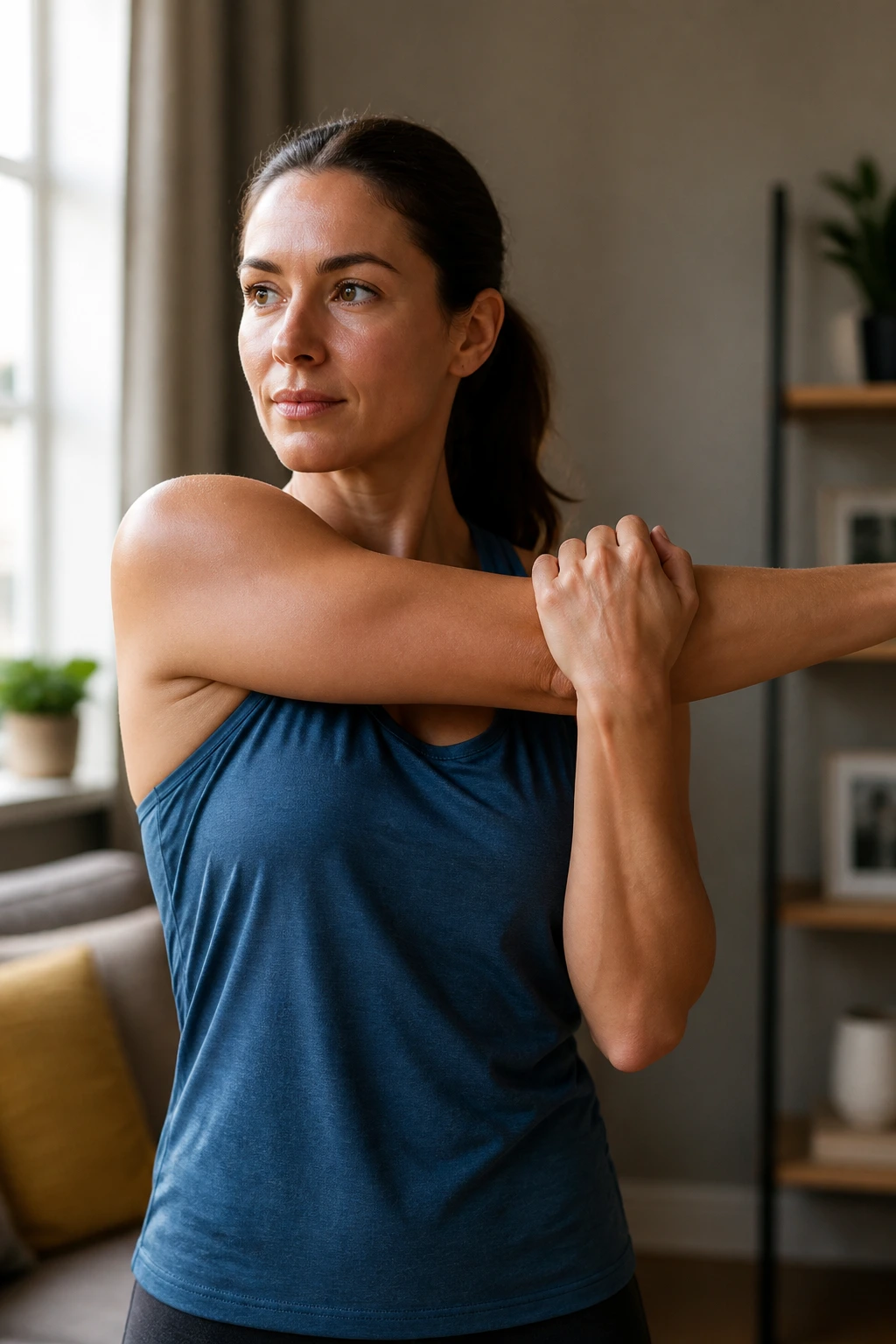
After a run, your upper body can feel surprisingly tight. Your shoulders work hard to stabilize your core, and if you have been carrying any tension or cold weather gear, they are likely screaming for release. This stretch is simple but effective.
Keeping It Correct
Stand tall and bring your right arm across your chest. Hook your left arm underneath your right elbow and gently pull your right arm closer to your body. Keep your right shoulder down—don’t let it creep up toward your ear. You should feel the stretch across the back of the shoulder. If you feel it in your neck, you are pulling too high. Keep the tension centered in the shoulder blade and the rear deltoid. Hold for 30 seconds and switch.
15. Neck Release

It sounds minor, but running-induced neck tension is a real thing. Whether from fighting wind or just general fatigue, you might notice you have been clenching your jaw or shrugging your shoulders without realizing it.
The Stretch
Sit or stand comfortably. Gently drop your right ear toward your right shoulder. To increase the stretch, reach your left hand toward the floor, actively pushing the shoulder down away from your ear. You do not need to pull on your head with your hand—the weight of your head is usually enough. Breathe into the side of your neck. Switch sides slowly. This is a very sensitive area, so be gentle and move with intention.
16. Supine Spinal Twist
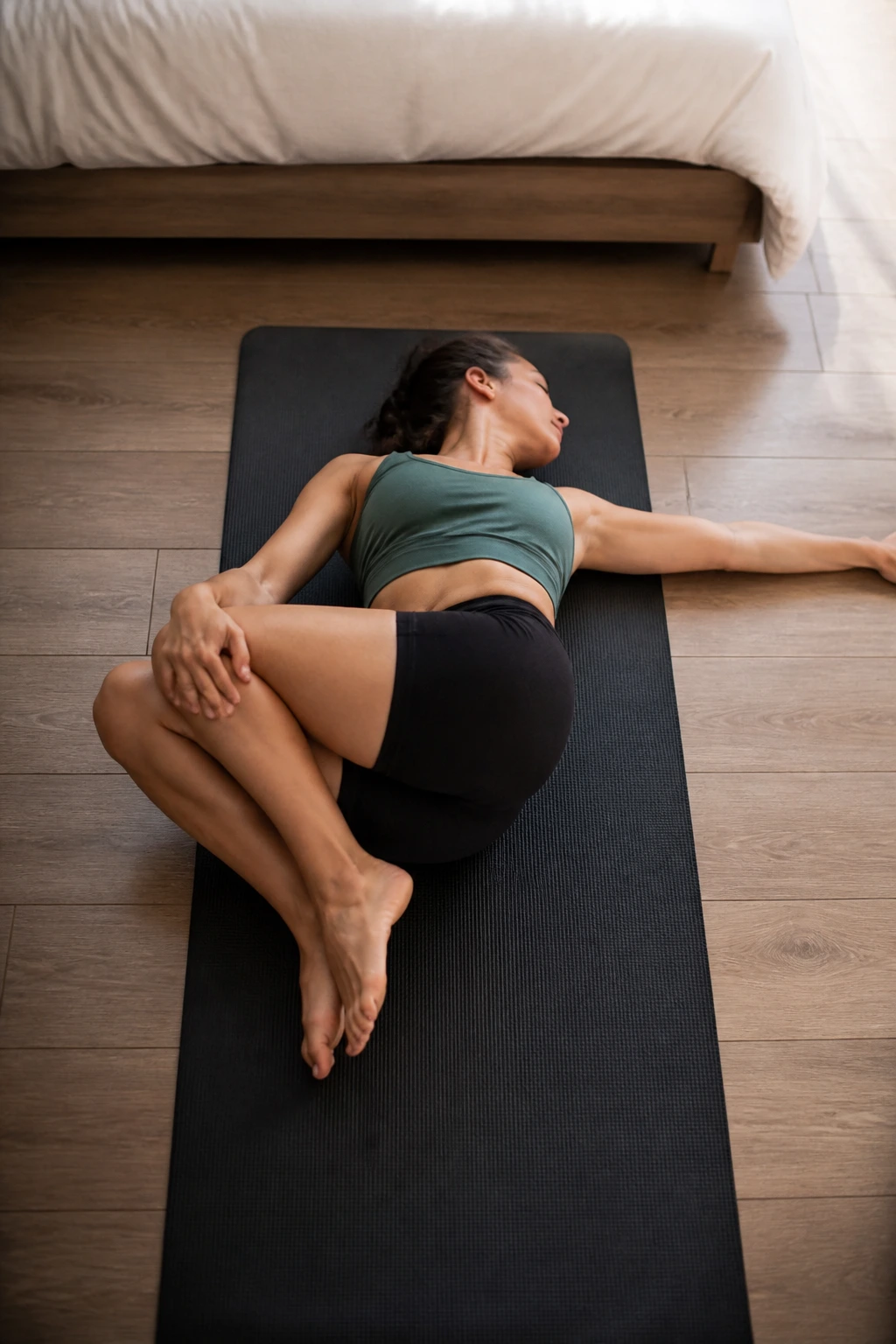
This is a fantastic “closing” stretch. It decompresses the lower back, which takes a significant amount of force with every footfall. It also helps gently rotate the spine, releasing tension that builds up around the waist and mid-back.
The Method
Lie on your back. Hug your knees to your chest. Extend your left leg straight along the floor. Guide your right knee across your body and toward the floor on your left side. Extend your right arm out to the side like a wing and look toward your right hand. Your right shoulder should remain pinned to the ground—that is the anchor. If your shoulder lifts, you have gone too far. Breathe into your side body. It is one of the most relaxing stretches you can do.
17. Ankle Circles
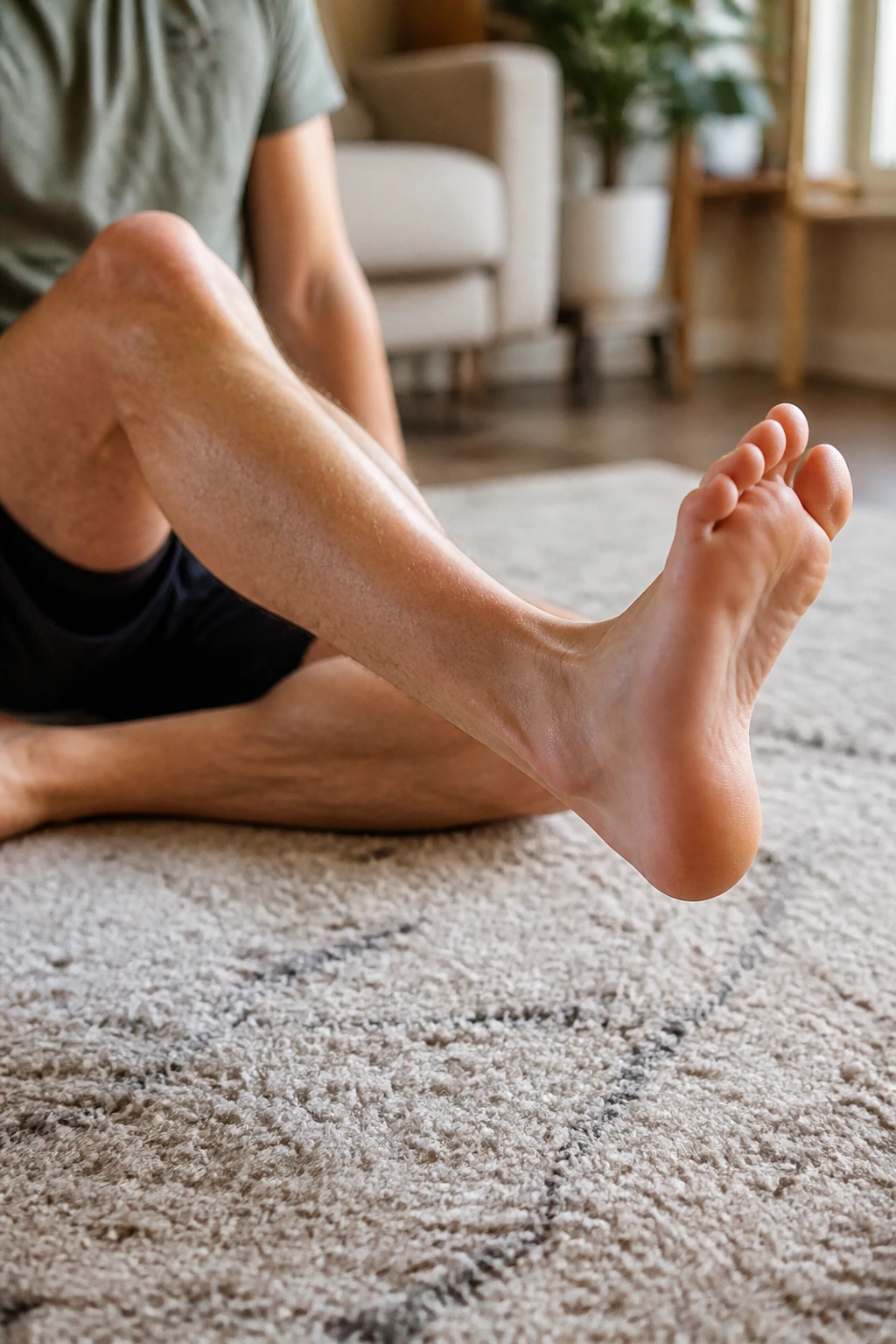
We often forget the feet and ankles, despite them being the point of contact with the ground. Every mile is a thousand micro-adjustments for your ankle stabilizers. Taking a moment to mobilize the joint helps prevent stiffness and maintains your balance.
Mobility Focus
Sit on the floor or in a chair. Lift one foot off the ground. Slowly rotate your ankle in large, controlled circles. Do not just flop your foot around; imagine you are drawing a circle on the wall with your big toe. Do 10 circles clockwise, then 10 counter-clockwise. You might hear some popping or clicking—that is usually normal. If it is painful, keep the range of motion smaller. Follow this up by flexing and pointing your toes to stretch the top of the foot.
18. Toe Extension and Stretch
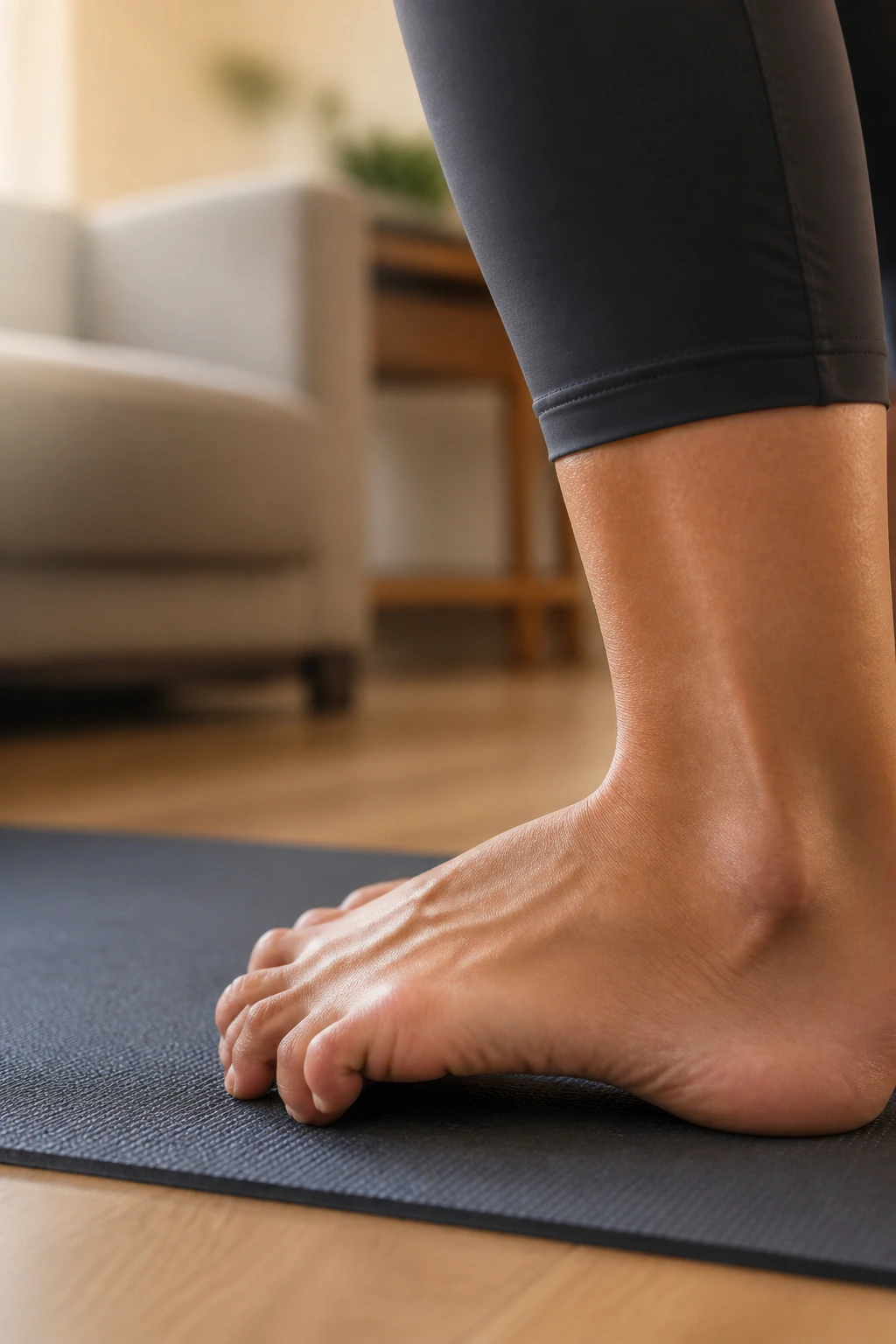
If you wear stiff running shoes, your toes spend a lot of time immobilized. After a run, your feet can feel like they have been in a vise. This stretch targets the small muscles in the feet and the fascia along the bottom of the foot.
The Technique
Kneel on the floor, sitting back on your heels. Tuck your toes underneath you so you are putting weight on the balls of your feet. This might feel intense if you have tight plantar fascia. If it is too much, lean forward and put some weight on your hands. If you can handle it, sit all the way back on your heels to increase the pressure. This is arguably the most uncomfortable stretch on the list, but for runners, it is incredibly important for foot health.
19. Glute Bridge Hold
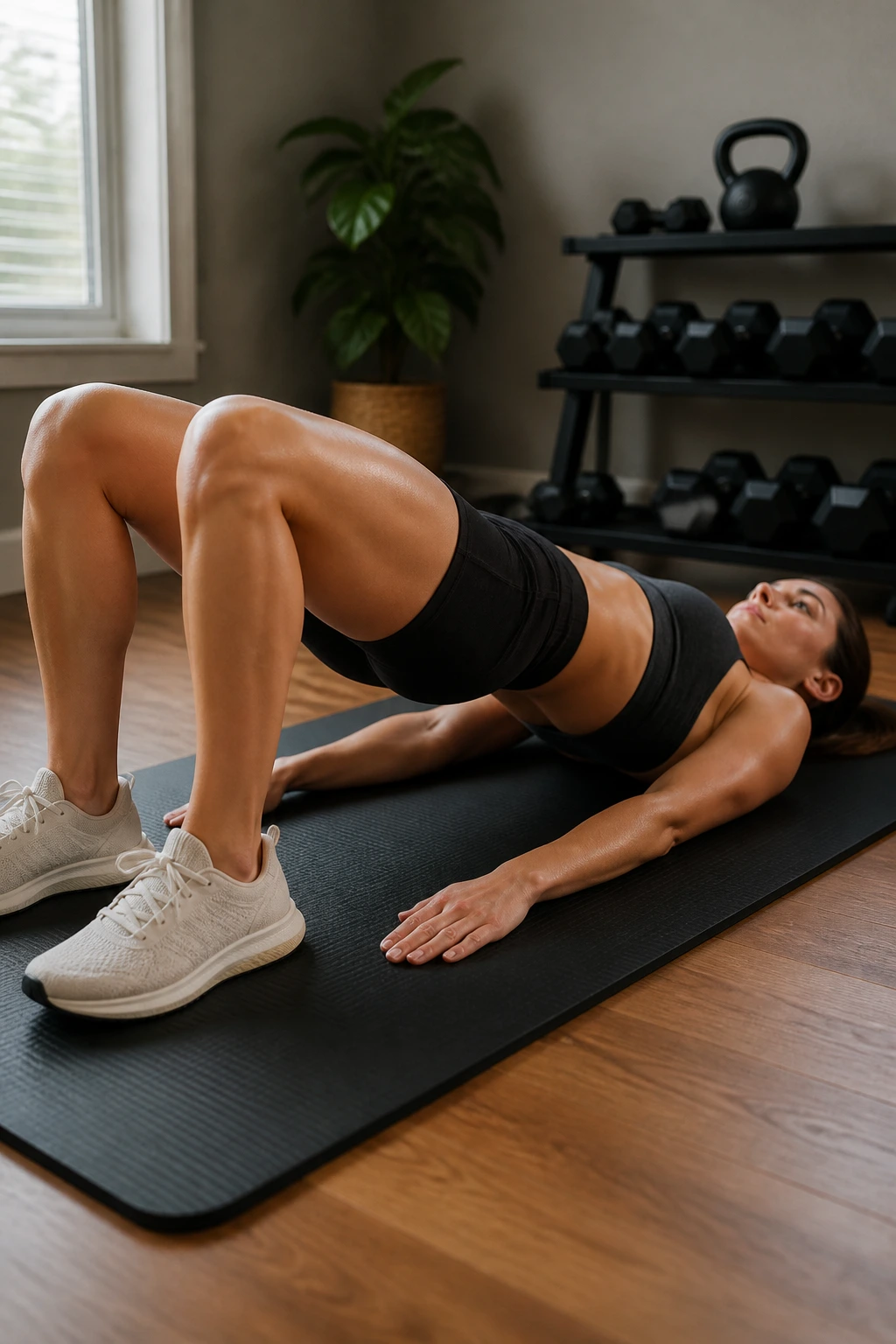
Is this a stretch or a strengthening exercise? It is a bit of both. It is an “active stretch” that helps re-engage your glutes after they have been “shut down” or tired out during a run. It helps stretch the hip flexors while activating the posterior chain.
The Movement
Lie on your back with your knees bent and feet flat on the floor, hip-width apart. Drive through your heels to lift your hips toward the ceiling. Squeeze your glutes at the top. Hold the position for 5-10 seconds, then lower down. Repeat this 10 times. It helps “turn on” the muscles that should have been doing the work during your run, rather than letting your lower back take the load.
20. Thread the Needle
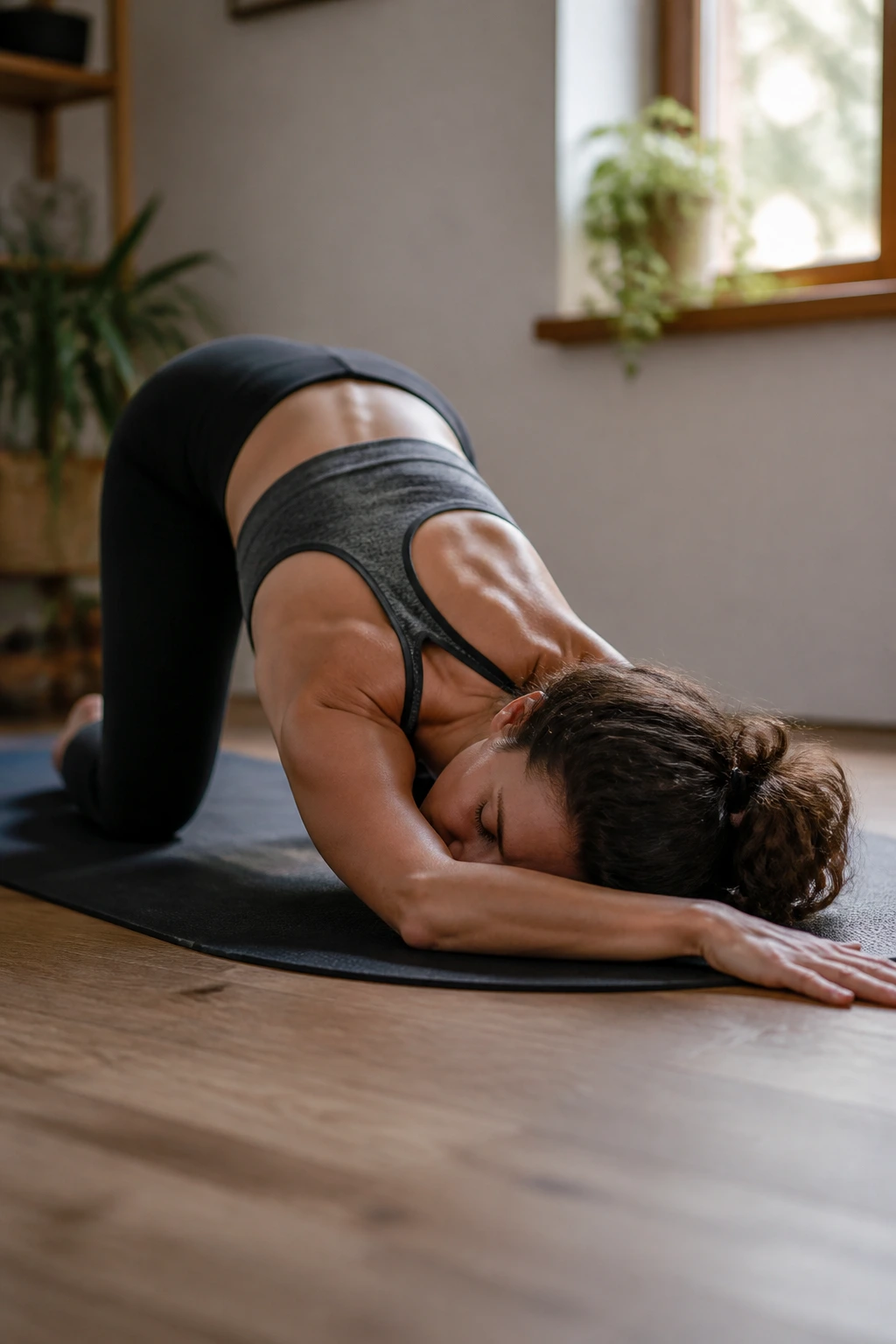
This move is a lifesaver for the upper back and thoracic mobility. It targets the muscles between your shoulder blades, which tend to lock up when you have been leaning forward in a run.
The Position
Start on your hands and knees. Slide your right arm underneath your left arm, reaching as far as you can until your right shoulder and the side of your head rest on the floor. Keep your hips high and square. You will feel a deep stretch in the upper back and the back of the shoulder. It feels awkward at first, but it is one of the most effective ways to release the tension between the scapulae.
21. Child’s Pose
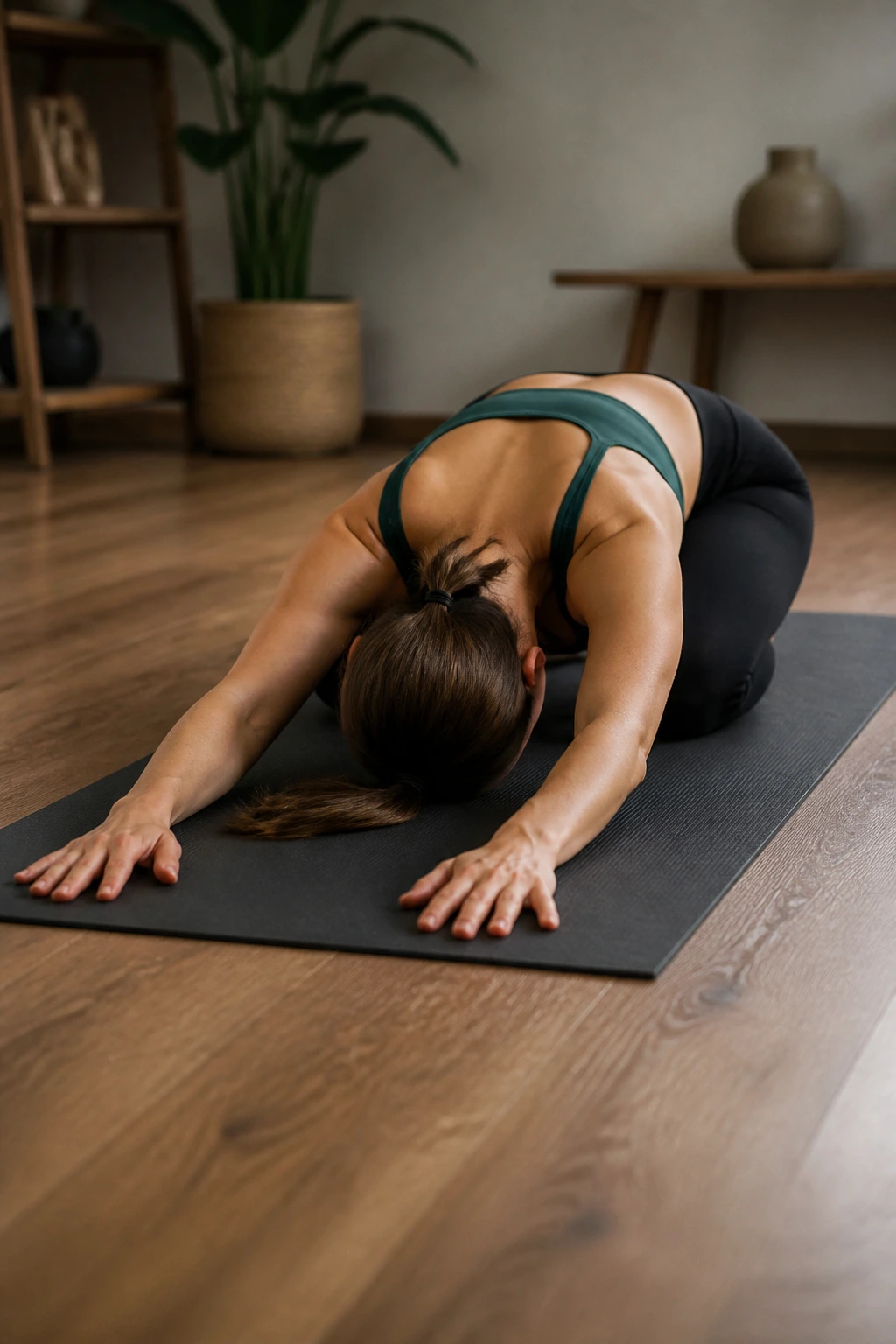
This is the ultimate recovery resting position. It elongates the entire spine and provides a gentle stretch for the hips, thighs, and ankles. It is the perfect place to end your post-run routine before you head into the shower.
How to Rest
From a kneeling position, bring your big toes together and separate your knees wide. Sink your hips back onto your heels. Reach your arms forward on the floor and rest your forehead on the ground. Let your whole body melt toward the earth. There is no “work” to be done here. Just breathe and feel your back expand with every inhale. Stay here for as long as you need.
22. Standing Quadriceps Stretch (The Classic)
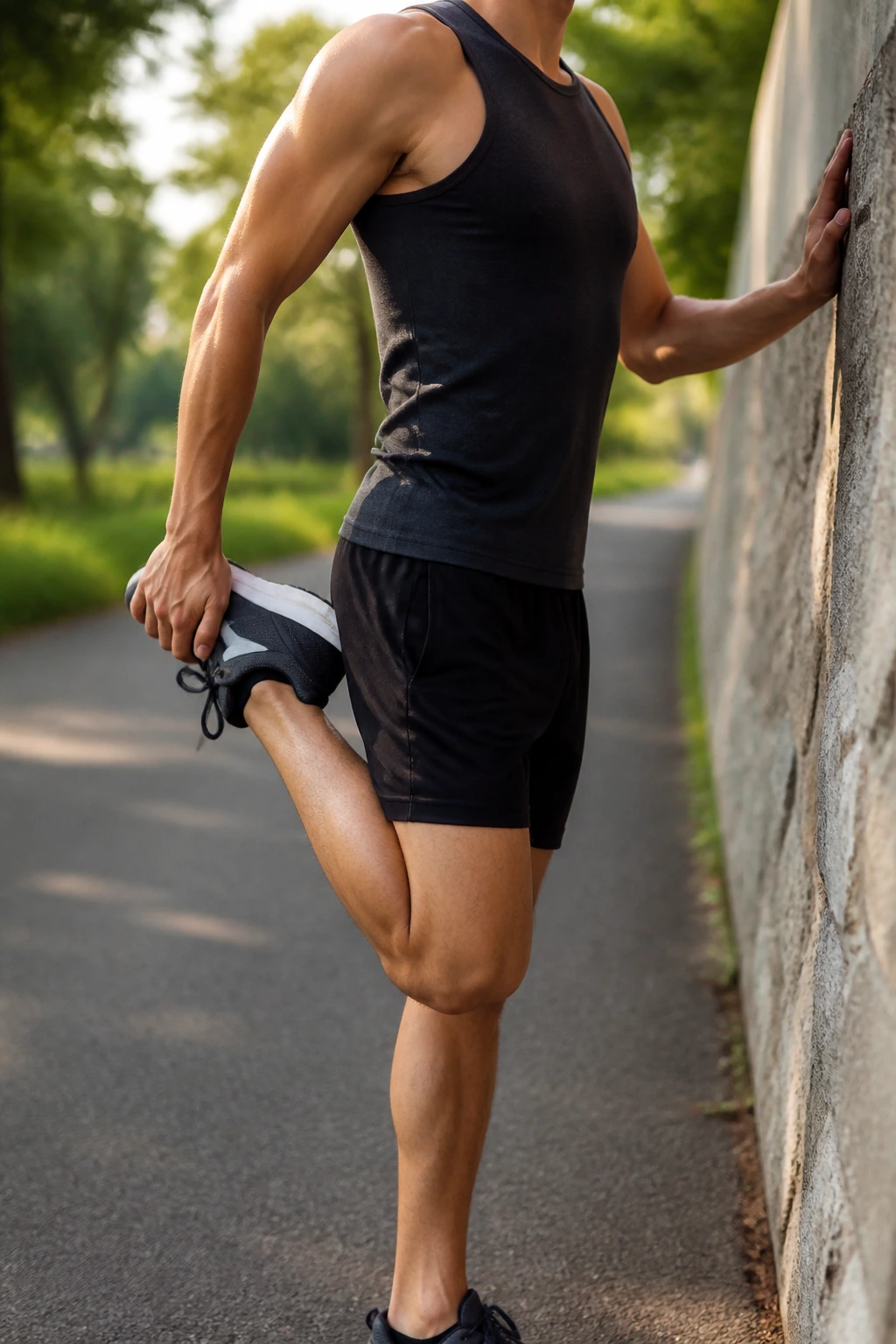
We covered the lying version, but the standing version is indispensable for its convenience. You can do this immediately after stopping your run, before you even have a chance to sit down.
Balancing Act
Stand on one leg, holding onto a tree, lamp post, or wall for balance. Grab the ankle of the other leg and pull your heel toward your glutes. The goal is to keep your knees side-by-side. If your knee drifts out to the side, you lose the stretch. Keep your hips pushed forward. This is all about the alignment of the knee, hip, and shoulder in one vertical line. If you are leaning forward, you are cheating the stretch.
23. Lateral Lunge Stretch
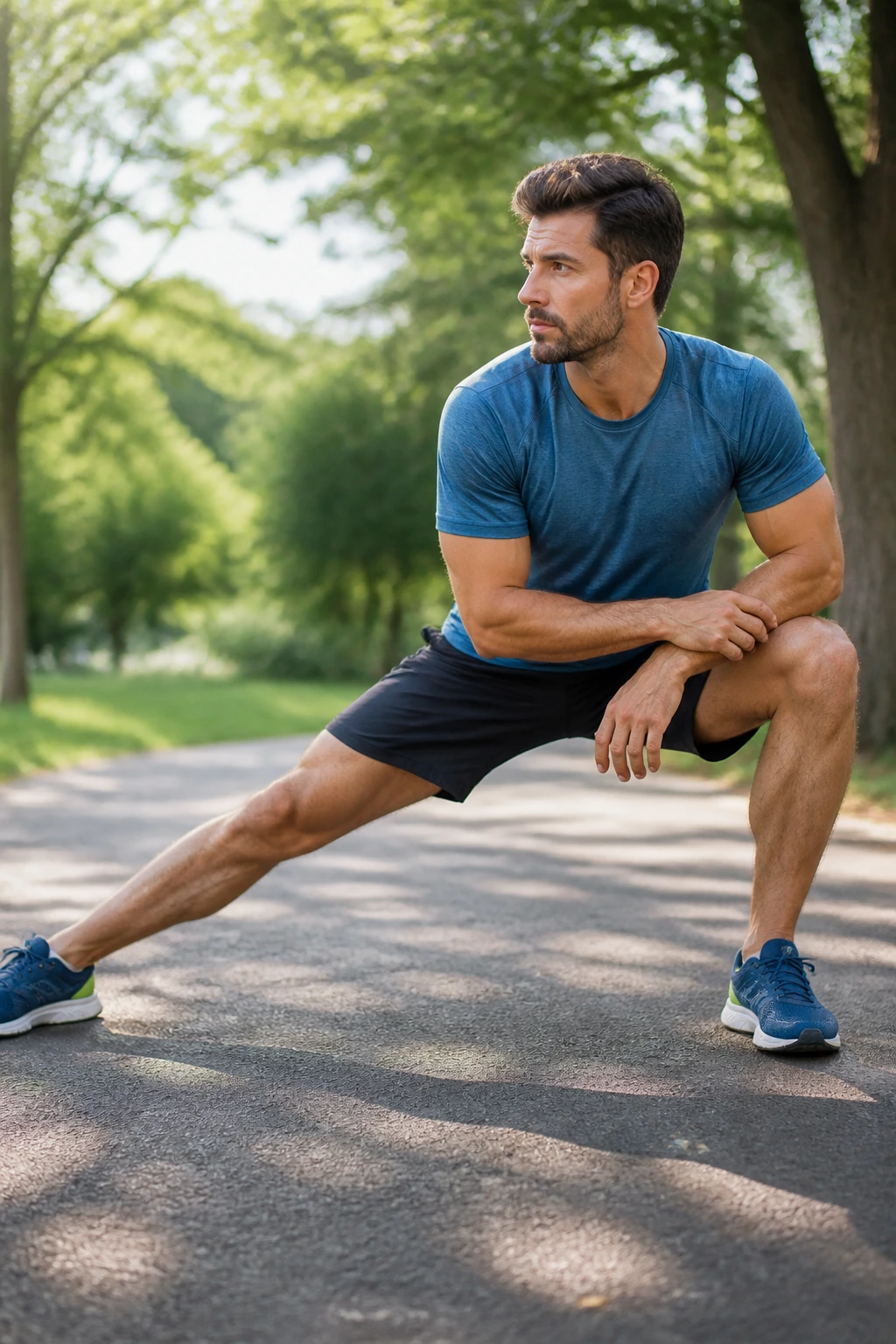
Running is almost entirely a forward-moving activity (sagittal plane). Your muscles are conditioned for forward motion, but they often get stiff when you move side-to-side. This stretch helps introduce lateral movement, opening up the adductors and improving hip mobility in a different plane.
The Movement
Stand with your feet wider than shoulder-width apart. Shift your weight to your right side, bending your right knee and keeping your left leg straight. Keep your chest up and your left foot flat on the floor. You should feel a significant pull on the inside of your left thigh. Hold, then shift slowly to the other side. This isn’t a race—move slowly and keep your balance.
24. Standing IT Band Stretch
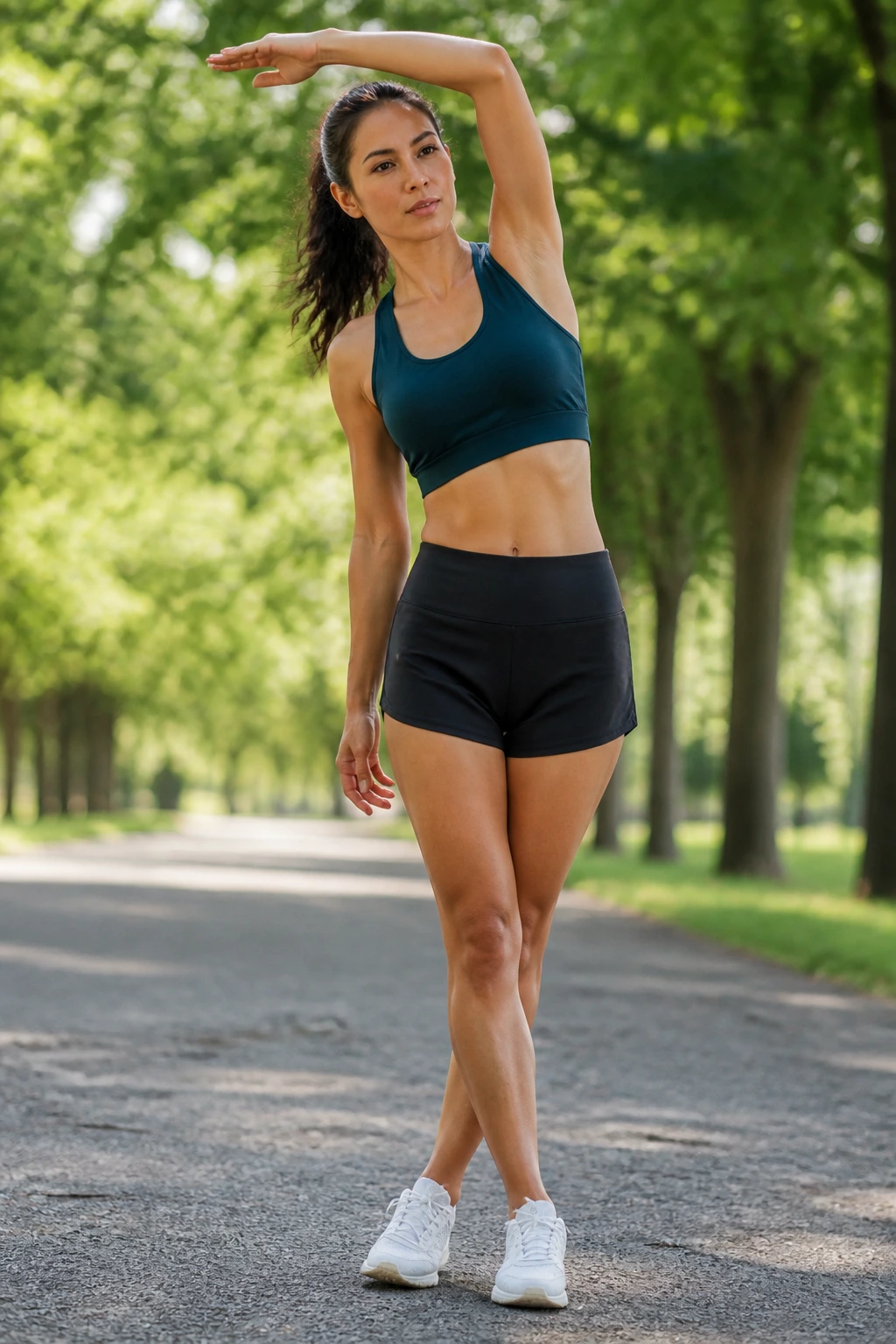
The Iliotibial (IT) Band is not a muscle, but a thick strip of connective tissue running down the outside of the thigh. It doesn’t “stretch” in the traditional sense, but you can lengthen the muscles that attach to it (the TFL and glute medius) to relieve tension.
How to Target It
Stand with your feet together. Cross your right foot behind your left foot. Reach your right arm up and over your head toward the left side. You should feel a stretch running down the outside of your right hip and thigh. Keep your hips square. This is a subtle stretch; you don’t need a huge range of motion to feel it. It is excellent for runners who struggle with knee pain on the outside of the joint.
25. Legs Up the Wall
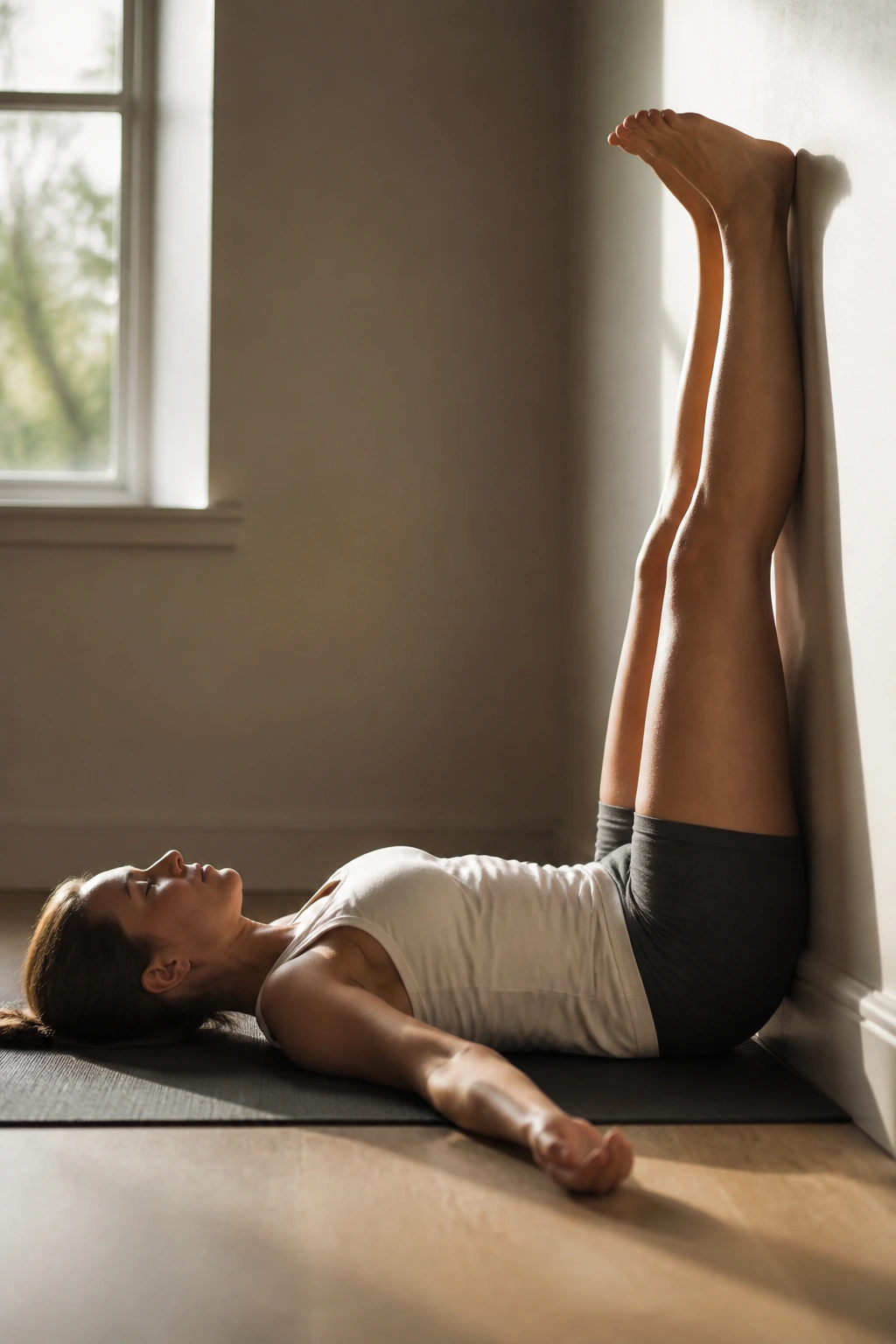
This is the king of recovery poses. It is passive, it is restorative, and it is the best way to let gravity help your body flush out metabolic waste from your lower legs.
The Simple Finish
Find a wall. Lie on the floor and swing your legs up so they are resting vertically against the wall. Scoot your hips as close to the wall as is comfortable. Your arms can rest by your sides, palms up. Close your eyes. This simple position aids venous return, pulling fluid out of your tired ankles and feet. It helps lower your heart rate and signals to your brain that the workout is finished. Stay here for at least 5 to 10 minutes. It is the best thing you can do for your legs after a long, grueling effort.
The Bottom Line
Consistency beats intensity every single time. You do not need to do all twenty-five of these stretches after every run. If you are short on time, pick the five that target your “problem areas”—the spots that usually feel the stiffest. Maybe that means focusing on your calves and hamstrings one day, and your glutes and hips the next.
The most effective recovery routine is the one you actually perform. If you find yourself skipping the cooldown because it feels like a chore, shorten it. Five minutes of deliberate, focused stretching is infinitely more valuable than twenty minutes of half-hearted, distracted movement. Pay attention to how your body responds to each stretch. Some days, your hamstrings might need extra time; other days, your lower back will be the priority. Listen to that feedback. Over time, this becomes less about “doing exercises” and more about an intuitive dialogue with your muscles, helping you stay healthy, flexible, and ready for the next mile.
