



Staring at the console of a treadmill while the minutes tick by with agonizing slowness is a special kind of mental torture. You watch the numbers change, you check your watch, you check the wall clock, and somehow, only thirty seconds have passed. Cardio training has gained an undeserved reputation for being mind-numbingly dull because people mistake “cardio” for “running in place.” The truth is that cardiovascular conditioning doesn’t require a conveyor belt. It requires elevated heart rates, consistent output, and a bit of sweat.
If you are tired of the rhythmic thud-thud-thud of belt-driven running, you are not alone. Many people abandon their fitness goals simply because they can’t stomach another session of steady-state indoor jogging. The alternative is not doing less cardio; it is doing more interesting, demanding, and effective movements. Your heart doesn’t know the difference between a treadmill motor and a jump rope hitting the ground—it only knows the work you are putting in.
The following list comprises movements and circuits that shift the focus from endurance to intensity. These methods rely on your own body weight, gravity, and a few pieces of standard gym equipment to keep your heart rate in the anaerobic zone. You will find that these options not only save you from the boredom of the treadmill, but they also recruit more muscle groups, improve your agility, and leave you finished in a fraction of the time.
1. Jump Rope
The jump rope is arguably the most efficient cardio tool ever invented. It costs next to nothing, takes up zero space, and provides an immediate cardiovascular spike that puts most machines to shame. You have to be engaged; if you lose focus for a split second, you trip. That forced concentration keeps your mind off the clock and on the rhythm.
Why It Works for Conditioning
You are not just working your lungs here. A proper jump rope routine engages your calves, hamstrings, glutes, and shoulders, all while stabilizing your core. It is a full-body engagement that forces you to stay upright, improving your posture simultaneously.
- Use a weighted rope if you want to turn this into a strength-endurance hybrid.
- Keep your jumps small—just enough to clear the rope—to conserve energy and maintain speed.
- Listen for the “tick” sound on the floor; it helps you find your cadence.
Pro tip: Do not waste time doing fancy footwork when you are just starting. Master the basic bounce first. Two minutes of unbroken basic jumping is harder than it sounds.
2. Stair Sprints
If you have access to a stadium or a decent flight of stairs, stop looking for a machine to do the work for you. Stair sprints are brutal, effective, and completely unavoidable once you commit to the climb. They force your body to work against gravity in a way that flat-ground running never can.
The Mechanics of the Climb
When you sprint up stairs, you are forced into a high-knee position that recruits the glutes and quads aggressively. Because you are moving vertically, your heart rate spikes almost instantly. You are essentially doing a series of explosive lunges with every step.
- Drive through the ball of your foot.
- Keep your torso upright—don’t hunch over the railing unless you are gassed.
- The descent is where you recover; walk down slowly and use the time to catch your breath.
Expect to feel “jelly legs” within five minutes. If you can do ten sets of twenty stairs without wanting to collapse, you have built a serious engine.
3. Battle Ropes

Battle ropes are the ultimate equalizer. They turn your arms into a secondary engine for your cardiovascular system. When you use these, you are oscillating the ropes, which requires a constant, high-speed output from your shoulders, back, and core, all while keeping your legs in a solid athletic stance.
How to Structure a Rope Session
Do not just wave them aimlessly. The key is in the intensity of the wave. You want the ripple to reach the anchor point every single time. If the rope just flops, you are wasting energy.
- Alternating Waves: Focus on speed and keeping your core rigid.
- Double Slams: This requires a full-body squat-and-heave movement.
- The 30/30 Split: Work for 30 seconds at max effort, rest for 30, and repeat for ten minutes.
You will find that your shoulders fail long before your lungs do. This is a common plateau; push through the shoulder fatigue to keep the heart rate up.
4. Rowing Machine
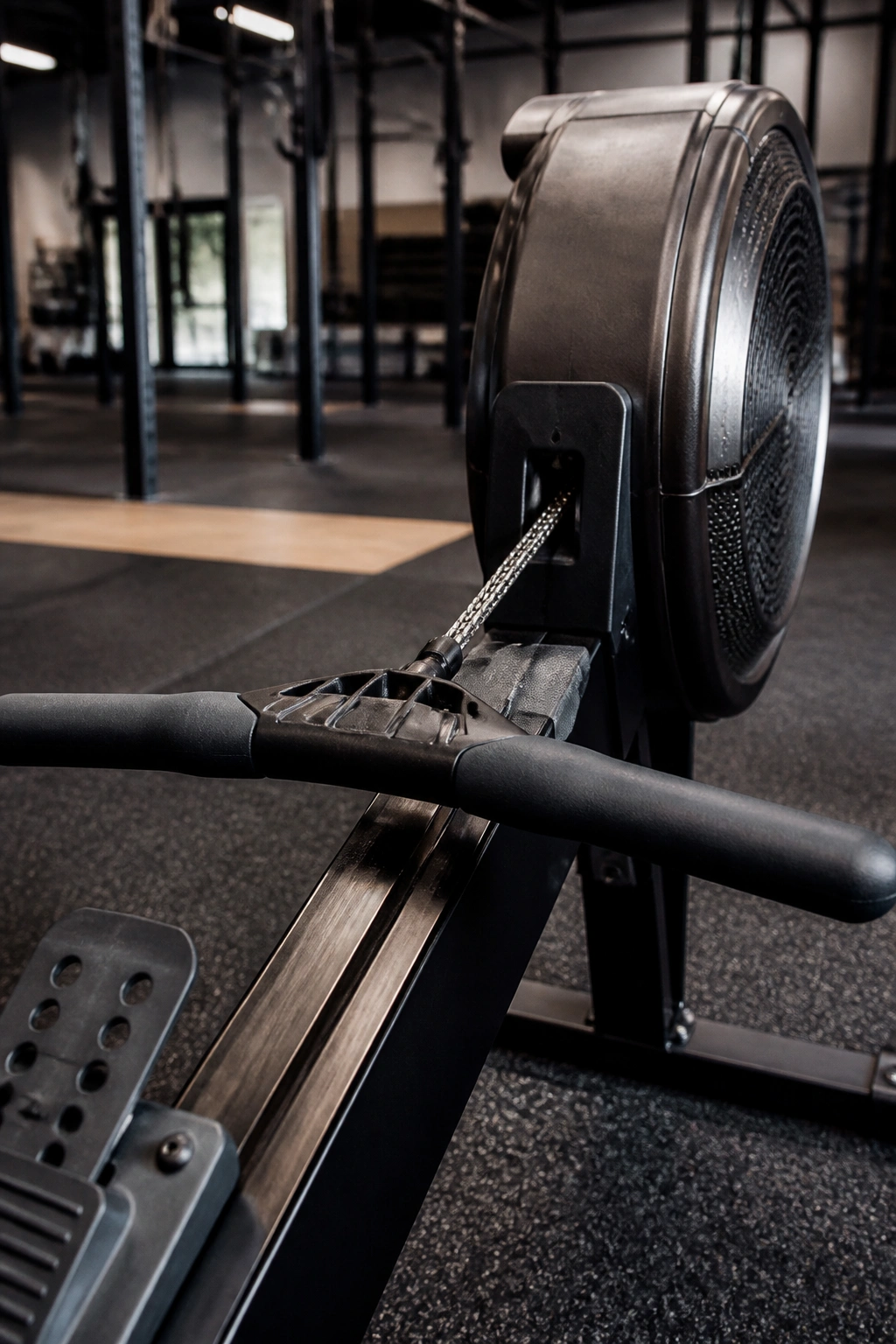
The rowing machine is often ignored in favor of the elliptical, which is a mistake. Rowing is a low-impact, full-body exercise that targets your posterior chain—the back of your body. When done with correct form, it is one of the best calorie-burning activities in any gym.
The Stroke Pattern
Most people get the rhythm wrong. They pull with their arms first. You must drive with your legs, lean back with your core, and finally pull with your arms. The return is the reverse.
- Leg drive = 60% of the power.
- Core/Back = 30% of the power.
- Arms = 10% of the power.
If your lower back hurts, you are likely rushing the return or pulling with your arms too early. Slow down the slide, focus on the explosive push, and breathe rhythmically with the stroke.
5. Kettlebell Swings
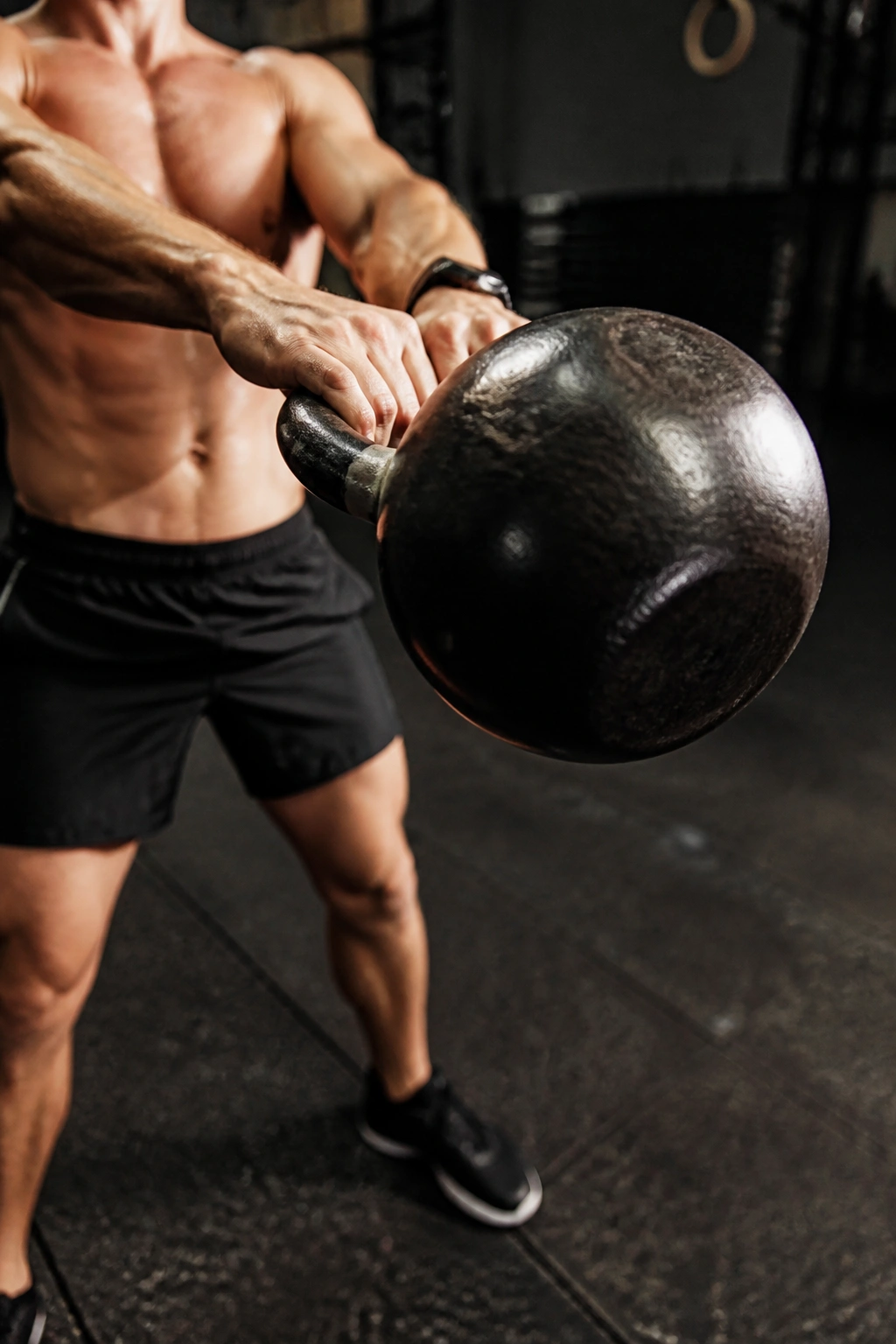
This is not a weightlifting move in the traditional sense; it is a ballistic, hinge-based cardiovascular movement. You are using the momentum of the kettlebell to tax your posterior chain and your heart simultaneously. It mimics a vertical jump but keeps the weight controlled.
Why This Beats Steady-State Cardio
When you swing, you are breathing heavily, yet you are also strengthening your hamstrings and lower back. It is a two-for-one benefit. You are not just burning fuel; you are building the foundation for a stronger, more resilient body.
- Keep the swing at chest height.
- Snap your hips forward aggressively.
- Do not squat the weight; it is a hinge at the hips, not a deep knee bend.
Warning: If you feel this in your lower back, stop immediately. You are likely using your back to lift the weight rather than using your hips to drive it. Reset and focus on the glute squeeze.
6. Shadow Boxing

You don’t need a heavy bag or a partner to get a world-class workout. Shadow boxing is about movement, balance, and rapid-fire output. You are essentially doing interval training with your upper body. It forces you to move in multiple planes—lateral, forward, and backward—which is much more dynamic than running forward on a belt.
How to Maintain Intensity
The common mistake is throwing lazy punches. You must snap your punches out and pull them back just as quickly. The retraction is where the core work happens.
- Keep your feet moving.
- Imagine an opponent is actually there.
- Throw combinations—jab-cross-hook-uppercut—and move after every combo.
Do three-minute rounds, just like a real fight. Rest for one minute in between. Five rounds of this will leave you more winded than a 5k run.
7. Burpees

Yes, everybody hates them. That is exactly why you should do them. The burpee is a complex movement that involves dropping to the floor, exploding into a pushup, and jumping into the air. It is a full-system reset.
The Effectiveness of the Movement
It takes your body from a horizontal position to a vertical one as fast as possible. This rapid change in elevation is what spikes the heart rate. It’s an exercise in discipline as much as physical capability.
- Drop your hips back.
- Chest to floor—don’t cheat the range of motion.
- Jump with intent.
If you struggle with the pushup portion, skip it initially. Drop to a plank, hop back up, and jump. Build the volume, then add the complexity.
8. Medicine Ball Slams
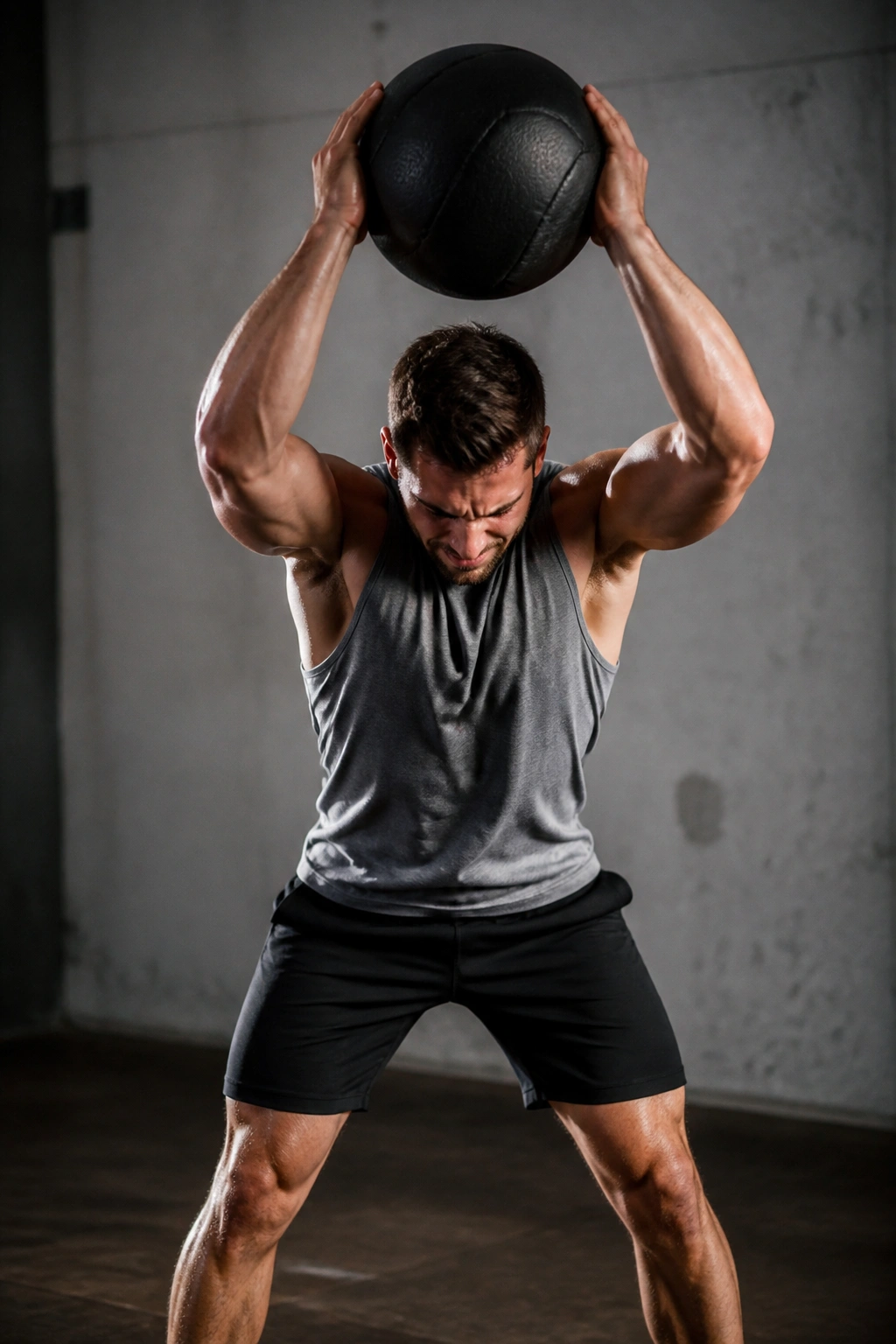
Sometimes you just need to exert force. Medicine ball slams are fantastic for cardio because they involve a total-body explosive movement followed by a brief recovery as you pick the ball up. It is a natural interval.
Technique for Maximum Impact
Select a ball that doesn’t bounce too much—a dead-bounce ball is ideal. If you use a bouncy ball, you lose the “pickup” portion of the movement, which is half the effort.
- Reach high overhead.
- Slam the ball into the ground between your feet.
- Use your core to pull the ball down—don’t just drop it.
The intensity comes from how hard you slam it. Aim to crush the floor. It is surprisingly cathartic and keeps the heart rate high.
9. Plyometric Box Jumps
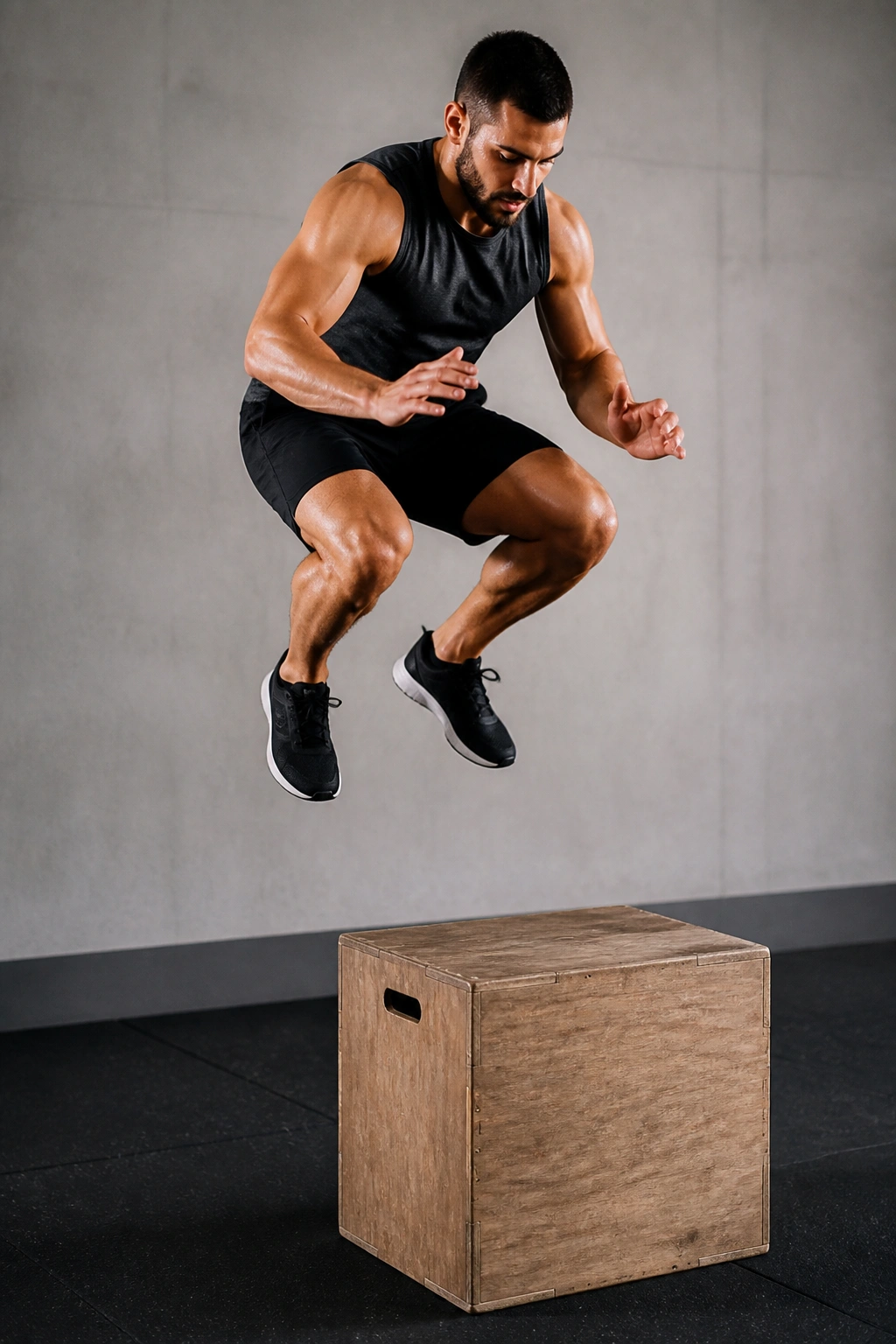
Explosive power is a marker of athleticism. Box jumps require you to engage your fast-twitch muscle fibers, which are often neglected in long, slow distance cardio. You have to be fully present to ensure you land safely, which keeps your brain engaged and prevents boredom.
Safety First
The biggest danger is missing the box. If you are tired, the risk of scraping your shins increases.
- Pick a height you can clear easily—don’t ego-jump.
- Land softly with your knees slightly bent.
- Step down; do not jump down (save your knees).
This is a quality-over-quantity exercise. Ten perfect jumps are better than twenty sloppy ones.
10. Swimming Laps

If you want the ultimate low-impact, high-intensity cardio, get in the water. Swimming forces you to regulate your breathing because you can only inhale when your face is out of the water. This builds incredible lung capacity.
Improving Your Stroke
Most people try to swim too fast. Focus on the glide. Reach as far as you can with each stroke, pull the water past your hip, and stay calm.
- Front crawl (freestyle) is the most efficient for calorie burn.
- If you get tired, switch to a breaststroke for a lap to recover while still moving.
The resistance of the water provides a full-body workout that no treadmill can replicate. You will find that even just twenty minutes of continuous swimming is exhausting.
11. Outdoor Hill Sprints

If stairs are the indoor king of cardio, hills are the outdoor king. Unlike a treadmill where the motor does some of the work, a hill forces you to overcome every inch of incline with raw force. There is no cheating a hill.
Finding Your Gradient
Look for a slope that takes you about 10 to 15 seconds to sprint up. Anything longer becomes a different type of endurance run. You want short, max-effort bursts.
- Sprint to the top.
- Walk down to recover.
- Repeat until your form starts to break down.
The benefit here is the biomechanics. Sprinting uphill naturally forces you to land on the balls of your feet and drive with your glutes, making it much safer on your joints than flat-ground sprinting.
12. Agility Ladder Drills

Agility ladders are not just for football players. They are incredible for developing foot speed and coordination. When you focus on where your feet are going, you cannot be bored. It is a puzzle for your nervous system.
How to Use the Ladder
Speed is the goal, but precision is the requirement. If you trip over the rungs, slow down.
- In-and-Outs: Step in with both feet, step out with both feet.
- Ali Shuffles: Lateral movement drills.
- Crossovers: Focus on hip mobility.
Do these for time, not reps. Set a timer for 30 seconds and move as fast as your feet will allow. You will be gasping for air within a few minutes.
13. Sled Push/Pull
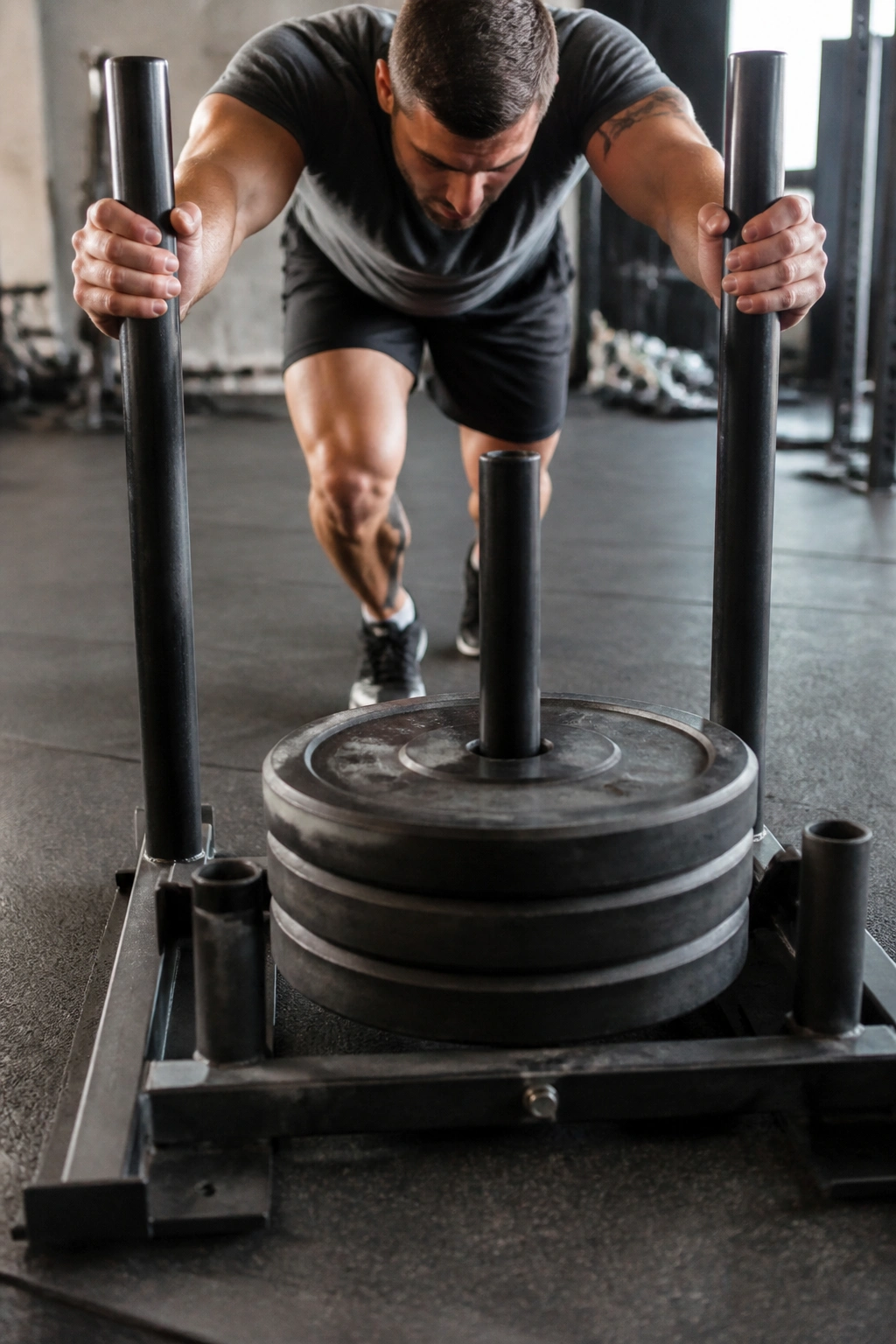
There is something primal about pushing a heavy object across a floor. The sled is a “non-eccentric” exercise, meaning there is no lowering phase that causes muscle soreness, allowing you to go hard more often. It is pure concentric work—just drive.
Loading the Sled
Start light. It is easy to load too much weight and end up just leaning against the sled rather than moving it. You want to be able to keep a steady, driving pace.
- Keep your arms straight and lock your elbows.
- Drive through the balls of your feet.
- Take short, choppy steps.
If you don’t have a sled, you can use a weighted tire. The effect is identical, and it often feels even more “old school” to push a tire.
14. Assault Bike Sprints
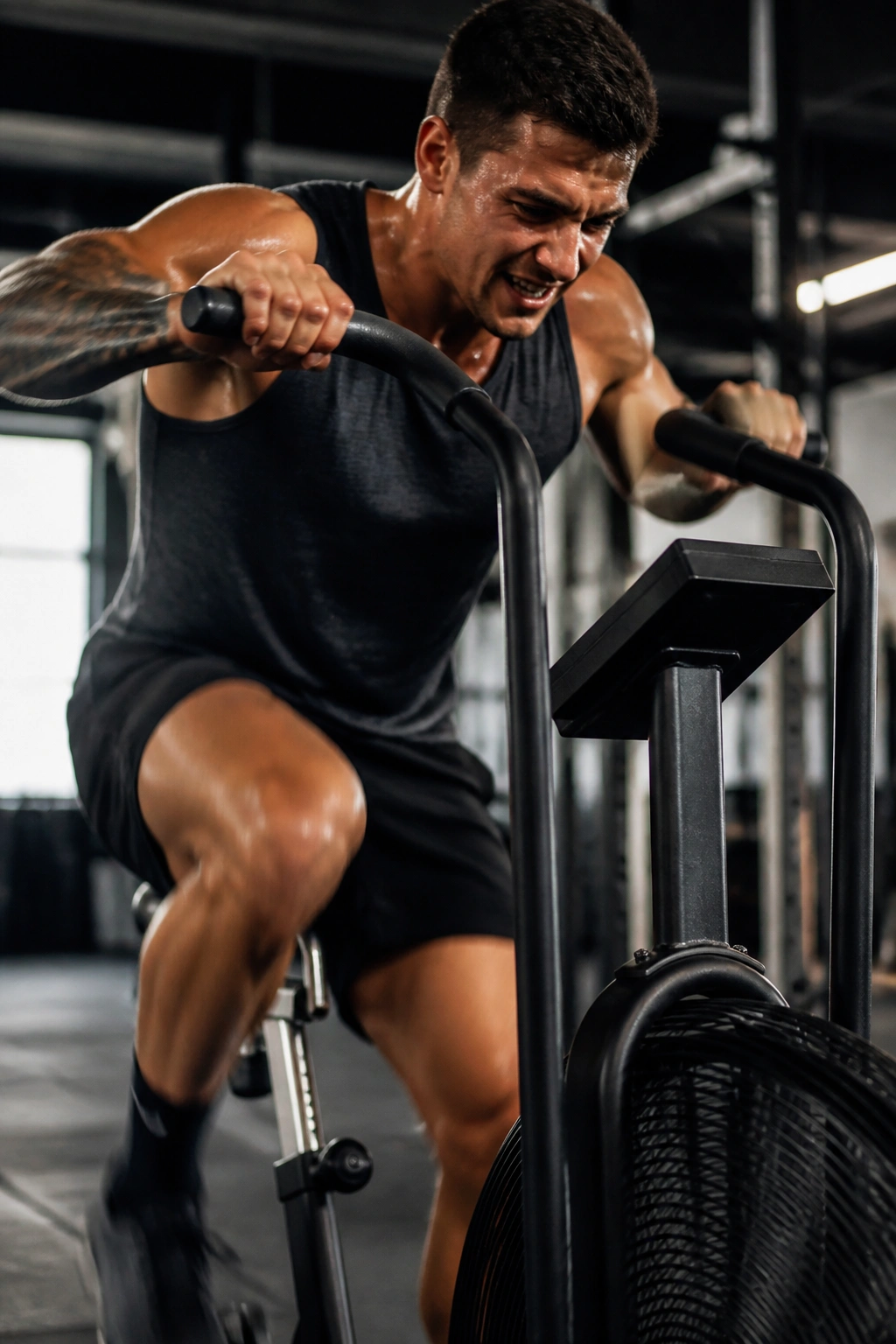
Also known as the “Air Bike,” this machine is the villain of every CrossFit gym. It uses a massive fan for resistance. The harder you push, the harder the resistance becomes. It is a self-regulating torture device that will humble even the fittest athlete.
The “Death” Interval
The most common protocol is the Tabata: 20 seconds of maximum effort followed by 10 seconds of rest.
- During the 20 seconds, push and pull with everything you have.
- During the 10 seconds, keep your legs moving slowly to flush the blood.
Do this for eight rounds. By round six, you will wonder why you ever complained about the treadmill.
15. Mountain Climbers
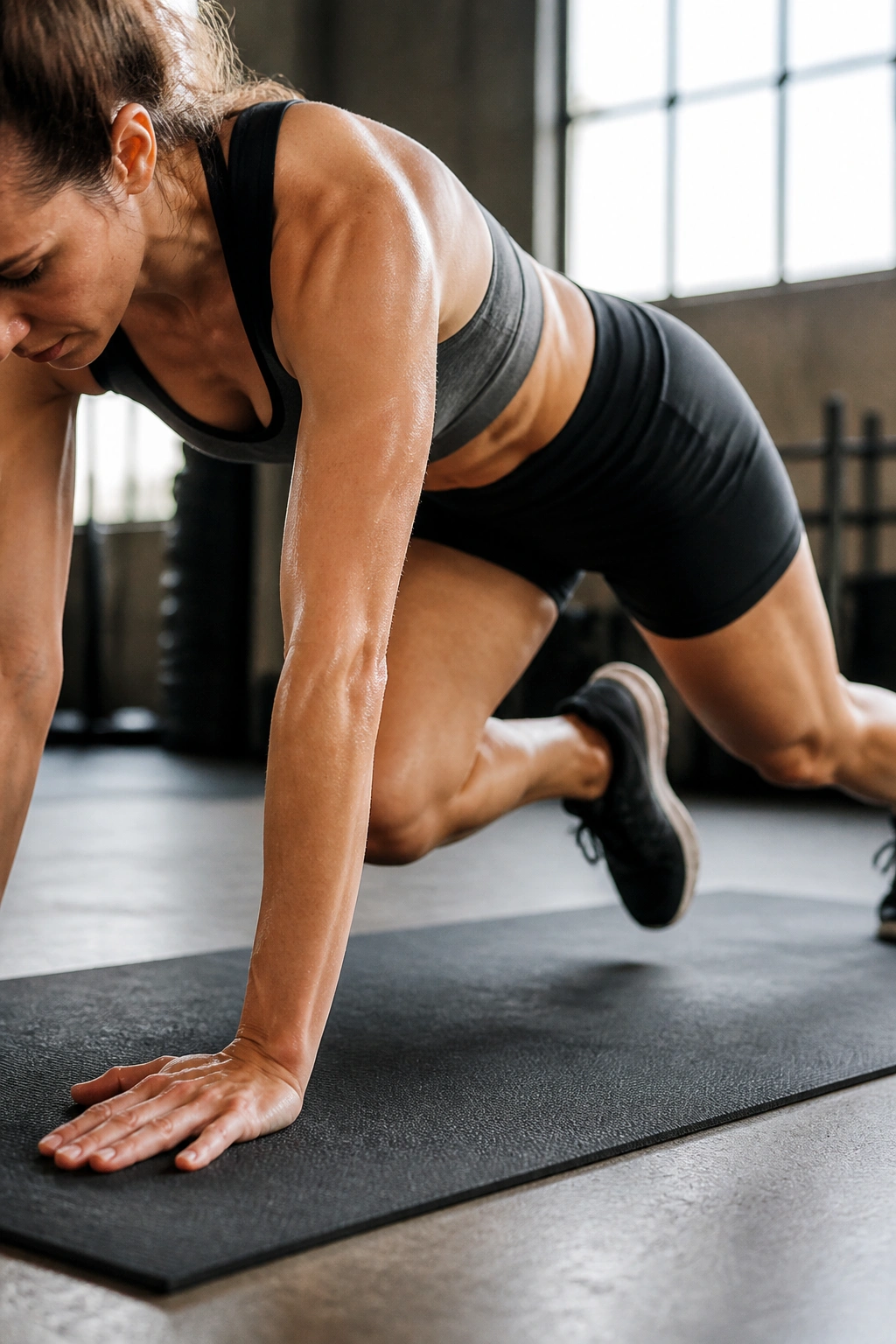
This is a core-focused cardio move that you can do anywhere. You start in a plank position and “run” your knees toward your chest. It is simple, but if you speed it up, it is incredibly demanding on your cardiovascular system.
Form Check
Do not let your hips sag toward the floor. Keep your back flat and your core tight. The moment your hips start bouncing up and down, you lose the effectiveness.
- Drive the knee toward the elbow.
- Keep the movement snappy.
- Maintain the plank position throughout.
Thirty seconds of high-speed mountain climbers will get your heart rate right into that “I can’t talk” zone.
16. Lateral Box Shuffles
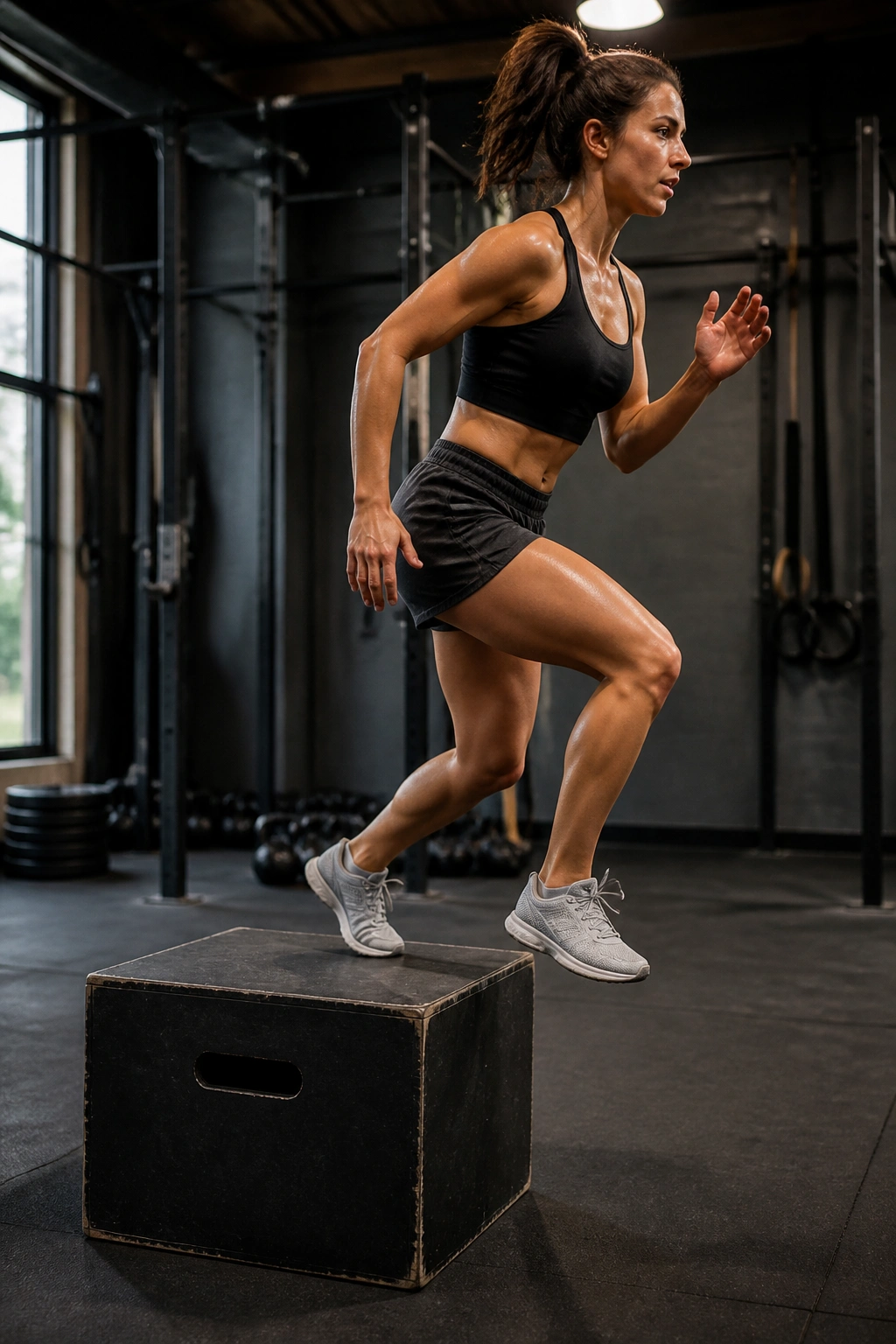
Most of our life is spent moving forward. We rarely move side-to-side, which is why lateral movements are so important for knee health and agility. A lateral box shuffle involves stepping up and over a box or a bench from the side.
The Lateral Benefit
This movement works your glute medius—the side muscle of your hip—which is crucial for stability. You are not just doing cardio; you are fixing movement imbalances.
- Keep your chest up.
- Push off the foot that is on the box.
- Maintain a rhythmic, bouncy tempo.
It’s easy to get lazy and just “step” across. Force yourself to jump/push off the box to keep the intensity high.
17. Bear Crawls
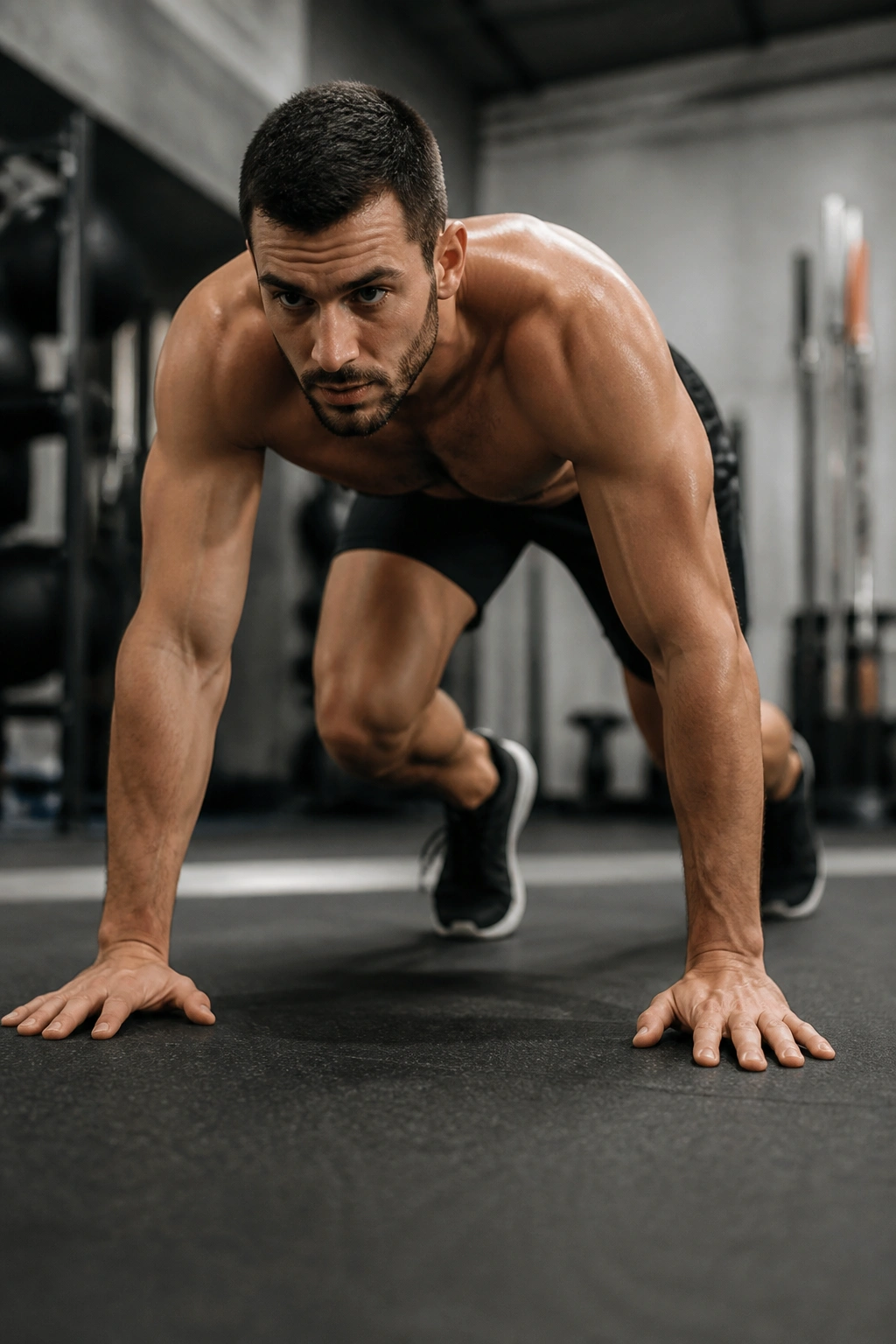
Bear crawls are a humbling experience. Walking on all fours requires total body coordination and immense core strength. It isn’t fast, but it is incredibly taxing.
Building the Crawl
Try to keep your knees close to the floor without touching it. This keeps the tension on your quads and core.
- Move opposite hand and opposite foot.
- Keep your back flat—imagine a glass of water on your spine.
- Go for distance (20-30 yards) rather than speed.
You will feel this in your shoulders, quads, and abs all at once. It’s a full-body conditioning tool disguised as a simple animal movement.
18. Farmer’s Carries

Pick up two heavy weights (kettlebells or dumbbells) and walk. That’s it. It sounds easy, but doing it for distance or time is a brutal test of grip, trap strength, and cardiovascular endurance.
The Focus
The cardio aspect comes from the fact that you are holding heavy tension while breathing under load. Your heart has to work hard to pump blood to your gripping hands and your stabilizing core.
- Stand tall—do not lean to one side.
- Retract your shoulder blades (pull them back).
- Walk with intent and speed.
This builds a “thick” physique and a rugged set of lungs. It is functional, gritty, and undeniably effective.
19. TRX Suspension Cardio

Suspension trainers allow you to use your body weight in ways that are impossible on the floor. You can do TRX mountain climbers, TRX jumps, and TRX sprints. The instability of the straps forces your core to work overtime.
Why Instability Matters
When the ground is stable, your body doesn’t need to work as hard to balance. By putting your feet or hands in straps, you are constantly fighting for control, which increases the metabolic cost of the exercise.
- Keep the straps taut.
- Do not let them sag.
- Focus on smooth, fluid transitions.
It adds a layer of mental focus that completely kills the boredom of the standard gym experience.
20. Heavy Bag Flow

Unlike shadow boxing, where you are punching the air, the heavy bag provides feedback. You can feel the impact. This allows you to really unload on the bag, which is a great stress reliever.
The “Flow” Approach
Don’t just hit the bag with one power punch after another. Mix it up. Two punches, a slip, move your feet, three more punches. Make it look like a dance.
- Stay light on your toes.
- Don’t push the bag; snap your punches through it.
- Focus on your breathing—exhale on impact.
If you have never done this, start with 30-second bursts. You will be surprised at how quickly your arms become heavy.
21. In-Place HIIT
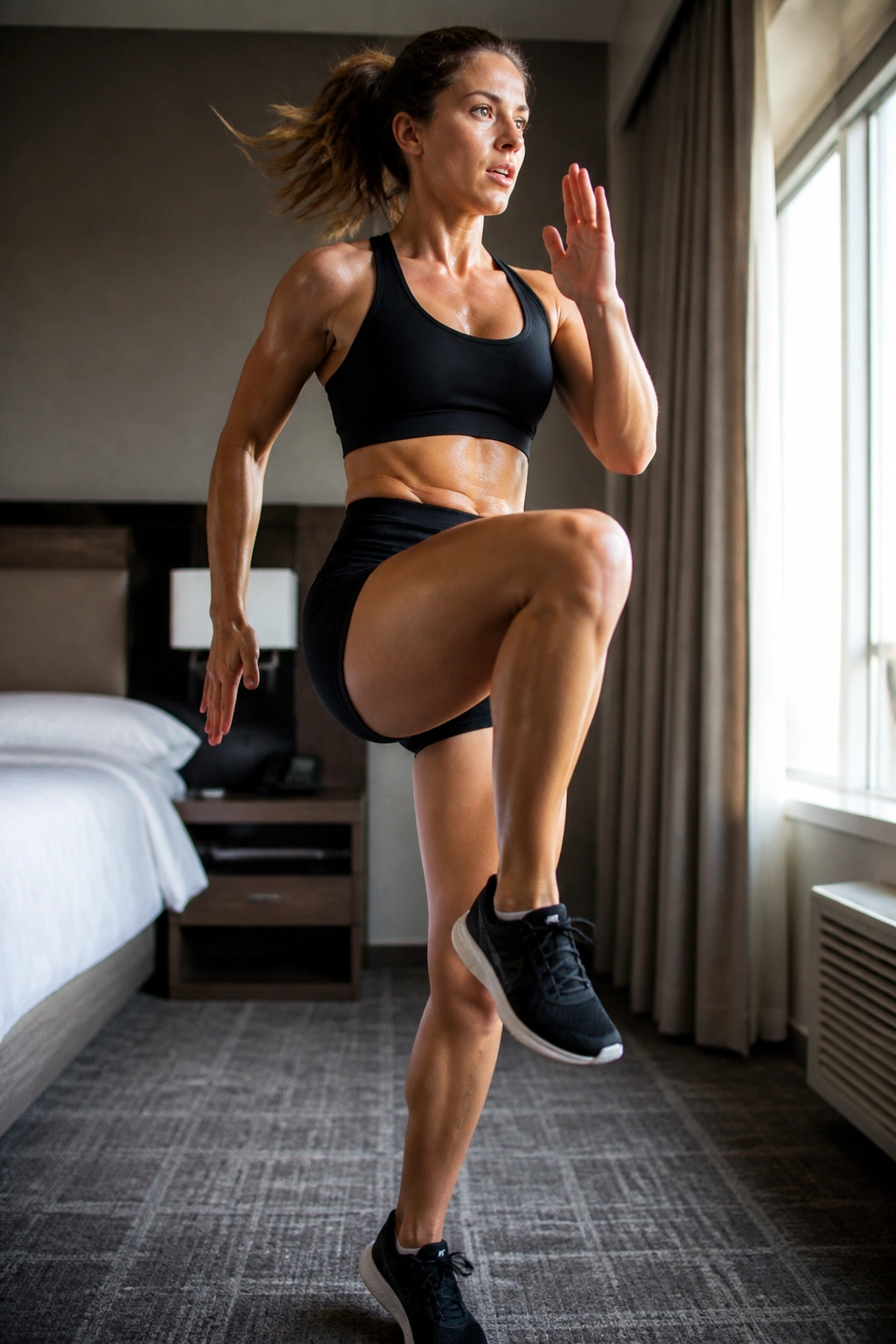
If you are trapped in a hotel room or a tiny corner of your living room, you don’t need a treadmill or a bike. You need high-knees and butt-kicks.
The Protocol
To make these effective, you must do them at maximum velocity. This is not a warm-up jog.
- High Knees: Pump your arms and drive your knees above waist height.
- Butt Kicks: Keep your chest upright and flick your heels up aggressively.
Combine these: 30 seconds of high knees, 30 seconds of butt kicks, 30 seconds of rest. Do this for ten minutes and you will be drenched in sweat.
22. Weighted Step-Ups
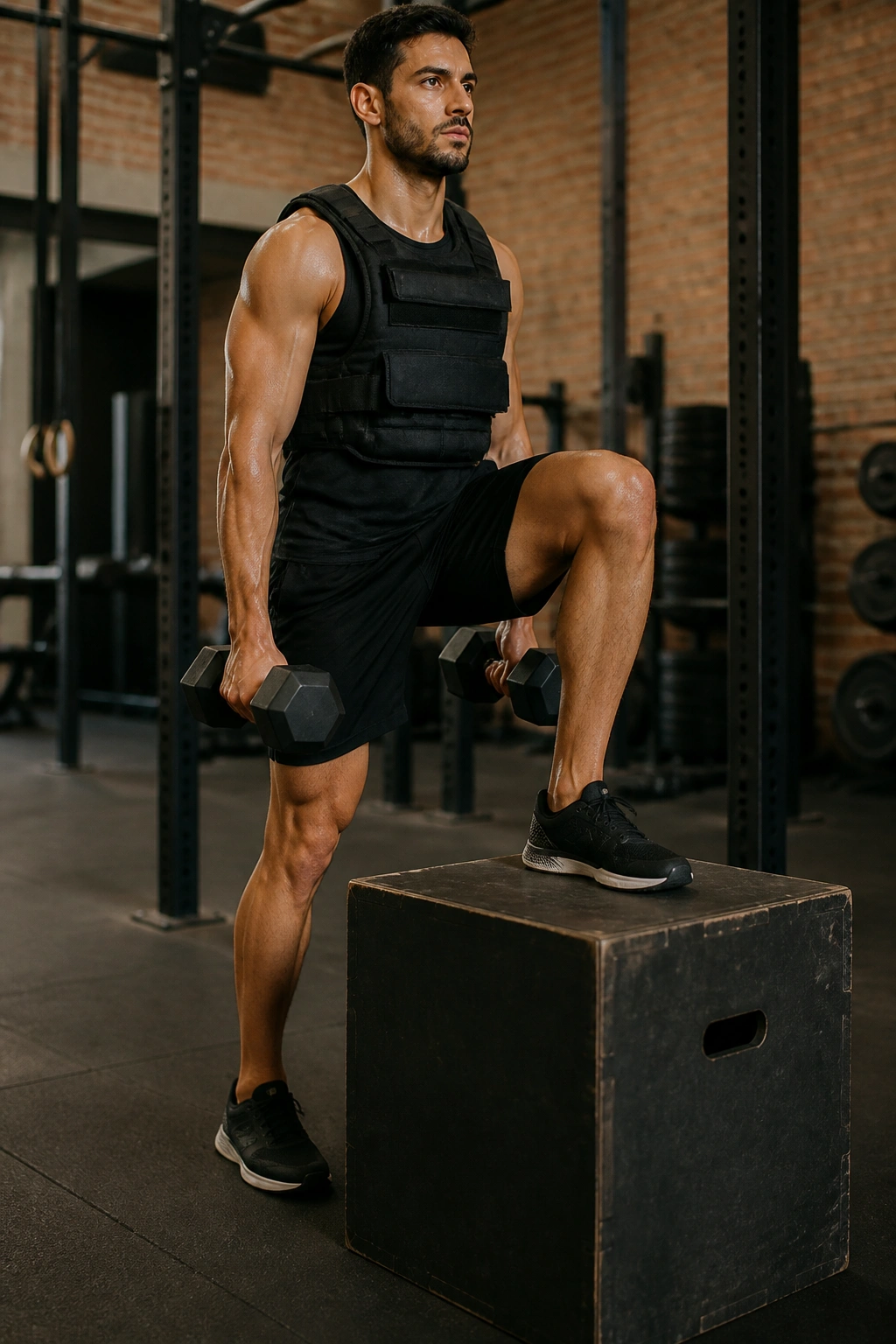
Step-ups are the most overlooked leg exercise in the gym. They are essentially single-leg squats, which makes them twice as hard as a regular squat. Adding a weight vest or holding dumbbells turns them into a high-intensity cardio session.
The Execution
Find a box or bench that puts your knee at a 90-degree angle when your foot is on it.
- Drive through the heel of the top foot.
- Do not push off the bottom foot; make the top leg do the work.
- Stay controlled on the way down.
Because this is a unilateral (single-side) movement, it is safer for your back and harder on your muscles than traditional bilateral squats.
23. Battle Rope Slams and Burpees

This is a combination finisher. It takes two of the best exercises on this list and merges them. It is designed to be the “final nail in the coffin” of your workout.
The Circuit
Perform 10 double-rope slams, followed immediately by 5 burpees. Repeat this cycle without resting.
- Keep the rope intensity high.
- Do not slow down on the burpees.
- The transition between the two movements is where you get the most conditioning.
Do this for 8 to 10 minutes, and you will understand why this combination is a staple in high-performance training centers.
24. Jump Squats

Jump squats are plyometric power. They force your muscles to contract explosively, which spikes your heart rate very quickly. It is all about the landing and the re-launch.
Landing Mechanics
You must land softly. If you sound like a bag of cement hitting the floor, you are setting yourself up for joint pain. Use your legs as shock absorbers.
- Squat to a half-depth position.
- Explode upward.
- Absorb the landing with bent knees and immediately go into the next rep.
Focus on the rhythm. If you lose the tempo, you lose the cardio effect.
25. The 100-Rep Circuit
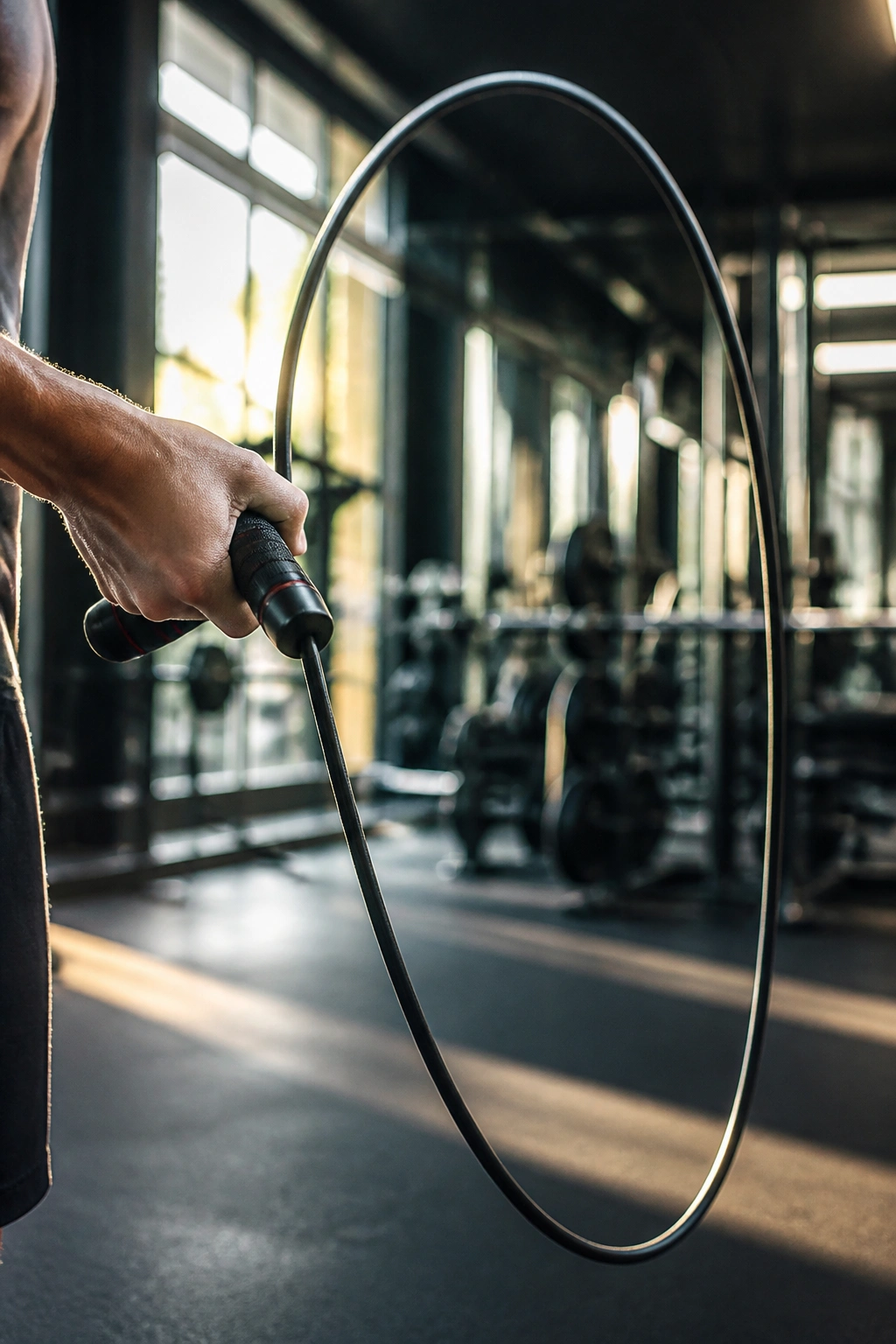
This is the ultimate boredom-killer. It is not about a specific machine; it is about a mission. You pick four exercises (e.g., 25 pushups, 25 bodyweight squats, 25 mountain climbers, 25 jumping jacks) and you cycle through them until you hit 100 reps of each.
Why This Works
The math is simple, but the execution is hard. You are not watching a clock; you are counting reps. Your brain focuses on the “what is next” rather than “how long is left.”
- Keep your rest intervals short.
- Do not sacrifice form to get the reps done faster.
- Keep a tally on a whiteboard or notebook.
It turns the workout into a game. If you can complete the 400 total reps in under 15 minutes, you have done a very high-quality piece of work.
Final Thoughts

The treadmill is not the only path to cardiovascular fitness. In fact, for many people, it is the path of least resistance—not in terms of effort, but in terms of engagement. When you stand on a belt, your brain goes to sleep. When you jump, climb, crawl, or swing, your brain has to stay in the game. That engagement is what keeps you consistent, and consistency is what produces results.
Do not be afraid to mix these movements. You don’t have to choose just one. A 15-minute circuit that incorporates jump rope, burpees, and kettlebell swings is infinitely more effective than 45 minutes of mindless jogging. Your body adapts to the stresses you place on it; if you only ever do steady-state cardio, your body only learns how to do that one thing. If you mix in agility, explosive power, and functional strength, you build a body that is capable of anything, not just moving in a straight line.
Start small. Pick three items from this list and create a circuit. Keep the rest periods short, keep your form tight, and for the love of everything, stop staring at the wall clock. If you are breathing hard and you aren’t bored, you are doing it right.
