



Burpees are rude.
That is exactly why they work. A hard set can jack your heart rate, load your shoulders, legs, and core at the same time, and leave you breathing through your mouth in under a minute. That kind of effort is why burpee workouts that burn belly fat earn their keep in a fat-loss plan — not because they magically melt the midsection, but because they help you spend more energy, build conditioning, and keep weekly movement high enough to matter.
The catch is simple. No workout trims fat from one spot. If your waistline changes, it’s because body fat is dropping overall, and burpees are part of the engine, not the whole car. Food intake, daily steps, sleep, and consistency still decide the outcome, even when the workout is doing the loud part.
I like burpee sessions that have a clear end point. Ladders, EMOMs, Tabata rounds, and short finishers beat the endless-flailing style every time. Your form stays cleaner, your pace is easier to repeat, and you can come back the next week without dreading the floor. That’s where the first workout starts.
1. The 20-Minute Burpee Ladder
A ladder works because it gives your lungs time to climb instead of fall off a cliff. Two burpees, then four, then six, then eight, then ten, then back down again. The early rounds feel almost polite. The middle turns ugly fast.
How to run the ladder
Do this for 20 minutes total:
- 2 burpees
- Rest 20 to 30 seconds
- 4 burpees
- Rest 20 to 30 seconds
- 6 burpees
- Rest 20 to 30 seconds
- 8 burpees
- Rest 20 to 30 seconds
- 10 burpees
- Then come back down: 8, 6, 4, 2
Keep every rep clean. If your landing gets loud or your lower back starts sagging in the plank, stop one rung earlier. That tiny adjustment matters more than bravado.
Why it works so well
The ladder format keeps your pace honest. You don’t sprint out of the gate, blow up, and spend the rest of the workout gasping. You build heat in a controlled way, which is exactly what most people need if they want a burpee workout they can repeat three times a week instead of once every two weeks.
Pro tip: if you’re newer, run a 1-2-3-4-3-2-1 ladder and cap the whole thing at 12 to 15 minutes. Same idea. Less drama.
2. Tabata Burpee Sprints

Why does 20 seconds feel longer than 2 minutes when burpees are involved? Because the move asks for power, coordination, and brute force at the same time. Tabata leans into that. It’s short, nasty, and weirdly efficient.
Set a timer for 8 rounds of 20 seconds on, 10 seconds off. During each work block, do as many crisp burpees as you can. During the rest block, stand still and breathe through your nose if you can manage it. That little reset is the whole point. You’re not trying to recover fully. You’re trying to keep the engine hot.
The version I like best is the standard burpee with a jump at the top, but that’s not the only choice. If your wrists or ankles complain, use a step-back burpee and keep the speed. The heart rate doesn’t care whether you jumped or stepped as much as the internet does.
The last two rounds tell you the truth. If your form turns into a wobble, slow the first six rounds by one rep each. That usually works better than trying to “make it up” in the final blast.
3. Burpee EMOM Workout

EMOM burpees are honest. Every minute on the minute means you do a set number of burpees at the top of each minute, then rest for whatever is left. If you finish in 18 seconds, you get 42 seconds to breathe. If you need 38 seconds, the workout quietly tells you you picked the wrong number.
Pick a rep count you can finish
Start with 10 minutes and choose one of these:
- Beginner: 4 burpees each minute
- Intermediate: 6 burpees each minute
- Advanced: 8 burpees each minute
The goal is not to race the first three minutes and collapse. It’s to finish every minute with the same pace, same shape, same control. That’s where the calorie burn gets sneaky. You’re working hard, but you’re also repeating the effort under fatigue, which is what makes the session useful.
What to watch for
- Chest touches the floor, if that’s part of your version.
- Hips don’t drop in the plank.
- The jump at the top stays small and sharp.
- You can still breathe between minutes.
Add one minute the next time before you add more reps. That order matters. A lot.
4. Burpee and Squat-Jump Circuits

If plain burpees bore you, pair them with squat jumps and let your legs complain about the paperwork. This circuit is a blunt way to push heart rate up while hammering the quads, glutes, and calves from a slightly different angle.
Try 4 rounds of this:
- 8 burpees
- 12 air squats
- 8 squat jumps
- 30 seconds of marching in place
The burpees spike the pulse. The squats keep the lower body under tension. The squat jumps add the explosive piece that turns the whole thing into a fatiguing, full-body grind. It’s a good choice if you want more leg work than a straight burpee session gives you.
Do not turn the squat jumps into half-hearted pogo hops. Land softly, knees tracking over toes, and take a breath before the next rep. Hard landings are noisy for a reason.
If 8 burpees per round feels like too much, drop to 5 and keep the rest of the circuit the same. The workout still works. It just hurts less in the first ten minutes, which is sometimes the smarter move.
5. Burpee Mountain-Climber Combos

What happens when you refuse to let the plank feel easy? You get this workout. Burpee mountain-climber combos keep the core under pressure after the floor phase, which is where a lot of people cheat without realizing it.
How to run it
Do 3 to 5 rounds of:
- 6 burpees
- 20 mountain climbers, alternating knees
- Rest 45 to 60 seconds
If you want to make it nastier, add a 3-second plank hold before each mountain-climber burst. That tiny pause forces you to brace before you start driving the knees in. It feels different fast.
The combination works because the burpee already taxes your shoulders and lungs. The mountain climbers keep your torso from fully relaxing between reps. There’s no real dead spot. You finish one part, and the next one steals the air right back.
How to scale it
- Shorten the climbers to 10 total.
- Step the burpee back instead of jumping.
- Rest 90 seconds between rounds if your lower back gets sloppy.
That last part matters. A sloppy plank is not “working harder.” It’s just messy.
6. The Burpee Pyramid

A pyramid is kinder than a straight sprint, but it still bites. Start low, build up, then come back down before your form turns to mush. That pattern is simple enough to remember and mean enough to feel effective.
Run it like this:
2, 4, 6, 8, 10, 8, 6, 4, 2 burpees
Rest 30 to 45 seconds between rungs. Keep the tempo steady. Don’t blast the first two rounds like you’re trying to prove something. The whole point is to save a little gas for the top, because 10 burpees after 8 burpees is where the workout starts talking back.
This is one of my favorite burpee workouts for people who get bored by identical sets. Every round has a different feel. The early ones are a warm-up. The middle is work. The top is a fight. Then the descent feels almost strange, because your lungs know the worst part already happened.
If you need a shorter version, stop at 8 burpees on top and run 2-4-6-8-6-4-2. Same shape. Less misery. Some days that’s exactly the right call.
7. Step-Back Burpees for Low-Impact Cardio

You do not need the jump to get the payoff. Step-back burpees are the version I use when someone wants the heart-rate spike without the pounding on the knees, ankles, or wrists. They’re also good when you’re tired but still want to move hard.
The simple setup
Do 30 seconds of work, 15 seconds of rest for 12 rounds. Each rep looks like this:
- Stand tall
- Reach hands to the floor
- Step one foot back, then the other, into plank
- Step one foot forward, then the other
- Stand and reach or do a small calf raise
That’s it. No jump. No rush to the floor. Still hard.
The trick is pace. If you move with purpose, step-back burpees can leave you sweating just as much as the jump version, especially once you hit round 8 or 9. They’re a nice reminder that fat loss work does not have to be dramatic to be useful.
If your wrists hate the floor, put your hands on a sturdy bench, a couch edge, or a pair of dumbbells. Small change. Big relief.
8. Burpee Push-Up Intervals

Unlike a plain burpee, this version makes your chest and triceps pay rent. The push-up slows the rep down a little, which sounds small until your arms start shaking on the third round.
What to do
Try 5 rounds of:
- 5 burpees with a push-up
- Rest 45 seconds
If full push-ups are too much, add the push-up only on every second burpee. That keeps the workout honest without turning it into a form disaster. The goal is still a clean burpee, not a sinking cobra pose with a jump at the top.
Form rules that matter
- Keep ribs tucked as you lower.
- Do not let hips sag in the push-up.
- Press the floor away hard at the top.
- Step back if the jump starts to ruin the rep.
This one is sneaky because it builds upper-body endurance while still driving the pulse. Your lungs get hit, then your chest, then your triceps, then your lungs again. That’s a good mix if you want a burpee workout that feels bigger than a cardio session.
9. Burpee and Lunge Alternations

One side is usually more asleep than the other. Lunges wake that up fast, which is why this pairing works so well. You get the full-body chaos of burpees, then you ask each leg to do its own job instead of hiding behind the stronger side.
A clean way to run it is:
- 6 burpees
- 8 reverse lunges on the right leg
- 8 reverse lunges on the left leg
- Rest 60 seconds
- Repeat for 4 rounds
Reverse lunges are easier on the knees for most people than forward lunges, and they keep the torso a little more upright. That makes them a better partner for burpees, which already ask a lot from the hips and core.
Why this one earns its place: the alternating work exposes balance issues. You feel it in the first set, usually around the moment one foot lands a little louder than the other. That’s useful feedback. It means your body is showing you where it cheats.
If you want more burn, turn the lunges into walking lunges for 10 steps per leg. Same idea. More leg fatigue. Less mercy.
10. The Burpee Density Challenge

This is the simplest way to turn burpees into a score. Set a timer, do clean reps, and try to beat your own number next time. No fancy structure. No excuses. Just a clock and a notebook.
Pick 10 or 12 minutes and do as many good burpees as you can. Count only the reps that look the way you want them to look. A sloppy half-rep does not count. That rule saves the workout from turning into a flop-and-jump contest.
A decent target for beginners is somewhere around 20 to 30 reps in 10 minutes. More experienced people can push past that, but the number is less important than the trend. One extra clean rep matters. Two fewer seconds of rest matters. A smoother landing matters.
How to progress it
- Add 1 minute to the timer.
- Add 2 total reps.
- Keep the same score but make the reps cleaner.
- Try a harder burpee version, such as a push-up burpee.
This style is useful because it stops you from hiding behind time alone. You can’t fake a density score. Either you got work done, or you didn’t.
11. Burpee-to-Plank Core Rounds
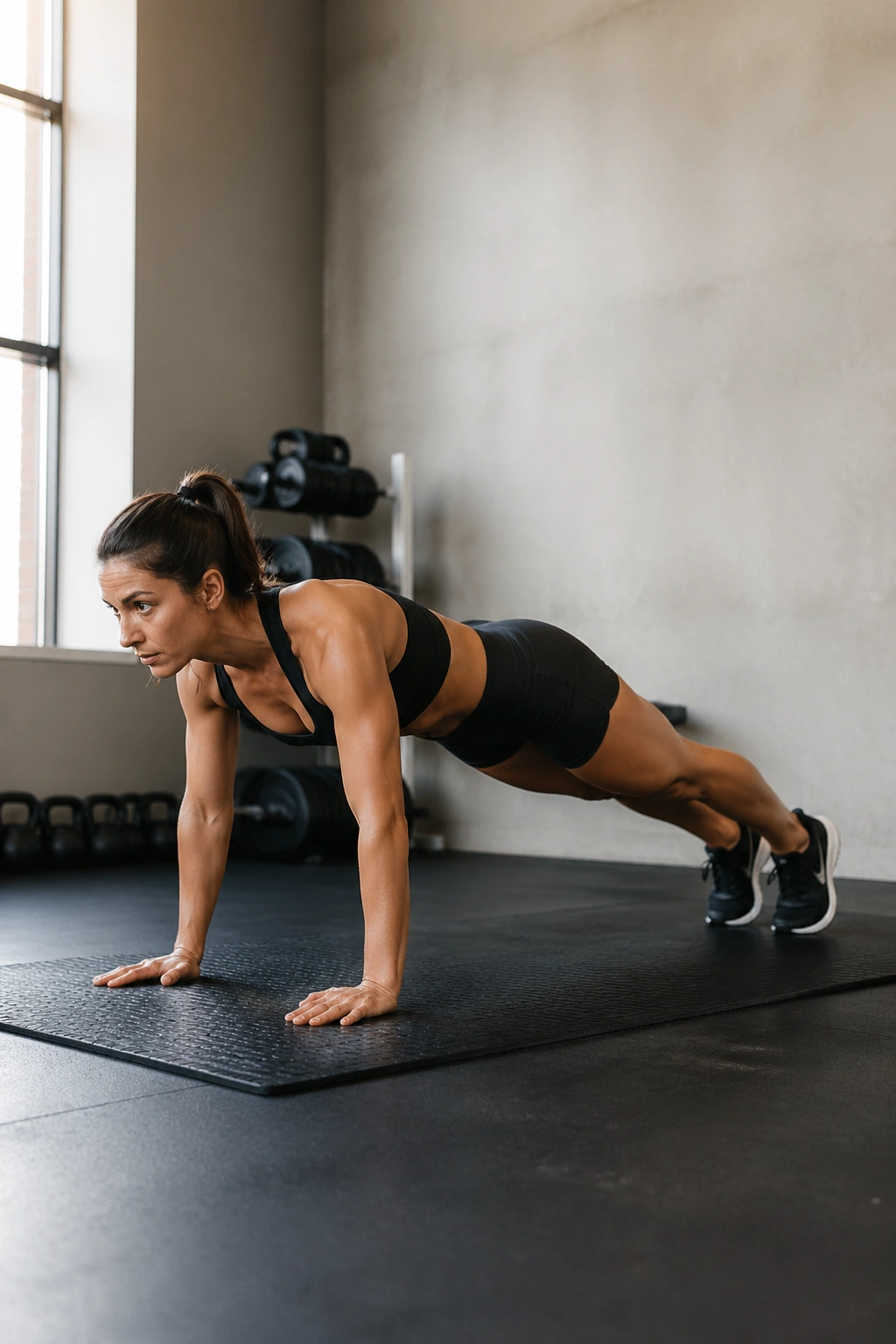
Want your core to work harder without adding a pile of crunches? Keep the plank alive after every burpee. That tiny pause changes the whole feel of the workout.
The setup
Do 4 rounds of:
- 8 burpees
- Hold plank for 3 seconds on the floor after the last rep
- 6 shoulder taps per side
- Rest 60 seconds
That plank hold sounds minor. It isn’t. The extra pause forces the abs, glutes, and shoulders to stabilize before you move again. If you rush through it, the workout turns into a bounce. If you hold it, the tension lands where it should.
What to feel
- Abs bracing, not sucking in
- Glutes squeezed lightly in plank
- Shoulders stacked over wrists
- Neck relaxed, not craned forward
If your wrists flare up, take the plank on forearms or step your feet back one at a time. The point is control. Not punishment.
This is a good choice for people who want a burpee workout that feels more athletic than frantic. You’ll still get the sweat. You’ll just get a stronger midsection feel along the way.
12. Burpee Shadow-Boxing Intervals

The breath has just enough time to settle, then the next burpee steals it back. That’s the rhythm here, and it’s a nice one if you want a session that feels fast without turning into nonstop jumping.
Run 6 to 8 rounds of:
- 20 seconds burpees
- 20 seconds shadow boxing
- 20 seconds rest
Use the shadow-boxing block as active recovery. Light jab-cross combos work fine. So do hooks, slips, and quick footwork in place. The point is to keep moving while your heart rate drops just enough to let the next burpee block land hard.
This format is especially useful if you hate long rests. You never fully cool off, but you also don’t get trapped in a single brutal effort with no relief. The contrast helps. Burpees spike the system. Shadow boxing keeps the shoulders busy and gives your legs a break from jumping.
If space is tight, stay in one spot and throw punches at chest height. Clean hands. Light feet. No need to turn it into a sparring match with the furniture.
13. The Reverse Ladder Burn

Starting high is mean on purpose. You get the hardest set first, when your ego still thinks it’s in charge. Then the workout gets a little easier, which is weirdly comforting and still unpleasant.
Try this:
10, 8, 6, 4, 2 burpees
Rest 30 to 45 seconds between rounds. If 10 is too much, start at 8 and descend from there.
The reverse ladder is a good choice when you want a workout that’s short and sharp. There’s no buildup. No gentleness. The first round sets the tone, and the rest of the session is you trying to hold that pace together without turning into a puddle on the floor.
I like this one for days when motivation is low but you still want something measurable. Five rounds. That’s it. You know exactly what you signed up for, and you can be done before your brain has time to argue.
If your rep speed drops by more than a second or two between sets, extend the rest to 60 seconds. That usually saves the quality of the whole session.
14. Mixed-Pace Burpee Intervals

Forty seconds at a calm pace and twenty seconds at a hard pace feel like two different sports. That’s the point. Mixed pacing teaches you not to explode too early, which is where a lot of burpee workouts go sideways.
How to run it
Do 6 rounds of:
- 40 seconds at a steady pace
- 20 seconds at a hard pace
- Rest 40 seconds
During the steady block, move with control. No sprinting. No rushing the floor. During the hard block, pick up the pace and shorten the transitions. You’re not trying to be sloppy. You’re trying to be faster without losing shape.
This one is useful because it gives you a rhythm to learn from. A lot of people only know two speeds: lazy and frantic. Mixed pace burpees sit between those extremes and teach your body to recover while still working.
What to watch
- Keep the plank tight in both blocks.
- Make the jump small in the hard block.
- Use the steady block to breathe through your nose if you can.
That rhythm trains better pacing than pure all-out work. And pacing matters more than people want to admit.
15. Burpee Finisher Workout

If you only have ten minutes, use them here. A good finisher is short enough to survive on busy days and hard enough to feel like it counted. This one is simple, repeatable, and mean in the right way.
Do 10 minutes of:
- 30 seconds burpees
- 30 seconds rest
If you want a slightly smoother version, switch to 40 seconds on, 20 seconds off for 8 to 10 rounds. If your body is already tired from lifting or another cardio session, use step-back burpees or half burpees and keep the pace moving.
The point of a finisher is not to set a record every time. The point is to finish a workout with a clean dose of extra work that helps drive total calorie burn and keeps your conditioning honest. That can matter a lot when you’re trying to trim the waistline and you know the rest of the day will be a little too quiet.
Track one thing: total reps. If the number goes up over time, the workout is doing its job. If it doesn’t, check your rest, your sleep, and how often you’re actually training. The mirror changes slowly. The notebook usually tells the truth first.
The smartest burpee plan is the one you can repeat without wrecking the next day. Two or three of these sessions a week, plus walking and sane food choices, will beat one heroic burst followed by a full collapse. Keep the form clean, keep the rep count honest, and keep the rest periods real. That is where the work adds up.
