



The biggest hurdle to fitness isn’t a lack of ability; it is the mental friction of carving out an hour for the gym. Life happens in the gaps between commitments, and sometimes those gaps are small. You have fifteen minutes before a meeting, or perhaps while the kids are occupied, or maybe just before you start dinner. That window is not wasted time; it is actually the sweet spot for a specific type of physiological stress.
High-intensity interval training, or HIIT, does not need to be an hour-long ordeal to be effective. In fact, the biological response to high-intensity work is largely independent of duration once you cross a certain threshold of intensity. You are not just burning calories while you move; you are creating an “afterburn” effect known as excess post-exercise oxygen consumption (EPOC). This keeps your metabolic rate elevated long after you have finished your shower and returned to your desk.
Consistency often outweighs duration in the long run. Spending fifteen minutes moving with genuine purpose three or four times a week will consistently outperform a single sixty-minute session that you inevitably skip because your schedule got complicated. Forget the idea that you need a complex gym membership or a room full of expensive equipment. Your own body, gravity, and a bit of focused effort are all that is required to change your internal chemistry.
1. The Classic Tabata Bodyweight Drill
The Tabata protocol is the gold standard for short-duration intensity. You work for twenty seconds at absolute maximum effort, followed by ten seconds of complete rest. You repeat this cycle eight times, totaling four minutes of work. For a fifteen-minute workout, you can perform three distinct Tabata blocks with a minute of active recovery—like walking in place—between each.
Why This Works
The structure forces your heart rate into the anaerobic zone rapidly. Because you are resting for only ten seconds, your body never fully recovers before the next round. This creates a cumulative fatigue that spikes your heart rate and forces your cardiovascular system to adapt to the stress.
The Protocol
- Round 1 (Burpees): Maximum reps for 20 seconds.
- Rest: 10 seconds.
- Repeat: 8 times.
- Transition: 1 minute of light walking.
- Round 2 (Mountain Climbers): Keep hips level.
- Round 3 (Air Squats): Focus on depth.
Pro Tip: Use a timer app specifically designed for intervals. Do not try to count in your head while you are gasping for air; you will lose track and likely cheat yourself on the intensity.
2. The EMOM Full-Body Sprint
EMOM stands for “Every Minute on the Minute.” You start a task at the beginning of a minute, finish it as quickly as you can, and then rest for the remainder of that minute. When the next minute hits, you start the next task. This format is brilliant because it rewards efficiency.
How to Structure It
You have fifteen minutes, so you have fifteen minutes to cycle through three different movements.
- Minute 1: 15 Burpees.
- Minute 2: 20 Jump Squats.
- Minute 3: 30 Mountain Climbers.
Repeat this cycle five times. If you finish your 15 burpees in 40 seconds, you get 20 seconds of rest. If you take 50 seconds, you only get 10. The goal is to move with enough speed to earn that rest, but enough control to avoid injury.
What to Watch For
If you find yourself consistently getting less than 15 seconds of rest, you are pushing too hard at the start. Dial back the rep count slightly. It is better to complete a fifteen-minute session with consistent rest than to burn out in the first five minutes and struggle to finish.
3. High-Intensity Burpee Pyramid
Burpees are the ultimate efficiency move. They engage your chest, shoulders, legs, and core, all while driving your heart rate through the roof. A pyramid structure keeps things mentally interesting because the work capacity changes every minute.
Start by doing one burpee in the first minute. In the second minute, do two. In the third, do three. Continue this until you hit the fifteen-minute mark. If you feel like you can go faster, double the increase—two, four, six, eight—or triple it.
Scaling the Effort
This workout is deceptive. The first five minutes feel remarkably easy, leading to a false sense of security. Around the ten-minute mark, the cumulative fatigue will hit you all at once. When you reach that point, focus on your breathing. Keep your rhythm steady—in through the nose, out through the mouth—to keep from hyperventilating.
4. Mountain Climber Endurance Test

This workout focuses entirely on the core and cardiovascular output. It is deceptively simple and requires zero space. You remain in a high-plank position for the duration, which places a massive demand on your stabilizer muscles.
The 15-Minute Protocol
- 45 Seconds: Fast mountain climbers (drive your knees toward your chest).
- 15 Seconds: Hold a static high plank.
- Repeat: 15 times without stopping.
The trick here is to keep your back flat. As you get tired, your hips will naturally want to rise toward the ceiling. Force your core to stay engaged. If your shoulders begin to burn, that is normal. Keep the pace consistent. Do not try to sprint the first three rounds only to collapse by round five.
5. Lunge and Squat Power Circuit

Leg workouts are inherently taxing because they involve the largest muscle groups in the body. Using them in a HIIT format creates a massive calorie burn and significant metabolic demand.
- 40 Seconds: Bodyweight Jump Squats.
- 20 Seconds: Rest.
- 40 Seconds: Alternating Reverse Lunges.
- 20 Seconds: Rest.
Repeat this cycle five times for a total of fifteen minutes. The jump squats provide the explosive power, while the lunges help stabilize the knees and hips. Keep your chest up during the lunges—if you lean forward too much, you put unnecessary strain on your lower back.
6. The “Ladder” Push-Up and Sit-Up Challenge

This is a classic conditioning protocol. You are alternating between an upper-body push (push-ups) and a core contraction (sit-ups). By switching between groups, you allow one to rest while the other works.
Set a timer for 15 minutes.
- Do 5 push-ups, then 10 sit-ups.
- Then do 6 push-ups, 12 sit-ups.
- Continue increasing by 1 rep for push-ups and 2 for sit-ups.
See how high you can climb before the timer goes off. The key is strict form. A push-up where your chest doesn’t touch the floor doesn’t count. A sit-up where you yank on your neck to get up doesn’t help your abs. Keep it clean.
7. Plyometric Jump Intervals

Plyometrics are explosive movements that build speed and power. They are excellent for burning fat, but they are high-impact. If you have joint issues, consider a lower-impact variation, but for most, these are the fastest way to get a heart rate spike.
The Circuit
- Jump Squats: 30 seconds.
- Tuck Jumps: 30 seconds.
- Lateral Skater Jumps: 30 seconds.
- Rest: 30 seconds.
Complete this circuit ten times. The lateral skater jumps are particularly good for ankle stability and balance. When you jump, land softly. Do not land flat-footed; always aim to absorb the impact through the balls of your feet and then your heels.
8. Core-Focused Metabolic Finisher

Many people think core workouts mean endless crunches. True core strength for fat loss comes from compound movements that require the midsection to brace against gravity.
- 30 Seconds: Plank Jacks (plank position, jump feet out and in).
- 30 Seconds: Bicycle Crunches.
- 30 Seconds: Russian Twists.
- 30 Seconds: Rest.
Run through this four-move cycle seven times for a 14-minute workout, then add a final one-minute static plank to finish. The combination of the plank jacks (cardio) and the abdominal-specific movements keeps the heart rate high while building functional core strength.
9. Dumbbell Swing and Press Protocol

If you have a set of dumbbells or a single kettlebell, you can drastically increase the efficiency of your fifteen minutes. The hinge movement of a swing works the posterior chain—hamstrings, glutes, and lower back—which are often ignored in standard workouts.
- 45 Seconds: Swings (or Kettlebell Swings).
- 15 Seconds: Rest.
- 45 Seconds: Overhead Press.
- 15 Seconds: Rest.
Repeat for fifteen minutes. The swing should be a hip-snap movement, not a squat. Think of it like snapping your hips into a wall rather than sitting down. If you do not have weights, perform this using a heavy backpack or even a gallon jug of water.
10. Jump Rope High-Intensity Intervals

The jump rope is arguably the most efficient cardio tool ever invented. It requires coordination, timing, and constant core engagement. In a HIIT format, it is lethal.
- 1 Minute: Standard jump (as fast as possible).
- 30 Seconds: High knees (while jumping or just running in place).
- 30 Seconds: Rest.
Do this for ten rounds. If you trip on the rope, don’t get frustrated; just reset and immediately pick it back up. The time you spend resetting is still part of the workout, so keep it brief. It is about total movement time, not perfect execution.
11. High-Knee Speed Session

Sometimes the simplest movements are the best. High knees are essentially running in place with exaggerated hip flexion. It sounds easy until you try to do it for fifteen minutes straight with interval breaks.
- 40 Seconds: High-intensity high knees (get them to waist height).
- 20 Seconds: Low-intensity walking or jogging in place.
Repeat this fifteen times. The key to burning calories here is the height of your knees. If you are just doing a light shuffle, you aren’t getting the HIIT benefit. Drive the knee up, engage the core, and use your arms to pump in rhythm.
12. Plank-Based Metabolic Finisher

This session is designed to test your mental resolve as much as your physical endurance. You will stay in a plank-related position for nearly the entire fifteen minutes.
- 1 Minute: Plank to Push-Up (moving from elbows to hands).
- 1 Minute: Plank Jacks.
- 1 Minute: Rest.
Perform five rounds. Moving between the elbow and hand positions is harder than it looks because it requires the core to prevent the hips from swaying. If you feel your hips rotating, widen your feet to create a more stable base.
13. Lateral Movement Drills

Most people move only in the sagittal plane—forward and backward. HIIT workouts should incorporate lateral (side-to-side) movement to challenge the muscles in the hips and glutes that are rarely used in daily life.
- 30 Seconds: Lateral Shuffles (touching the ground at each end).
- 30 Seconds: Side Lunges.
- 1 Minute: Rest.
Perform six rounds. The touch-down is essential—it forces you to hinge at the hips, ensuring your glutes are doing the work, not your back. Speed is the priority for the shuffles; depth is the priority for the lunges.
14. The “Down-Up” Full Body Sprint

This is a variation of a burpee that skips the push-up, allowing for a higher volume of repetitions in a shorter amount of time. It keeps the heart rate sustained at a high level.
- 45 Seconds: Down-ups (hands to floor, jump feet back, jump feet forward, stand).
- 15 Seconds: Jump squats.
Complete seven rounds. The key to the down-up is the explosive return to a standing position. When you jump your feet back, keep them together. When you bring them forward, land them slightly outside your hands so you can stand up without hunching over.
15. Kettlebell or Weighted Squat and Press
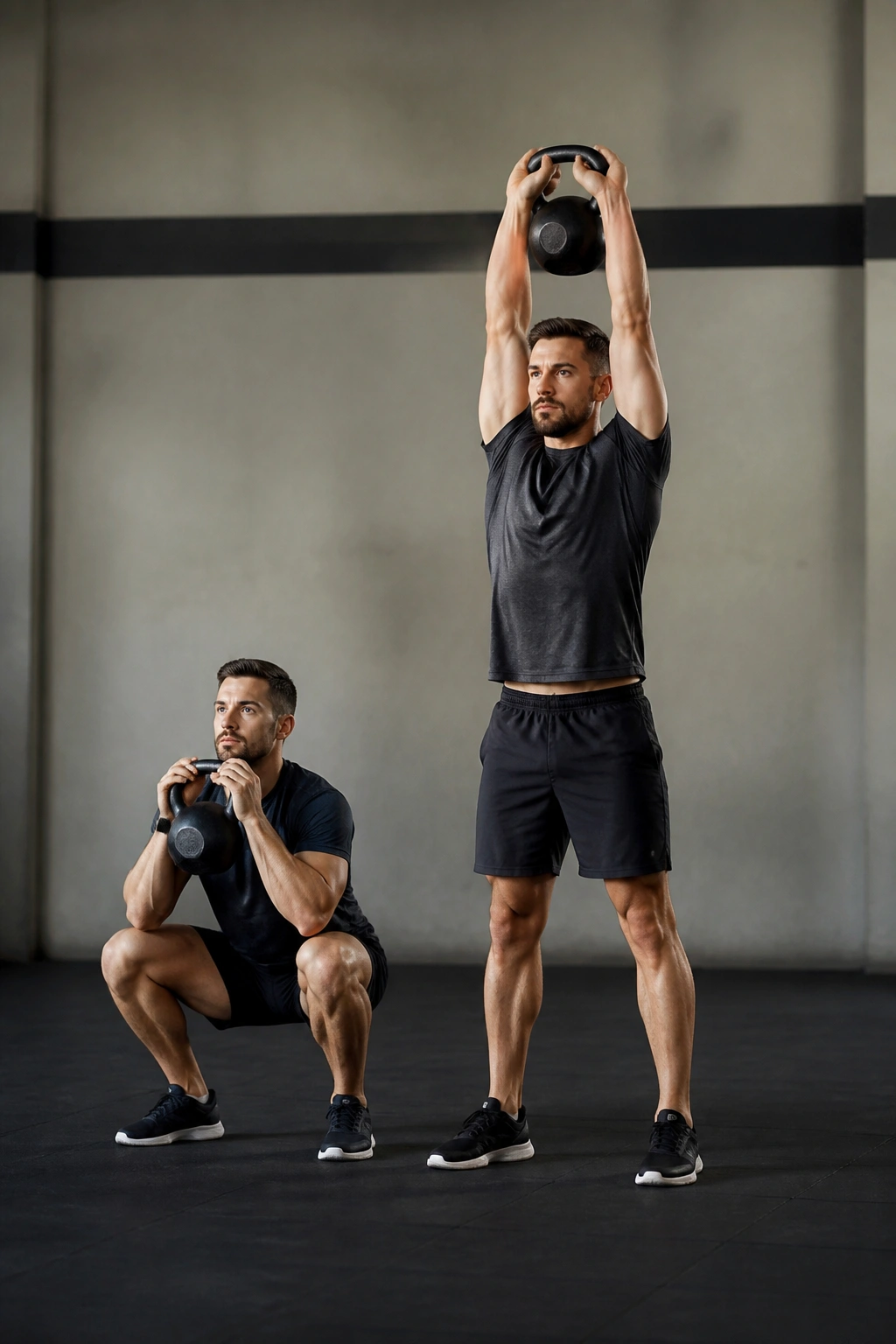
Combining a lower-body movement with an upper-body movement increases the total energy expenditure. This is a “thruster” pattern, which is a staple of high-intensity functional training.
- 45 Seconds: Thrusters (Squat down, press weight overhead as you stand).
- 15 Seconds: Rest.
Repeat this for fifteen minutes. This is a very demanding movement. Choose a weight that you can move safely for 45 seconds straight. If you find your form breaking down, reduce the weight immediately. A thruster is only useful if it’s performed with full range of motion.
16. Shadow Boxing HIIT

You do not need to be a boxer to shadow box. The combination of footwork, core rotation, and arm movement makes this an excellent full-body HIIT workout that is easy on the joints.
- 1 Minute: Jab/Cross/Hook combination (keep moving).
- 30 Seconds: High-intensity shuffling or jumping.
- 30 Seconds: Active recovery.
Repeat for seven rounds. Keep your core tight the whole time; all your power comes from your hips, not your shoulders. If you just wave your arms around, you aren’t getting a workout. Punch with intent, retract your hand quickly, and keep your guard up.
17. Split-Squat Endurance

Split squats (or lunges where you stay in the same position) are incredible for isolating the legs and building endurance. Doing them in a HIIT format is a recipe for very sore, very strong legs.
- 30 Seconds: Right-leg split squats.
- 30 Seconds: Left-leg split squats.
- 30 Seconds: Burpees.
- 30 Seconds: Rest.
Perform five rounds. The transition between legs is key; try not to rest between the right and left sides. This keeps the legs under constant tension, which is what forces the metabolic adaptation you are looking for in a short session.
18. The “50-10” Split

The 50-10 split is a classic for a reason. You work for 50 seconds and rest for 10 seconds. That 10-second rest is just enough to take two deep breaths before you go again. It is grueling, but it is effective.
- 50 Seconds: Mountain Climbers.
- 10 Seconds: Rest.
- 50 Seconds: Air Squats.
- 10 Seconds: Rest.
- 50 Seconds: Push-ups.
- 10 Seconds: Rest.
Cycle this for 15 minutes. Because the work interval is long, you must pace yourself. Do not go at 100% effort in the first 10 seconds or you will gas out by the 30-second mark. Aim for 80% effort—a pace you can maintain for the full 50 seconds.
19. Explosive Tuck Jumps

Tuck jumps are high-intensity and high-impact. They require you to jump as high as you can and bring your knees to your chest.
- 20 Seconds: Tuck jumps (maximum effort).
- 40 Seconds: Slow-paced walking or standing rest.
Do this for 15 rounds. The 40-second recovery is necessary because tuck jumps are extremely taxing on the central nervous system. Do not try to shorten the rest; your goal is to make every 20-second interval as explosive as humanly possible. If you can’t get your knees up, your power output has dropped, and you should rest more.
20. The “Everything” Finisher

If you are at the end of your fifteen minutes and want to ensure you have left nothing in the tank, use this final, brutal combo.
- 1 Minute: Burpees.
- 1 Minute: Jumping Jacks.
- 1 Minute: High Knees.
- 1 Minute: Mountain Climbers.
- 1 Minute: Plank.
Repeat three times. This utilizes every part of the body and every energy system. It is the ultimate way to cap off a high-intensity session. By the time you hit that third plank, your core should be shaking. That is the point.
Final Thoughts

The beauty of these fifteen-minute sessions lies in their simplicity. You do not need to overthink the science or the equipment. You just need to show up and perform the movements with as much intensity as you can safely manage.
Consistency is the hidden variable that determines success. A fifteen-minute workout that actually gets done is infinitely better than a sixty-minute workout that sits on a calendar, untouched. Listen to your body—if you feel sharp pain, stop—but if you feel that familiar, burning fatigue that signals you are working hard, you are exactly where you need to be. Pick one of these routines, set a timer, and get to work. Your body will adapt to the stress, and the results will follow.
