



HIIT—High-Intensity Interval Training—is not about finding the easiest path to calorie burn. It is about voluntary discomfort. If you are doing it right, you should be checking the clock every ten seconds, praying for the interval to end. That specific physiological demand is what triggers the metabolic adaptations that make this training style so effective for shedding body fat while trying to cling onto your hard-earned muscle mass.
The beauty of these sessions lies in their efficiency. You do not need an hour. You do not need to read a magazine while pedaling a stationary bike at a casual pace. You need maximum effort for short windows of time, followed by recovery that is just long enough to let you do it all over again. If you can talk during the work intervals, you are not working hard enough.
Many people make the mistake of thinking HIIT is a specific type of exercise. It is not. It is a protocol. You can apply it to rowing, sprinting, bodyweight movements, or heavy lifting. The goal is to spike your heart rate into that anaerobic zone—where your body screams for oxygen it cannot immediately get—and then force your metabolism to play catch-up for hours afterward.
1. The Classic Tabata Sprint
You have likely heard of Tabata, but most people butcher it. It is not “go until you are tired.” It is a precise mathematical formula: twenty seconds of absolute, balls-to-the-wall effort, followed by ten seconds of total rest. Repeat this eight times. That is one four-minute cycle.
Why This Hurts
The ten-second rest is barely enough to take a breath. By the fifth or sixth round, your nervous system will start to fatigue, and your power output will drop. That is the point. You want to reach a state where you are fighting to maintain your intensity.
How to Execute
- Choose a movement that allows for high power output: air bike, rowing machine, or sprint intervals.
- Set a timer for twenty seconds of work.
- Perform the movement with 100 percent intensity.
- Rest for exactly ten seconds.
- Repeat for eight rounds.
Pro tip: Do not pace yourself on the first two rounds. If you hold back, you have defeated the purpose. You should feel physically spent by the eighth interval.
2. EMOM Burpee Hell
EMOM stands for “Every Minute on the Minute.” This is a test of mental fortitude just as much as physical capability. The premise is simple: pick a number of reps you want to achieve, complete them within the minute, and use whatever time remains as your rest.
If you finish your reps in forty seconds, you get twenty seconds of rest. If you are slow and take fifty-five seconds, you only get five seconds to recover before the next minute starts. This creates a self-regulating intensity trap. As you get tired, your rest decreases, which makes you tire even faster.
For fat burning, aim for 12 to 15 burpees per minute. If you can consistently hit that, you are moving fast enough to keep your heart rate in the stratosphere. If you start to slow down to 8 or 9 reps, you are resting too much. Keep the work density high.
3. Kettlebell Swing and Thruster Complex
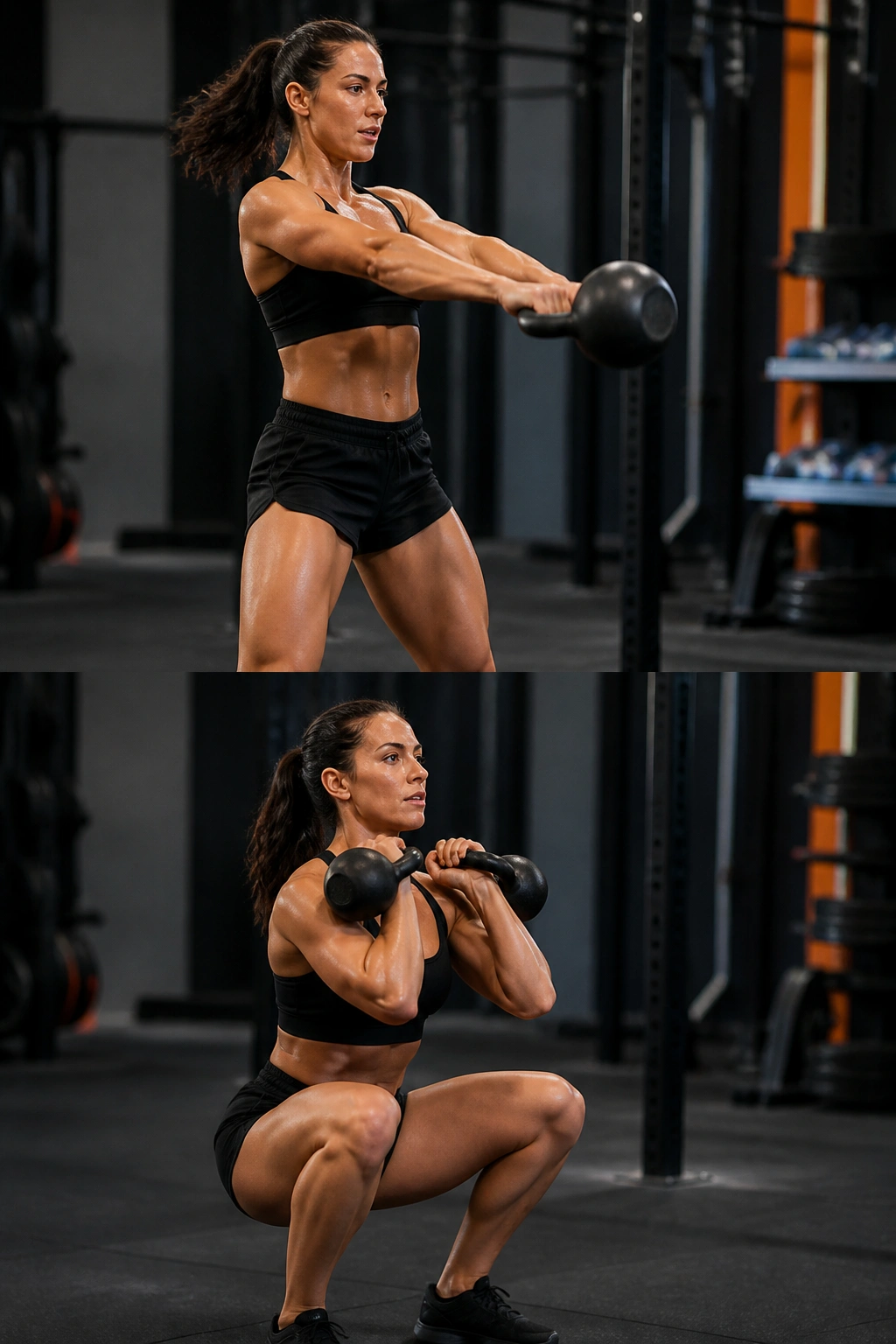
Why do people ignore the kettlebell for HIIT? It is arguably the best tool for the job. It combines resistance training with cardiovascular demand. By pairing a high-output movement like the swing with a full-body movement like the thruster, you force blood to shunt back and forth between your upper and lower body.
The swing primarily hammers your posterior chain—glutes, hamstrings, and lower back—while the thruster burns the quads and shoulders. When you alternate these, you create a metabolic demand that is hard to replicate with standard steady-state cardio.
The Protocol
- Perform 30 seconds of heavy kettlebell swings.
- Rest for 15 seconds.
- Perform 30 seconds of dumbbell or kettlebell thrusters.
- Rest for 15 seconds.
- Repeat this cycle for 10 to 12 total minutes.
The weight should be challenging but manageable enough that you do not break your form. You are not trying for a one-rep max; you are trying for volume.
4. The Hill Sprint Siege

Sometimes, available technology is less effective than simple geography. Find the steepest hill you can locate within a reasonable distance. A ten-to-fifteen-percent grade is perfect. There is something primal about sprinting uphill that triggers a level of exertion most people can never reach on a flat track or a treadmill.
Gravity is your enemy here, which is exactly what you want. It forces you to drive your knees high and strike the ground with more force, recruiting more muscle fibers in your legs. Sprinting uphill also removes the impact stress that comes with downhill running, making it slightly more joint-friendly while still delivering a massive heart rate spike.
Walk down the hill slowly to recover. By the time you reach the bottom, your heart rate should have dropped enough to let you explode back up again. Repeat until you cannot maintain your sprint speed. If you can run up that hill ten times with the same intensity, you need to find a steeper hill.
5. Battle Rope Chaos

Battle ropes are misunderstood as a shoulder workout. In reality, they are a full-body endurance test if you use your legs. Most people stand still and just whip their arms. That is a waste of time. You need to get into a half-squat, engage your core, and drive the movement through your hips.
Structuring the Waves
- 45 seconds of double-arm slams.
- 15 seconds of rest.
- 45 seconds of alternating waves (fast, small movements).
- 15 seconds of rest.
- 45 seconds of side-to-side power slams.
Your forearms will burn, your lats will scream, and your lungs will feel like they are expanding against a tight vest. That is the feeling you are chasing. If you stop the movement halfway through the interval because your arms are burning, you are cheating yourself. Keep the ropes moving until the timer hits zero.
6. Bodyweight Ladder Climbs

This is the workout to keep in your back pocket for travel or hotel rooms. It requires zero equipment, just a bit of floor space. You will perform a descending ladder of reps for three movements: push-ups, squats, and mountain climbers.
Start with 20 reps of each. Do not rest. Immediately move to 18 reps of each. Then 16, 14, and so on, all the way down to 2. The volume starts high and taxing, but the psychological relief of the descending ladder keeps you moving.
The catch is the speed. Because you are doing fewer reps as you go, you should be moving faster in the later rounds. By the time you get to the round of four and two, you should be moving at maximum speed. If you are not sweating through your shirt by the time you reach the round of ten, you are sandbagging.
7. The Rower 500-Meter Repeat

The rowing machine is the most honest piece of equipment in the gym. It hides nothing. If you are working hard, the display shows it. If you are coasting, the numbers drop instantly. The 500-meter repeat is a classic protocol for a reason.
The Approach
- Set the damper setting to a medium resistance (around 4 or 5).
- Row 500 meters as fast as you possibly can.
- Record your time.
- Rest for exactly 90 seconds.
- Repeat this for 5 total rounds.
Your goal is to maintain your split time across all five rounds. If your first round is 1:40 and your fifth round is 2:10, you started too fast. The skill here is pacing—learning exactly how much you can give without blowing up before the final interval.
8. Medicine Ball Slam Intervals

Slams are the ultimate frustration release. They are also incredibly taxing on the core and posterior chain. Unlike lifting a barbell, a slam allows you to create force without worrying about the deceleration phase. You just put your entire body weight into the ball.
Use a heavy ball—no lighter than 15 pounds, preferably 20 or 25. Stand with feet shoulder-width apart, reach the ball overhead, and drive it into the ground as hard as possible. Catch it on the bounce or pick it up from the floor, then go again.
Do this for 40 seconds on, 20 seconds off, for 10 minutes. If the ball is too light, you will just be doing cardio. If it is heavy enough, you will be doing a power workout. The key is the force behind the slam. Every rep should be aggressive.
9. Assault Bike “Death” Intervals

If you walk into a gym and see an Assault Bike, and no one is using it, there is a reason. It is universally hated. It works your arms and legs simultaneously, creating a demand for oxygen that is practically impossible to satisfy.
The most effective way to use this for fat burning is the 30/30 protocol. Sprint for 30 seconds, pedal slowly for 30 seconds. Do this for 15 minutes. It sounds easy on paper. It is not. After five minutes, your legs will feel like lead pipes.
Do not coast during the 30 seconds of “rest.” Keep the pedals moving. The goal is active recovery—getting blood flowing to flush out the lactate before the next sprint. If you sit completely still during the rest, the blood pools, and the next sprint will be agonizingly difficult to start.
10. Boxer’s Jump Rope Routine

Boxers are lean for a reason. They spend hours skipping rope. It develops coordination, calf endurance, and aerobic capacity. You do not need to do fancy tricks; double-unders are great, but steady, high-speed basic bouncing is enough to keep your heart rate in the anaerobic zone.
The Structure
- 3 minutes of skipping.
- 1 minute of rest.
- That is one round. Do 6 to 8 rounds.
If you trip on the rope, do not stand there fixing it for 20 seconds. Pick it up and get back into the rhythm immediately. The time you spend tangling the rope is time your heart rate is dropping. Keep the intensity high by incorporating high knees while you jump.
11. Dumbbell Clean and Press Complex

This is a full-body power movement. By cleaning the dumbbells from the floor to your shoulders and then pressing them overhead, you are moving weight through a massive range of motion. This requires every muscle in your legs, core, back, and shoulders to fire in sequence.
Use a moderate weight—you should be able to do 10 to 12 reps with good form, but you should not be able to do 20. Perform as many as you can in 45 seconds, then rest for 15 seconds. Repeat for 10 minutes.
The danger here is form breakdown. As you fatigue, your back will start to round when you pick up the dumbbells. If you feel your form slipping, lighten the weight. It is better to move lighter weight with perfect form than to move heavy weight with a rounded back.
12. Box Jump and Squat Superset

Plyometrics are excellent for metabolic conditioning. Jumping onto a box recruits explosive fast-twitch muscle fibers, which are often neglected in standard steady-state cardio. Pairing this with bodyweight squats keeps the legs under tension for the entire duration of the interval.
How to Build It
- 10 box jumps (step down, do not jump down).
- 20 bodyweight squats (fast tempo).
- 60 seconds rest.
- Repeat for 8 to 10 rounds.
The “step down” rule is non-negotiable. Jumping down puts excessive stress on your patellar tendons. Save the energy for the explosive jump up. You want to focus on the power of the ascent, not the impact of the descent.
13. The Bear Crawl Circuit

Sometimes you need to get on the floor. Bear crawls are a deceptive way to build conditioning. They require core stability, shoulder strength, and coordination. By crawling back and forth for 45 seconds, you keep your core engaged and your heart rate elevated.
The Workout
- 45 seconds of bear crawls (stay low, keep knees off the ground).
- 15 seconds of plank.
- 45 seconds of mountain climbers.
- 15 seconds of rest.
- Repeat 5 times.
This is a grind. It doesn’t have the high-impact “pop” of sprinting, but the constant tension in your shoulders and core makes it an incredible builder of work capacity. You will find that your midsection tightens up significantly just from the stabilizing required to hold that crawl position.
14. Swimming Sprints

Swimming is the ultimate low-impact, high-intensity workout. The resistance of the water is constant, and you have to fight for every breath. This forces your lungs to become more efficient, which translates into better performance in other athletic endeavors.
Sprint the length of the pool (25 meters) as fast as you can. Walk or swim slowly back to the start. The water temperature and the pressure on your body provide a unique sensory experience that makes the intensity feel different—you aren’t sweating in the traditional sense, but you are working just as hard.
Most people swim at a lazy pace. To turn this into HIIT, you have to treat every lap like a race. If you are not panting when you hit the wall, you are just playing in the pool.
15. The Stair Climber “Intervals”

The stair climber is often used as a mindless, steady-state tool. Change that. Instead of a slow slog, set the machine to a high speed for 60 seconds. Then, stand on the side rails and rest for 30 seconds.
This mimics sprinting up stairs. When you are on the machine, do not hold onto the handrails for support. If you lean on the machine, you are taking weight off your legs and reducing the intensity. Stand tall, core engaged, and let your legs do the work.
If you find that 60 seconds is too easy, increase the speed. If 60 seconds is too hard and you cannot maintain the speed, shorten the work interval to 45 seconds. The key is to match the intensity to your current fitness level so you are truly gassed by the end of each round.
16. Plyometric Push-Up and Lunge Complex

This is a high-volume bodyweight circuit designed to tax your upper and lower body simultaneously. It is simple but brutal.
The Protocol
- 20 jumping lunges (10 per leg).
- 10 plyometric push-ups (push up with enough force to lift your hands off the ground).
- 30 seconds of rest.
- Repeat for 10 rounds.
The plyometric push-up requires a solid base of strength. If you cannot do a plyometric version, do explosive standard push-ups—as fast as possible on the way up. The key is the speed of the concentric (pushing) phase. You are trying to maximize power output.
17. The 400-Meter Track Repeats

The 400-meter sprint is the gold standard of track workouts. It is exactly one lap around a standard track. It is long enough to be an aerobic test, but short enough that it remains anaerobic.
Aim for 6 to 8 laps. Rest for 90 seconds between each lap. If you are a beginner, you might start with 4 laps. The pace should be uncomfortable. You should be breathing heavy, legs burning, and checking the time.
If you find yourself running the final lap faster than the first, you paced it too easily. If you run the first lap as a sprint and then have to jog for the last 200 meters of the final lap, you started too hard. Consistency across all laps is the hallmark of a disciplined athlete.
18. Slam Ball and Mountain Climbers
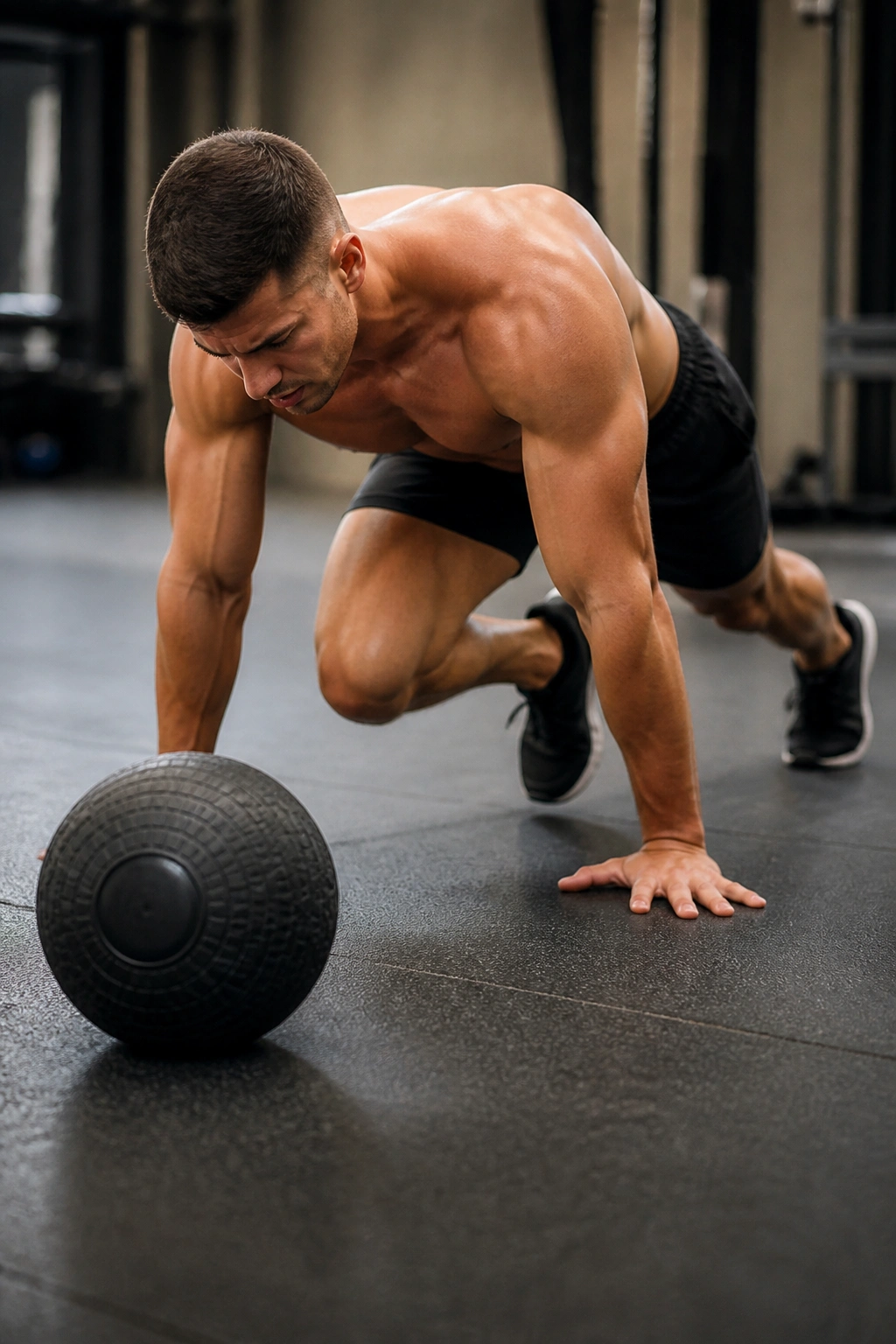
This is a pairing of upper-body power and core-intensive cardio. The slam ball keeps your heart rate elevated through explosive movement, while the mountain climbers force you to stabilize your core while moving your legs rapidly.
The Flow
- 30 seconds of slam balls (heavy ball).
- 30 seconds of mountain climbers (knees to chest).
- 30 seconds of rest.
- Repeat for 10 rounds.
Do not pause between the slams and the climbers. Drop the ball, hit the floor, and start climbing. This seamless transition is what keeps the intensity high. If you need 5 seconds to catch your breath between movements, you are losing the metabolic advantage of the interval.
19. Tire Flips and Agility

If you have access to a tire and some space, tire flips are one of the most functional exercises you can do. It requires a squat-to-deadlift pattern, back strength, and explosive hip drive.
The Structure
- 5 tire flips.
- 30 seconds of agility drills (shuttle runs, ladder drills, or side-to-side hops).
- 60 seconds rest.
- Repeat 8 times.
The agility portion forces you to shift from heavy, grinding strength (the flip) to fast, reactive speed. This forces your body to adapt to multiple stressors, which is excellent for fat burning and overall conditioning. It also makes for a far more interesting workout than just running on a treadmill.
20. The “Death by” Protocol

“Death by” is a classic CrossFit-style workout structure that sounds easy but becomes impossible very quickly. You start with one rep of an exercise and add one rep every minute.
Example: “Death by Burpees.”
- Minute 1: Do 1 burpee. Rest for the remainder of the minute.
- Minute 2: Do 2 burpees. Rest for the remainder.
- Minute 3: Do 3 burpees. Rest for the remainder.
- Continue until you cannot complete the required reps within the minute.
This is a self-limiting workout. You will eventually hit a wall where the reps take the full 60 seconds. That is your finish line. It is a fantastic way to see exactly where your conditioning stands. Because it is simple, you can do it with almost any movement: squats, push-ups, or kettlebell swings.
Final Thoughts
HIIT is effective, but it is not a magic pill. You cannot out-train a poor diet. These workouts will help you burn fat and improve your cardiovascular health, but they are physically demanding. If you are not recovering—sleeping enough, eating enough protein, and taking rest days—you will quickly find yourself burned out, injured, or simply hating the gym.
Start with two sessions per week. Do not jump into doing HIIT every single day. Your central nervous system needs time to recover from the high-intensity stress. Once you adapt, you can add a third session, but monitor your energy levels. If you are constantly exhausted and your performance is dropping, pull back. The best workout is the one you can consistently perform with intensity, not the one that destroys you so completely you cannot train again for a week.
