



You can spend every waking hour performing standard crunches and sit-ups, but if you do not address the metabolic demand of your body, those abdominal muscles will remain hidden. The concept of spot reduction—the idea that you can burn fat in one specific area by working that area—is a myth that refuses to die. Your body burns fuel globally. If you want to see your midsection, you need to elevate your heart rate to burn calories while simultaneously placing your core under tension to build the structural integrity of the muscles underneath.
The bridge between traditional cardiovascular endurance and core strength is where the real work happens. When you combine dynamic, explosive movement with constant abdominal bracing, you force your body to stabilize while under physiological stress. This is not about doing a thousand situps; it is about keeping your core locked in while your limbs are moving rapidly. This requires coordination, balance, and a level of grit that standard gym routines often overlook. If you are ready to stop wasting time on ineffective floor work and start training with purpose, this list will provide the specific tools to get the job done.
1. Mountain Climbers
Mountain climbers are the gold standard for blending high-intensity cardio with constant core engagement. You are essentially performing a high-speed plank, which demands that your abs work overtime to prevent your hips from sagging or bouncing. The movement forces your core to resist gravity and rotational forces simultaneously.
Why This Works
The primary benefit here is the sheer volume of tension. Every time you drive a knee toward your chest, you create a rapid contraction in the rectus abdominis and the obliques. You are not just moving your legs; you are fighting to keep your spine neutral while your lower body acts like a piston.
How to Execute With Precision
- Start in a high plank position, hands directly under your shoulders, body in a perfectly straight line from head to heels.
- Drive your right knee toward your chest as fast as you can, then switch legs in a jumping motion.
- Keep your butt down. If your hips rise into the air, you are taking the load off your abs and putting it on your shoulders.
- Maintain a steady, rhythmic breath. Do not hold your breath, or your performance will drop off a cliff within thirty seconds.
Pro tip: Focus on bringing your knee to the inside of your elbow to hit the obliques harder.
2. Burpees with a Tuck Jump

There is no getting around the fact that burpees are demanding. They are a full-body movement that forces your core to stabilize during the transition from a plank to a standing position. Adding the tuck jump at the top creates an explosive element that forces your lower abs to contract violently to bring your knees up to your chest.
Breaking Down the Movement
You start standing, drop your hands to the floor, jump your feet back into a plank, perform a pushup, jump your feet back to your hands, and then explode into a jump, bringing your knees to your chest. It is a sequence of movements that leaves no muscle group untouched.
Avoiding Common Pitfalls
Most people cheat the burpee by letting their back sag during the plank phase. This is the fastest way to injure your lumbar spine. Always keep your core tight throughout the entire transition. If you are struggling with the tuck jump portion, focus on just standing up fast initially, and add the height later.
3. Bicycle Crunches with Tempo

Bicycle crunches are often treated as a slow, deliberate floor exercise. To turn them into a cardio workout, you need to increase the tempo and commit to the rotation. This variation requires you to move your limbs rapidly while keeping your upper body lifted, which puts immense strain on your entire abdominal wall.
The Mechanics of the Twist
The key is to touch your elbow to the opposite knee, but don’t just reach with your arm. You must rotate your torso. If you just move your arms, you are missing the point. Your obliques are responsible for rotation, and they need to fire to make that connection.
Integrating Cardio
To make this a cardio move, set a timer for forty-five seconds. Perform the movement as fast as you can with perfect form, then rest for fifteen seconds. Repeat this for five rounds. The rapid pace of the leg movement, combined with the isometric hold of the upper body, will spike your heart rate in seconds.
4. High Knees with Core Engagement

High knees seem simple, but when performed correctly, they are a powerful tool for abdominal bracing. Most people just jog in place and lift their knees. To make this an ab workout, you must stand tall and use your abs to lift your knees, rather than just using your hip flexors.
Proper Form for Maximum Impact
Imagine there is a string pulling the crown of your head to the ceiling. Keep your chest up and your shoulders back. When you lift your knee, exhale sharply and tighten your stomach muscles. This rhythmic contraction with every step is what creates the burn.
Why This Is Effective
- Constant vertical movement forces your body to stabilize.
- Exhaling on each lift empties your lungs, forcing you to engage your diaphragm.
- The speed required keeps your cardiovascular system under load.
5. Plank Jacks

Plank jacks take the stability of a plank and add the lateral movement of a jumping jack. It is a deceptively simple move that tests your ability to keep your core solid while your legs move outward and inward. Your abs have to fight to keep your torso from swaying as your feet land.
Maintaining Stability Under Load
The second your feet jump out, your abs have to engage harder to counteract the outward force. If you feel your lower back arching, your core is not engaged enough. Tighten your glutes and press your belly button toward your spine.
Adjusting Intensity
If you find yourself bouncing too much, slow the pace down. Quality of movement is far more important than speed here. Once you can hold a rock-solid plank while your feet jump, then you can increase the tempo to make it more of a cardio challenge.
6. Russian Twists with a Medicine Ball
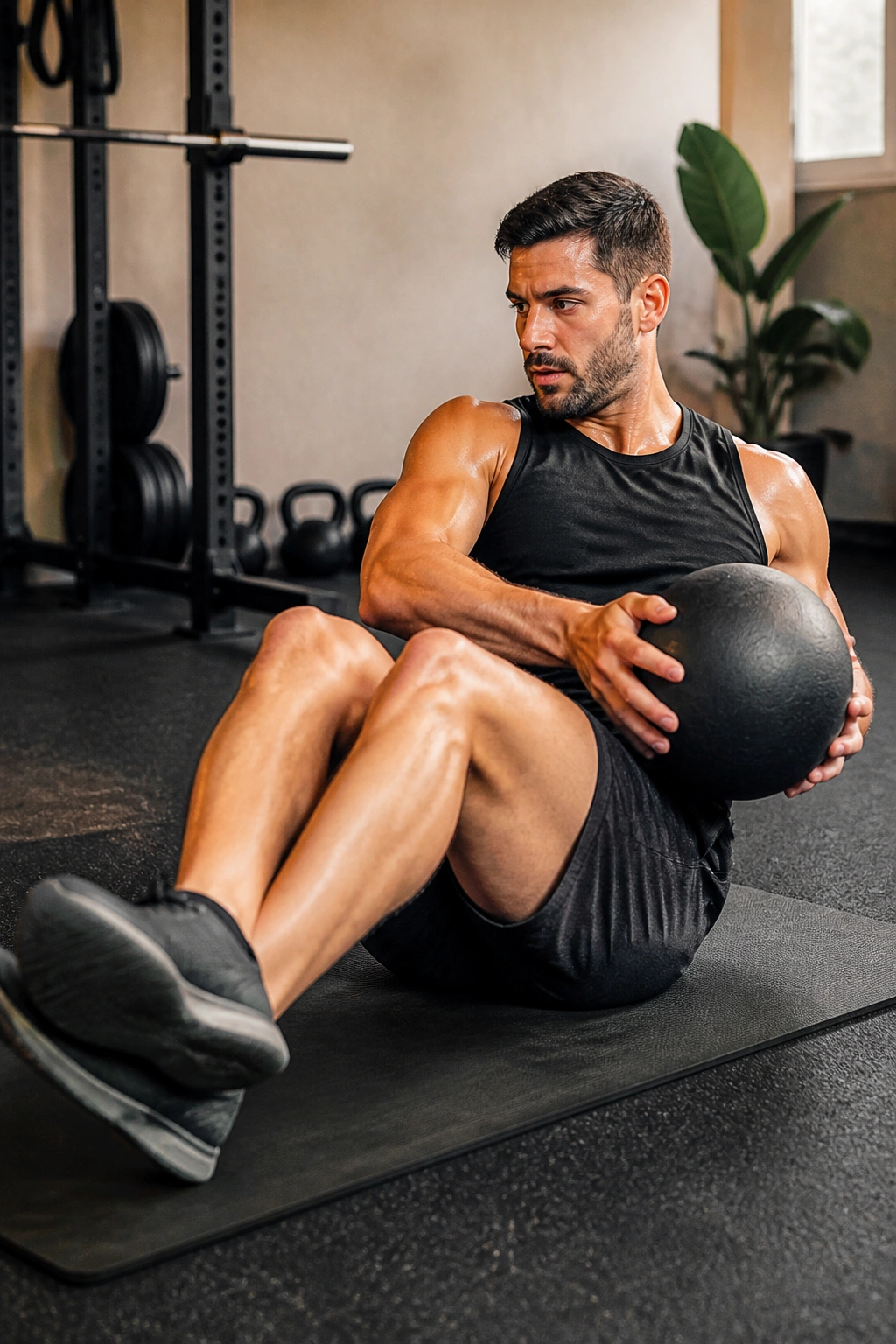
Russian twists target the deep muscles of the core, specifically the obliques. When you hold a medicine ball and rotate from side to side, you are working against the momentum of the weight. This is a rotational cardio move that requires stability and power.
Why the Twist Matters
Rotation is a fundamental movement pattern that is often ignored in traditional ab training. By adding a medicine ball, you force the obliques to decelerate the weight on one side and accelerate it on the other. This constant shifting creates a metabolic demand that standard crunching cannot match.
Finding the Right Angle
Sit on the floor, lean back slightly until you feel your abs engage, and lift your feet a few inches off the ground. If your feet are on the floor, you aren’t engaging the lower abs as effectively. Keep your gaze following the ball as you move to ensure full range of motion.
7. Speed Skaters

Speed skaters are a lateral movement exercise that mimics the motion of an ice skater. They are excellent for the obliques and require a significant amount of balance and coordination. You leap from side to side, landing on one foot and sweeping the other behind you.
Why This Hits the Obliques
Every time you land on one leg, your body wants to tilt. Your obliques must fire instantly to stabilize your torso and keep you upright. This is essentially a core exercise disguised as a leg workout.
Tips for Better Performance
- Go for distance, not just speed. A wider jump requires more stabilization.
- Keep your chest forward. If you stand too upright, you lose the core engagement.
- Land softly. Absorb the impact through your leg and core, not your joints.
8. Jumping Lunges with Core Bracing

Jumping lunges are a high-intensity plyometric exercise that demands total body control. When you switch legs in the air, your core has to act as the stabilizer that keeps you from falling over. This requires intense abdominal bracing to ensure you land safely and effectively.
The Role of the Core
Your core is the anchor. Without it, you would wobble and lose balance upon landing. By engaging your core before you leave the ground, you create a rigid structure that allows you to transition power from your legs through your torso.
Managing Fatigue
This is a high-fatigue move. If you lose form, stop immediately. It is better to perform ten high-quality reps with your core braced than thirty sloppy reps that put your knees and lower back at risk.
9. Bear Crawls
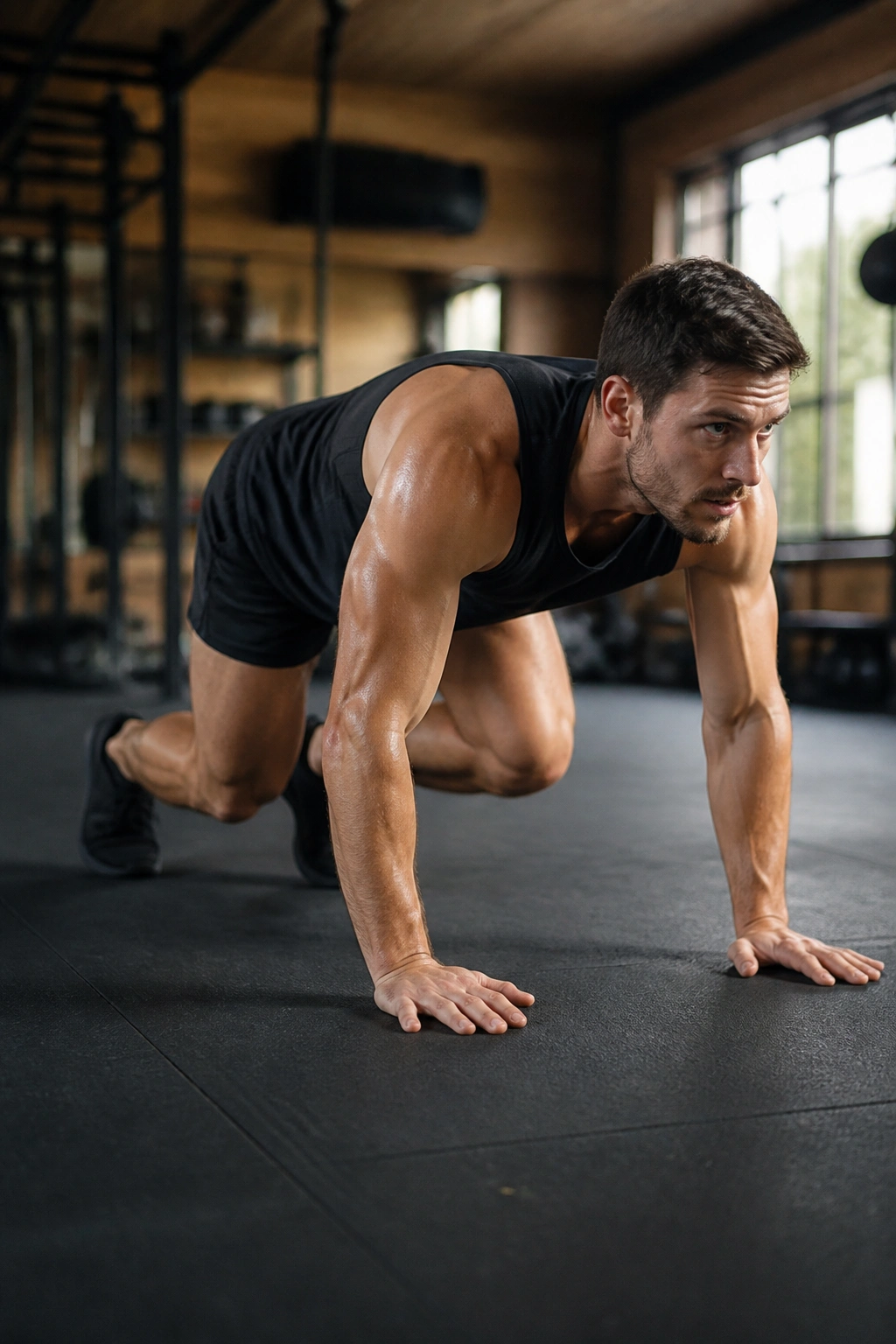
Bear crawls are a crawling variation that forces you to keep your knees close to the ground while moving your limbs in a cross-body pattern. This requires constant abdominal tension to keep your back flat and your hips stable as you crawl forward, backward, or laterally.
The Science of the Crawl
This is a full-body integration exercise. Your shoulders, hips, and core must communicate perfectly to move your opposite arm and leg in unison. If your hips start to rotate too much, you are losing the core tension. Keep your back parallel to the floor, like you are balancing a tray of drinks on your lower back.
Why It Belongs in a Cardio Routine
While it looks slow, doing bear crawls for distance or time will absolutely spike your heart rate. It is a grueling, slow-burn cardio that builds incredible abdominal endurance. Do not underestimate the intensity of a thirty-foot crawl.
10. Kettlebell Swings

Kettlebell swings are often classified as a posterior chain exercise, but they are also a powerful tool for abdominal training. The movement is driven by your hips, but your core must stop the weight at the top of the swing. That deceleration is where the ab work happens.
Bracing for the Impact
At the peak of the swing, your abs must contract forcefully to prevent your spine from hyperextending. This is an explosive contraction that repeats every time the bell comes to the top. It is the definition of core stability under dynamic load.
Proper Weight Selection
Do not go too heavy, especially if you are focusing on high-volume swings for cardio. Pick a weight that allows you to maintain speed and form. If the bell feels like it is swinging you, the weight is too heavy.
11. Inchworms

Inchworms begin in a standing position, where you hinge at the hips, place your hands on the floor, and walk them out into a plank position. Then, you walk your feet back to your hands. This movement stretches the hamstrings while placing the core in a vulnerable, extended position that requires maximum engagement to protect the spine.
Focus on the Extension
The “danger zone” of the inchworm is when your hands are fully extended in front of you in the plank. This is where your abs are fighting to keep your back from dipping. Do not rush this transition. Hold the plank for a second at the full extension to maximize the time under tension.
Why It’s Effective
It combines flexibility, strength, and stamina. The constant movement keeps your heart rate elevated, while the plank pauses provide the abdominal work. It is an excellent way to transition between higher-intensity moves in a circuit.
12. Plank-to-Pushup

This movement transitions between a forearm plank and a full pushup position. You start on your forearms, push up onto one hand, then the other, and then descend back to the forearms. This is a massive test of stability because every time you lift a hand, your body wants to rotate.
The Anti-Rotation Challenge
Your job is to prevent that rotation. You must keep your hips square to the ground throughout the entire transition. This forces your obliques and transverse abdominis to work overtime to keep your torso level.
Keeping the Pace
Because this is a slow, methodical movement, it might not seem like cardio. However, if you keep the transition time short and move continuously for sixty seconds, you will find it quickly challenges your breathing and endurance.
13. Shadow Boxing

Shadow boxing is an underrated core workout. When you throw punches, you are utilizing the rotational power of your torso. Every jab, cross, hook, and uppercut originates from the ground, travels through your core, and releases through your fist.
The Secret to the Punch
The power does not come from your shoulder; it comes from your core. You must snap your hips and rotate your torso to generate force. If you are standing still and just flicking your arms, you are doing it wrong. Focus on the waist twist.
Adding Cardio
To maximize the cardio aspect, throw combinations in fast succession. Keep your guard up, stay light on your feet, and keep your core braced as if you were expecting a punch in return. It creates a rhythmic, high-intensity environment.
14. Jump Rope with High Knees

Jumping rope is a classic cardio move, but adding high knees changes the game for your abs. When you pull your knees up toward your chest while jumping, you force your lower abdominals to contract repetitively.
Maintaining Rhythm
The challenge here is the timing. You have to jump, pull the knee up, and then clear the rope all in one motion. It requires intense focus and core control. If your core is weak, you will lose your balance and trip over the rope.
Variation for Intensity
Try double-unders if you are advanced. The speed required to get the rope around twice in one jump forces an even greater abdominal contraction to get the knees up high enough and fast enough to maintain the tempo.
15. Battle Rope Waves

Battle ropes provide an excellent way to train the core while keeping your heart rate sky-high. By holding the ropes and creating waves, you are essentially performing an isometric core hold while your arms do the work.
The Core Component
If you stand upright and loose, the ropes will pull you forward. To combat this, you must sit into a squat position, brace your abs, and keep your spine straight. Your core is the stationary anchor for the dynamic movement of your arms.
Mixing Waves
Use different wave patterns to hit different areas. Big, slam-style waves require an explosive core contraction to handle the weight of the rope. Small, rapid waves require high-frequency abdominal stability to keep your torso from shaking.
16. Sprints

Sprints are the ultimate cardiovascular challenge, and they are also a surprisingly effective core workout. To run at maximum speed, you have to maintain an upright, rigid posture. Your core muscles are the stabilizers that transfer the massive power generated by your legs.
The Bracing Mechanism
When you sprint, your arms drive forward and back. Your core must rotate slightly to counterbalance this but stay tight enough to transfer the force. This is not a slow, controlled movement; it is an explosive, high-tension effort.
Sprint Intervals
Do not just run. Perform intervals. Sprint for twenty seconds at absolute maximum effort, then walk for forty seconds. Repeat this ten times. The sheer intensity of the effort forces your body to recruit every muscle fiber in your midsection to maintain the sprinting form.
17. Medicine Ball Slams

Medicine ball slams are all about raw, explosive power. You lift the ball overhead, engage your core, and throw it into the ground with everything you have. This movement utilizes the entire core, from the lats down to the rectus abdominis.
The Slam Motion
The power comes from the descent. You aren’t just dropping the ball; you are crunching your entire torso downward to accelerate it. This is a dynamic, high-velocity crunch that hits your abs harder than almost any floor exercise.
Choosing the Ball
Pick a ball that has no bounce. If the ball bounces back up, it ruins the flow of the movement and can be dangerous. You want to focus on the downward slam and catching it on the rebound, then immediately resetting.
18. Sprawls

A sprawl is effectively a burpee without the pushup and without the jump. It is a wrestling-based movement designed to keep your hips away from an opponent. You drop your hips to the floor, kick your legs back, and then pull your feet back under you.
Why It Works for Abs
The speed of the hip drop and the quick return require rapid abdominal engagement. It is a hip-dominant movement that forces the abs to act as the brake and the accelerator. It is highly fatiguing and forces you to breathe hard, which further taxes the core.
Managing the Landing
Land softly on your hands. Do not slam your knees into the ground. Keep your abs tight so that when your hips drop, your back remains neutral. This is a fantastic move to integrate into high-intensity interval training (HIIT).
19. Standing Knee-to-Elbow Crunches

If you want to work your abs without hitting the floor, this is your go-to move. Stand with your feet shoulder-width apart, hands behind your head, and bring your right knee up to meet your left elbow. Twist your torso to make the connection.
The Vertical Challenge
By standing, you remove the floor’s support, meaning you have to stabilize your body on one leg. This engages the core stabilizers in your hips and lower back, in addition to the obliques and rectus abdominis.
The Cardio Element
Do these quickly. Because it is a unilateral movement (one side at a time), you have to maintain a steady rhythm to keep your heart rate up. Switch sides halfway through your set or alternate every rep to keep the metabolic demand high.
20. Rowing Machine Intervals
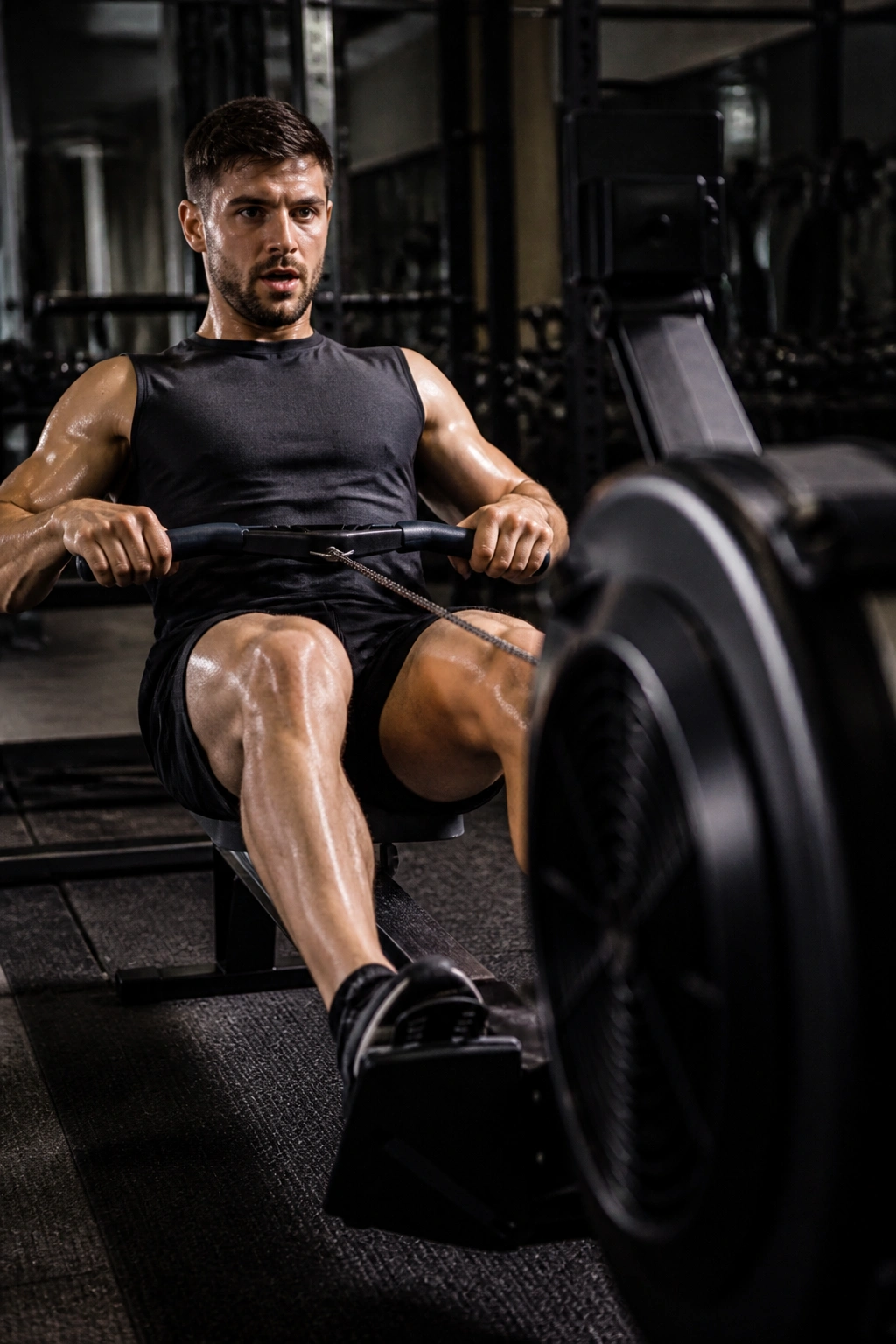
The rowing machine is perhaps the most complete cardio-core machine in the gym. Every stroke is a combination of a leg drive, a core pull, and an arm finish. You cannot row correctly without a strong, engaged core.
The Rowing Sequence
The power of the row starts with the legs, but the core is the bridge. As you lean back slightly during the pull, your abs must catch the weight of your torso and handle the load of the handle pull. If you don’t engage your core, your lower back will take the strain.
Maximizing the Workout
Focus on your split times. Use the monitor to track your pace. High-intensity intervals on the rower—such as 500 meters at max effort followed by two minutes of easy recovery—will incinerate calories and force your core to work harder than almost any other steady-state cardio.
Final Thoughts

Building a midsection that is both strong and visible is not about finding the magic exercise that melts fat; it is about combining high-energy movement with the fundamental necessity of core bracing. The list above provides twenty ways to achieve this, but the key is how you use them. Do not treat these as isolated moves to be done in isolation at the end of a workout. Incorporate them into your routine as circuits or intervals to ensure your heart rate stays elevated while your abs are under constant load.
Remember that consistency matters more than intensity on any single day. If you are exhausted, perform the movements slower, but keep the core engagement perfect. The moment you lose your form, the effectiveness of the exercise drops, and the risk of injury increases. Prioritize the quality of your movement over the speed of your repetition. Over time, as your cardiovascular endurance improves and your metabolic rate stays high, the combination of these movements will force your body to change. Stay committed to the process, listen to your body, and keep the core tight.
