



A yoga mat can stay in the room through all three trimesters, but the work on it changes fast. What feels calming early on can feel wobbly, cramped, or flat-out annoying once your center shifts and your joints loosen up. That is why yoga routines for each trimester need to change with the body, not with some fixed class formula.
Early pregnancy often brings fatigue and nausea. Mid-pregnancy can feel more open, but balance gets trickier and the belly starts changing how twists and lunges land. By the third trimester, standing too long can feel like carrying a backpack on the front of your body.
A blanket, a wall, a chair, and two blocks do more good than a flashy sequence. The American College of Obstetricians and Gynecologists advises exercise in an uncomplicated pregnancy, while also steering people away from hot rooms and anything that causes dizziness, pain, or a sense that the breath has gone ragged. If a pose feels off, shrink it. If it still feels off, skip it.
The smartest prenatal yoga rarely looks dramatic. It looks steady. And that steadiness matters most when you are tired, swollen, or simply over it.
1. First-Trimester Breath Reset on the Mat
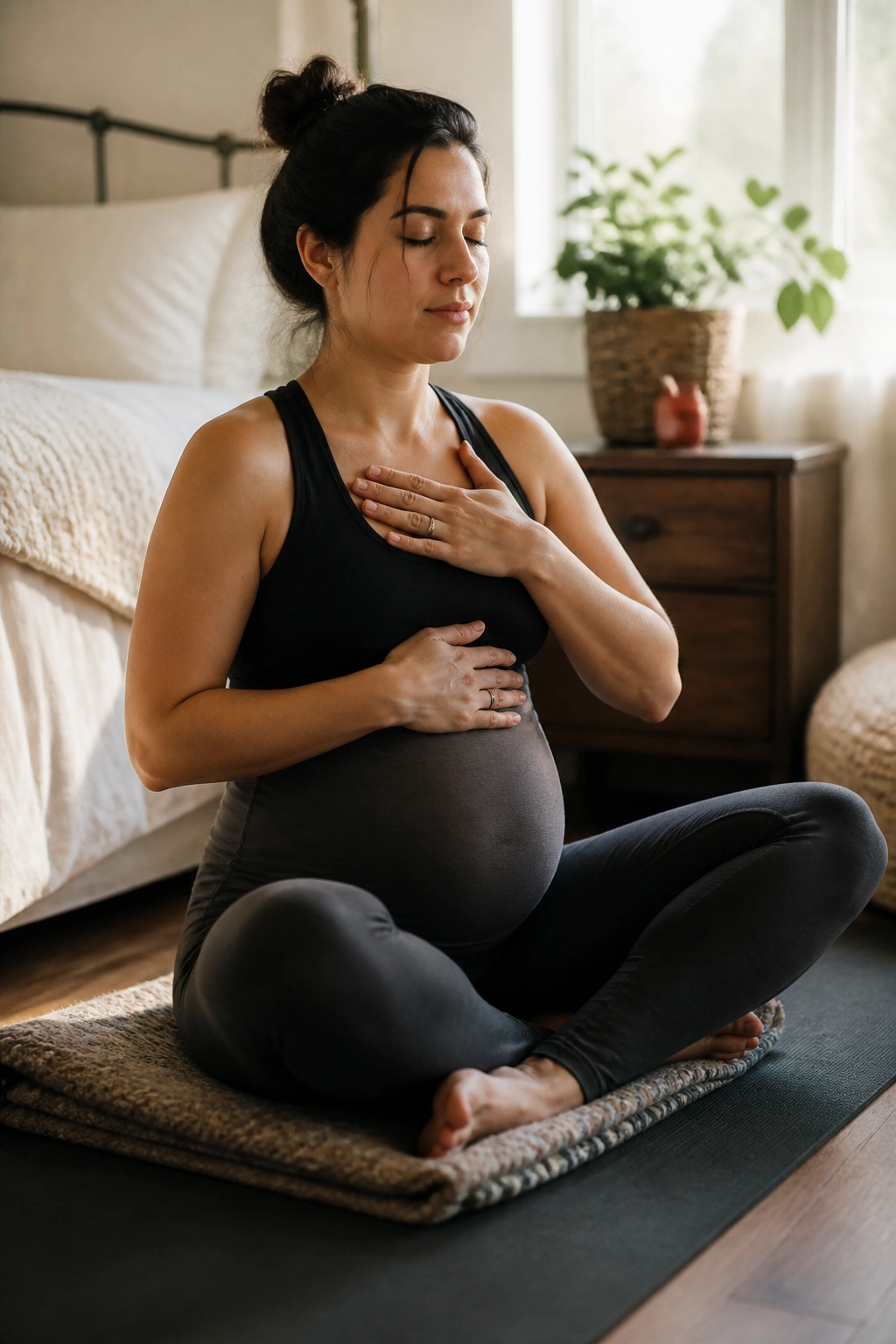
Shorter wins here. Early pregnancy can make you feel like you ran a race before breakfast, even when you barely moved. A breath-focused routine gives you a place to land without asking for much energy.
How to do it
Sit on a folded blanket or yoga bolster with your knees bent and your spine tall. Rest one hand on your chest and the other on your ribs. Breathe in for a count of four, then out for a count of six. That longer exhale matters; it tends to settle the shoulders and make the whole practice feel less frantic.
Add three slow shoulder rolls, five neck circles in each direction, and a gentle head nod. Keep it tiny. Tiny is the point.
- 3 to 5 minutes of seated breathing
- 4-count inhale, 6-count exhale
- 5 shoulder rolls each way
- 5 slow neck circles each side
If nausea hits, stop with the seated part. If sitting up feels like too much, lie on your left side with a pillow under your head and keep the same breathing pattern.
Best use: those days when you want to exercise but your body is asking for mercy first.
2. First-Trimester Cat-Cow for a Tight Back
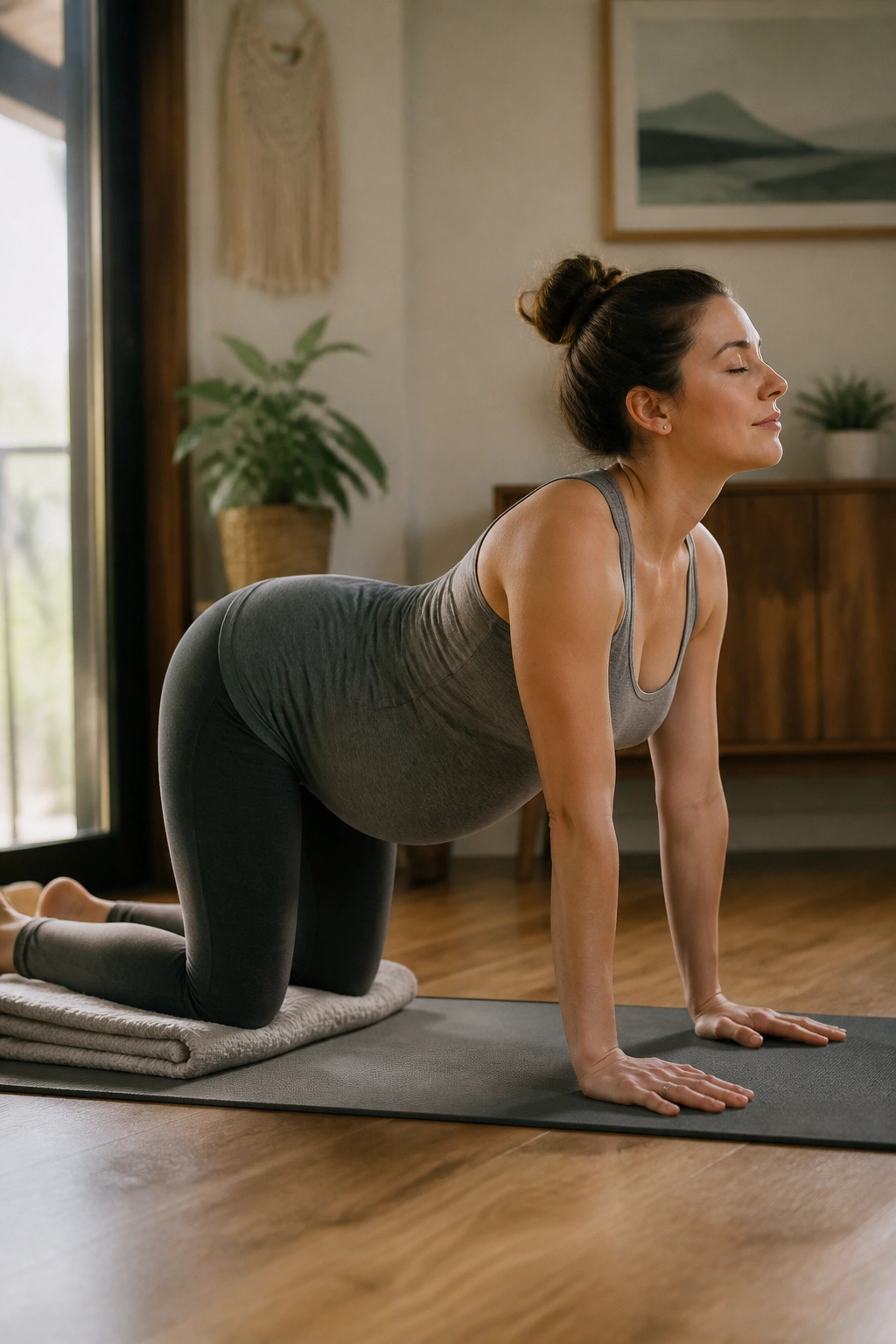
The simplest back relief pose still earns its keep. Cat-cow looks basic because it is basic, and that is exactly why it works when your lower back feels stiff from sitting, sleeping badly, or just existing in a changing body.
Use a folded blanket under the knees and a second blanket under the hands if the wrists are cranky. Move from a rounded spine to a gentle arch on the inhale and exhale, but keep the curve small. No yanking. No big sways.
A lot of people make cat-cow too ambitious. They turn it into a performance. Don’t.
What to watch for
If your wrists complain, come down to forearms or place fists under the shoulders. If your belly feels sensitive, widen the knees a bit. The movement should feel like a soft massage for the spine, not a crunch in the low back.
The nice part is that you can do this for 60 seconds or 10 minutes and get something useful either way. I usually like 8 to 10 slow rounds, then a still pause in tabletop. The pause matters. It lets your back register the change.
3. First-Trimester Wall-Supported Squat Hold
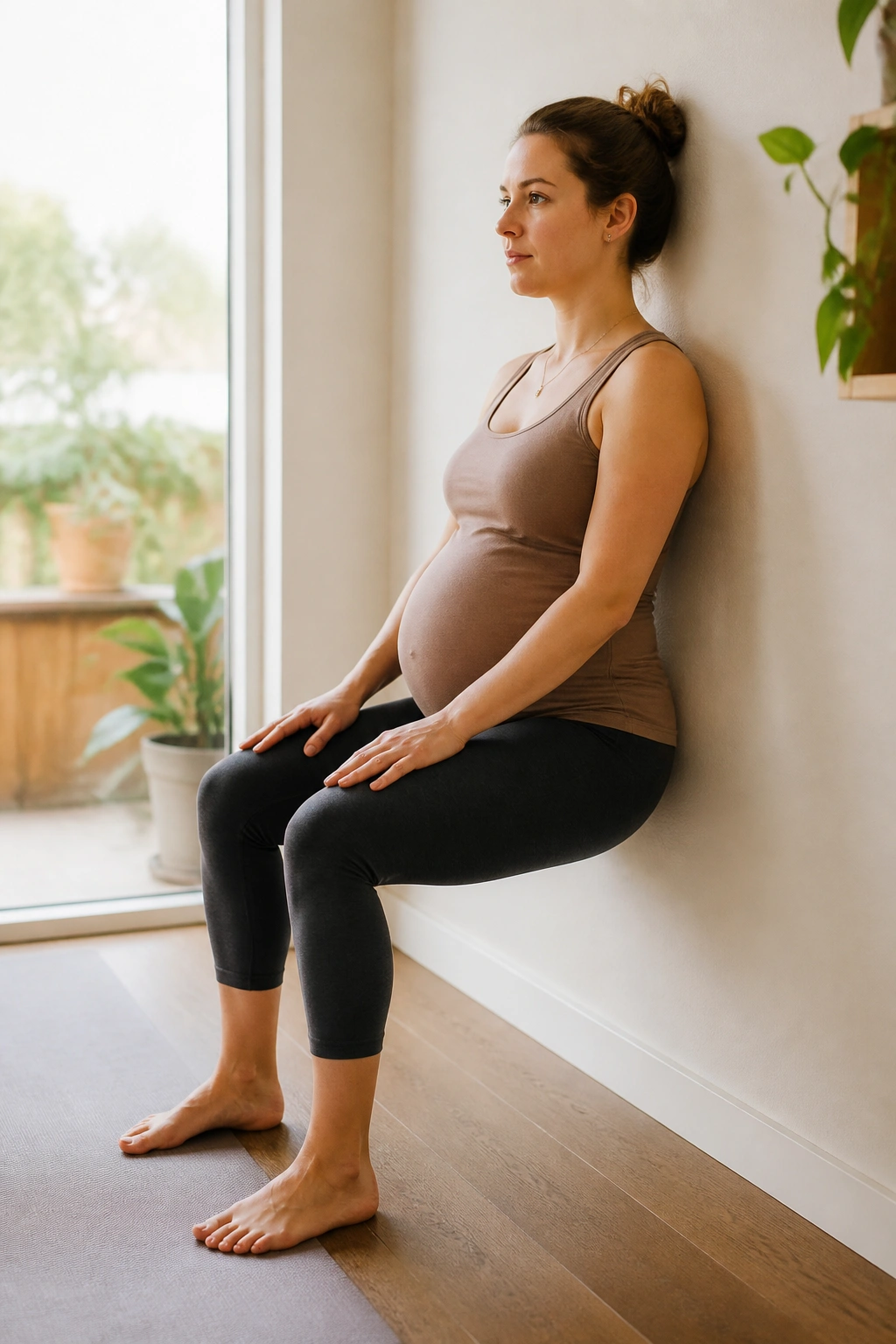
Why keep a squat in the first trimester? Because the hips and ankles like to be reminded that they still know how to bend well.
Stand with your back against a wall and your feet about 18 to 24 inches forward. Slide down only as far as feels clean. If your knees talk back, stay high. If your heels lift, place a rolled towel under them. Then hold for 3 to 5 breaths and come up slowly.
How to set it up
- Feet hip-width or a touch wider
- Wall behind you for balance
- Hold a block or counter if needed
- Stay for 3 to 5 breaths
- Repeat 2 to 4 rounds
This is not about sinking low. It is about reminding your legs to work without strain. The posture helps with everyday stuff too, like getting in and out of cars or crouching to pick things up.
A shallow squat often feels better than people expect. It opens the inner thighs, wakes up the glutes, and gives the pelvic floor a chance to soften instead of clenching all day.
4. First-Trimester Balance Drills Beside a Counter
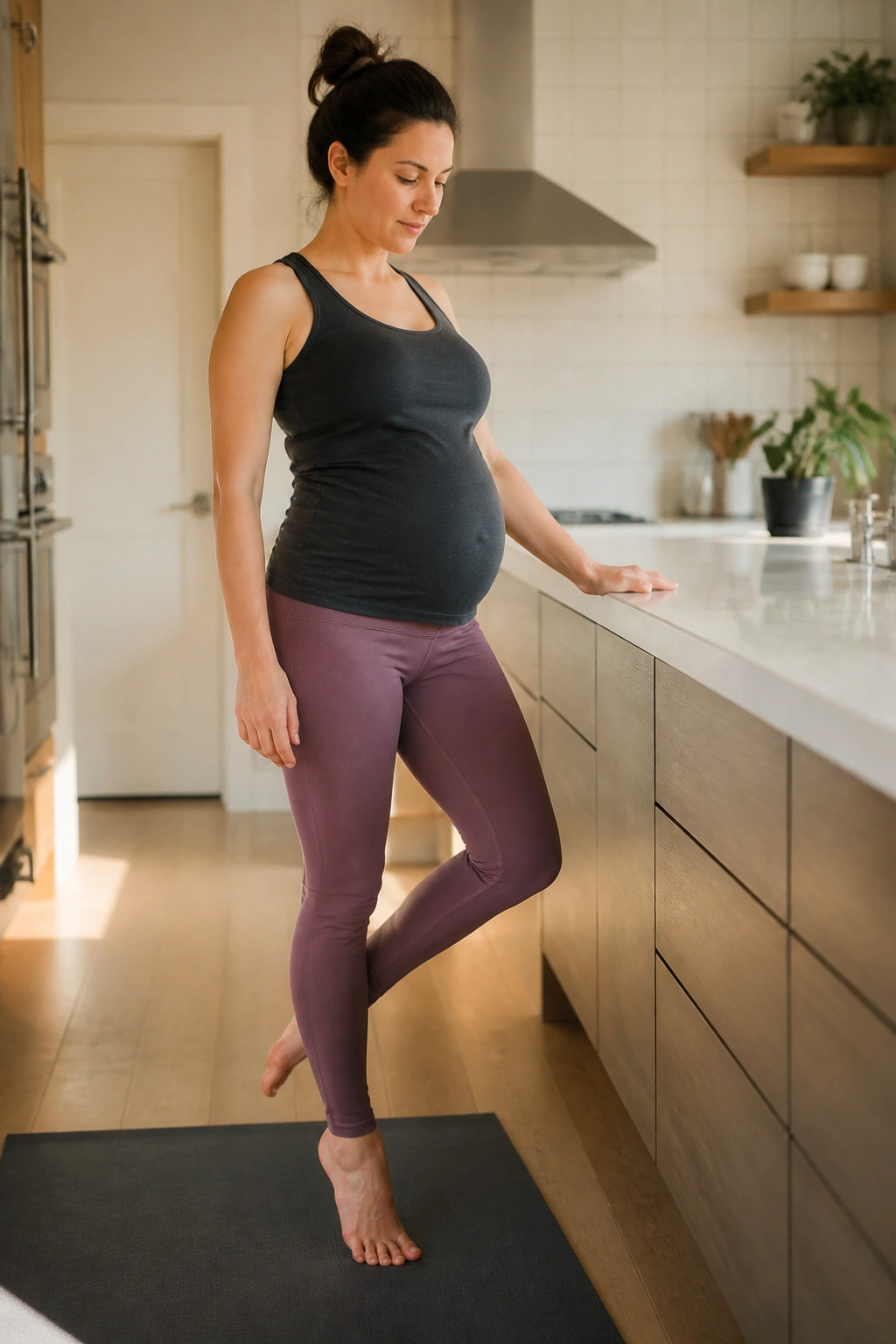
You may notice balance gets weird before the bump is obvious. Weird is the right word. One minute you feel fine, and the next you reach for a high shelf and suddenly need to grab the fridge.
A counter turns balance work into something calm enough to trust. Start with weight shifts from one foot to the other. Then lift one heel, then both toes for a second, then try a supported tree pose with the toes of the lifted foot still on the floor.
A lot of prenatal balance work gets skipped because it seems too small. It is not.
Why it helps
- Builds ankle control
- Keeps the standing leg awake
- Makes later-trimester wobble less annoying
- Trains you to use support instead of fighting for perfection
Keep one hand near the counter the whole time. That is not cheating. It is smart. A wobble that ends in a hard catch is not the goal.
Best cue: feel the whole foot, especially the big toe mound and heel.
5. First-Trimester Side Bend and Open-Torso Flow
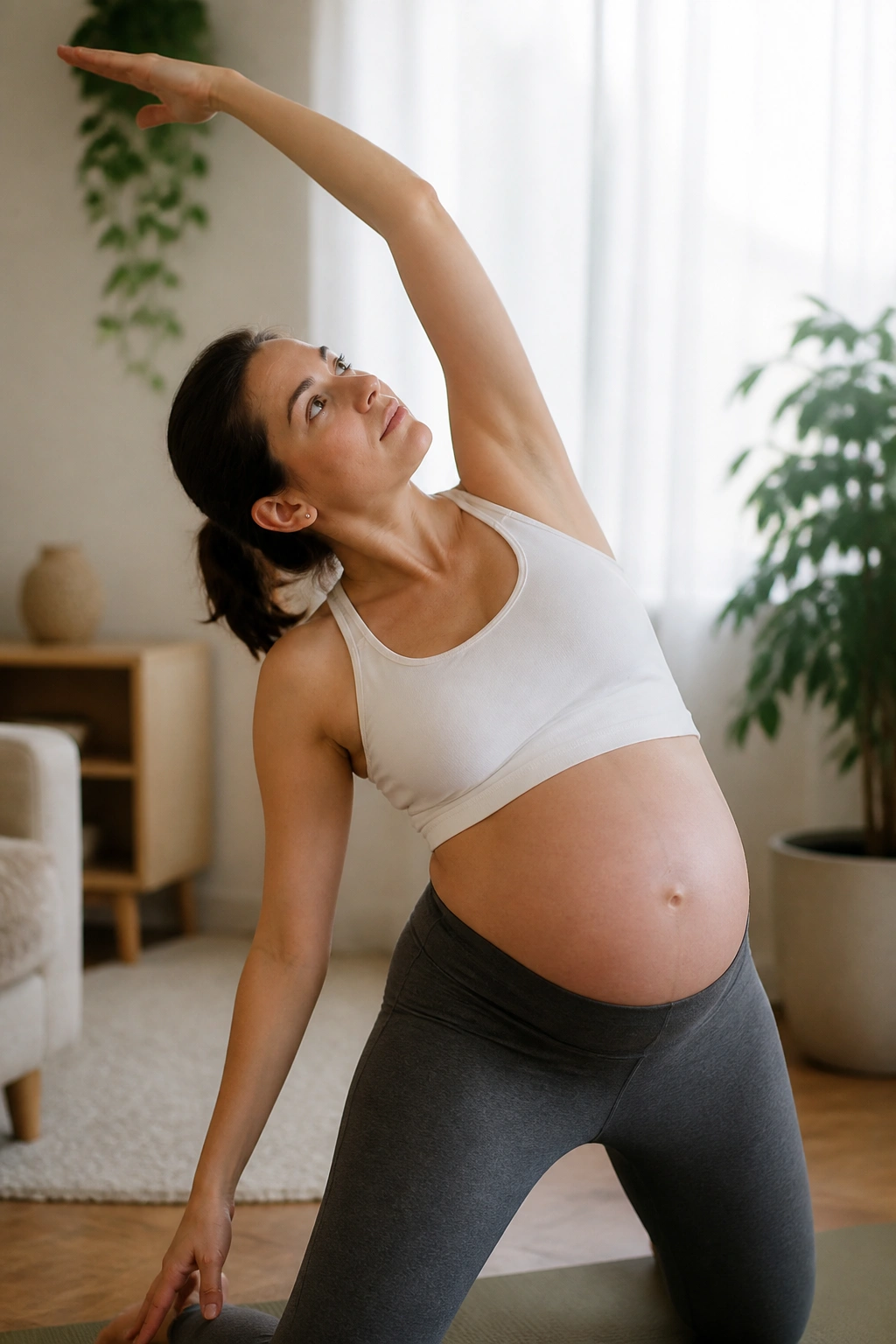
A quiet side bend can do more than a flashy twist. It opens the ribs, gives the breath more room, and loosens the waist without squashing the belly.
Start in standing or half-kneeling, whichever feels better. Lift one arm overhead and arc gently to the side while keeping both hips fairly level. The movement should feel long, not crunched. Stay for two or three breaths, come back to center, and switch sides.
If you like a little more shape, sweep the arm forward and up on the inhale, then melt into the side bend on the exhale. Keep the lower ribs soft. Do not wrench into a deep twist.
I like this one in early pregnancy because it feels elegant without asking for much. A person can be tired, hungry, or mildly nauseated and still get a good effect from it. The ribs open, the neck eases, and the torso stops feeling locked in place.
6. First-Trimester Legs-Up-the-Wall Rest Break
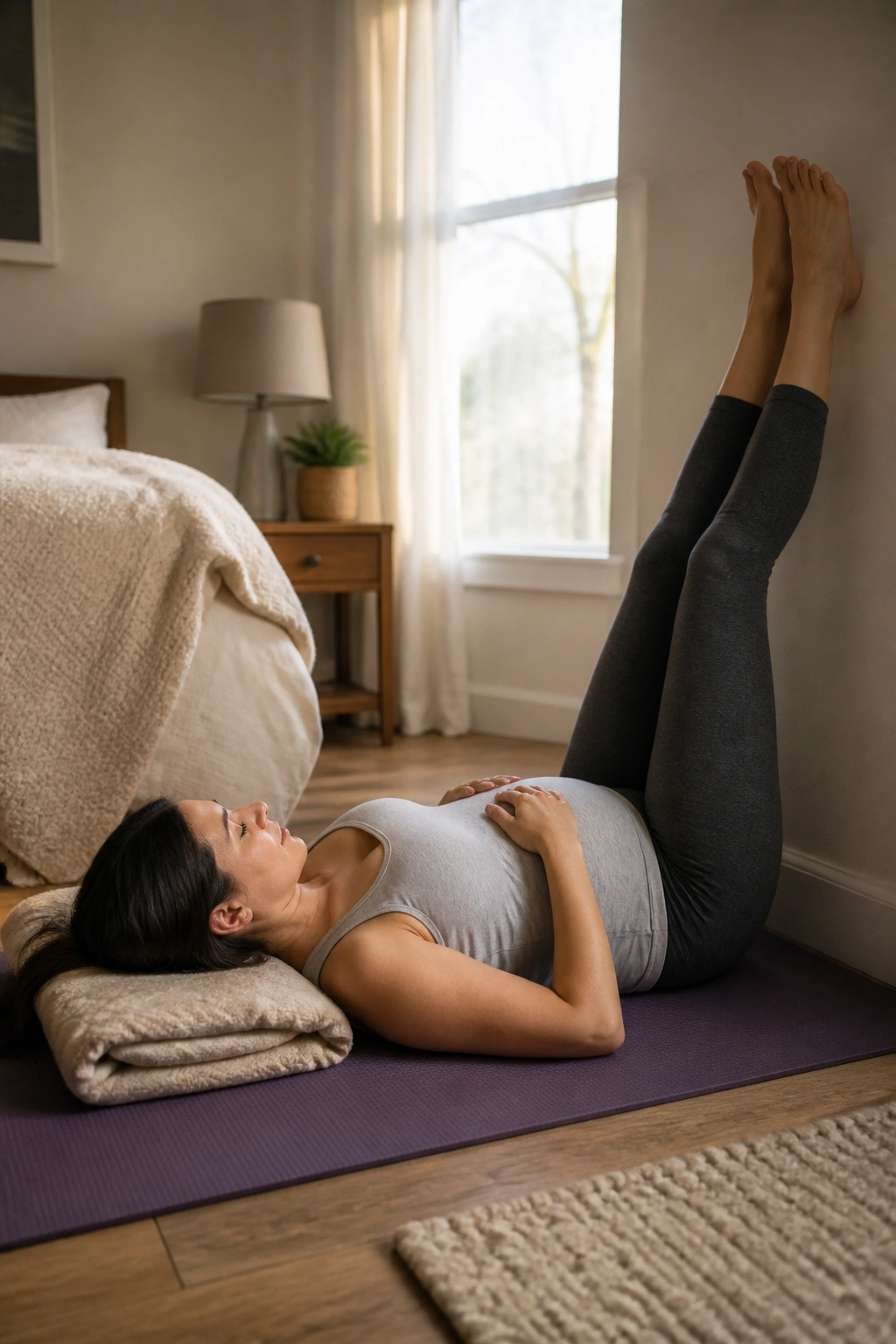
Unlike a sweat-heavy sequence, this one is about downshifting. It is the pose I reach for when the body feels buzzy, the legs feel thick, or standing has been enough for the day.
Lie on your side first, then roll carefully onto your back only if it feels fine. Put your calves on the wall or on a chair if a full wall setup feels awkward. Keep the knees soft. If you feel lightheaded, come out. No debate.
Five to 10 minutes is plenty. Longer can be nice, but only if you are comfortable and your lower back stays happy.
Use it for
- Swollen ankles
- A racing mind
- Heavy legs after walking
- That “I need to lie down now” feeling
The body often reads this pose as permission. Breathing slows. The jaw unclenches. Sleep might even look more possible afterward, which is a gift in itself.
7. Second-Trimester Half-Speed Sun Salutation
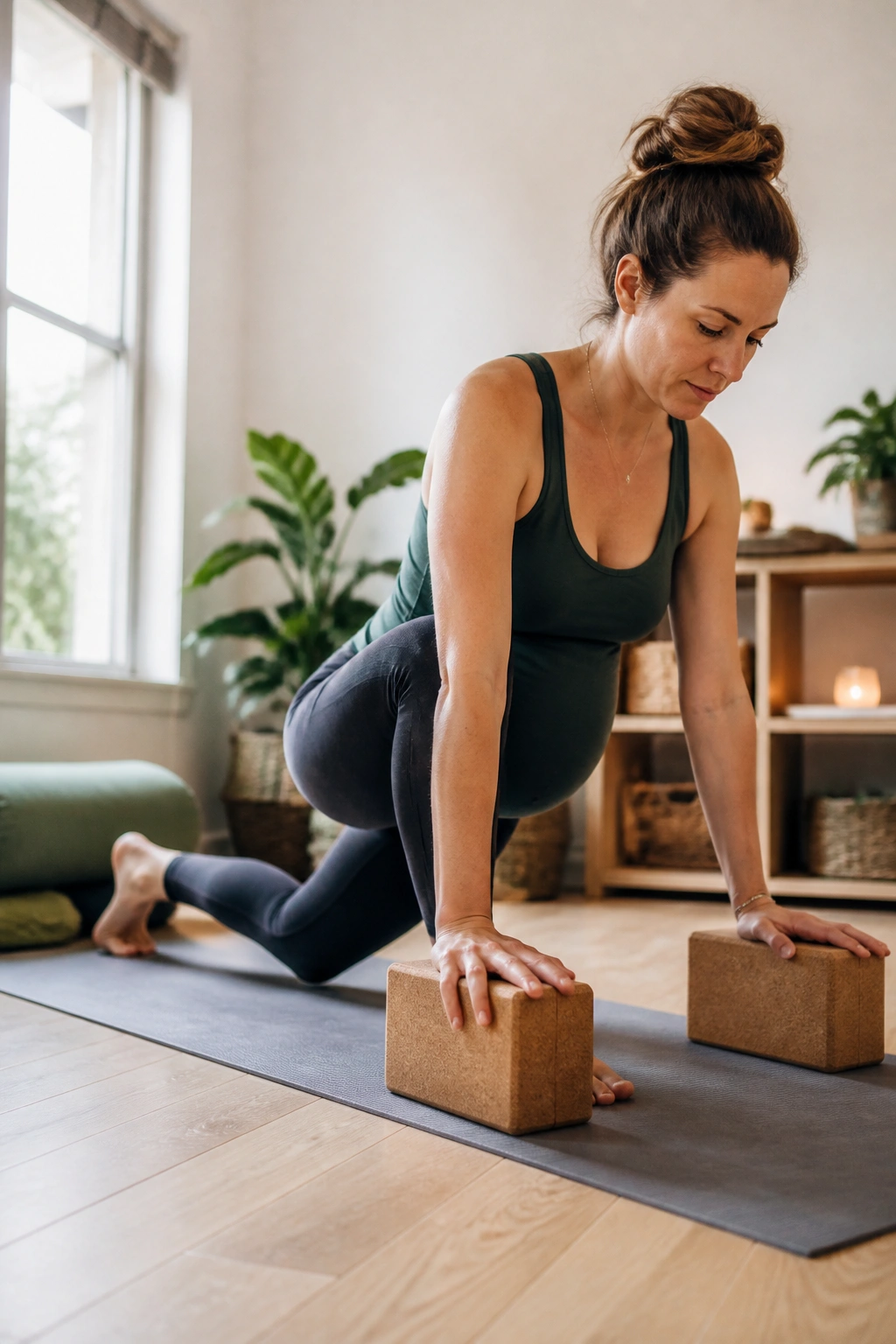
Second trimester often gives you a little more room to move. Energy may come back, but the body also starts changing shape in a way that makes fast transitions feel clumsy. A half-speed sun salutation keeps the rhythm without the bounce.
Step one foot back instead of hopping. Use blocks under the hands. Skip chaturanga and lower one knee or come straight to the mat. If cobra feels like a bad idea, switch to sphinx or stay lifted on your hands. The whole flow should feel deliberate and clean.
What changes in the sequence
- No jumps
- Wider stance
- Hands elevated on blocks
- Slower transitions
- No breath-holding
A modified sun salutation is useful because it keeps familiar yoga logic in place. You get standing work, spinal movement, and a little heat without the frantic edge. Two or three rounds is enough for most days.
If you find yourself rushing, slow down more than you think you need to. That extra beat is where the practice gets safer and more useful.
8. Second-Trimester Wall Warrior Flow
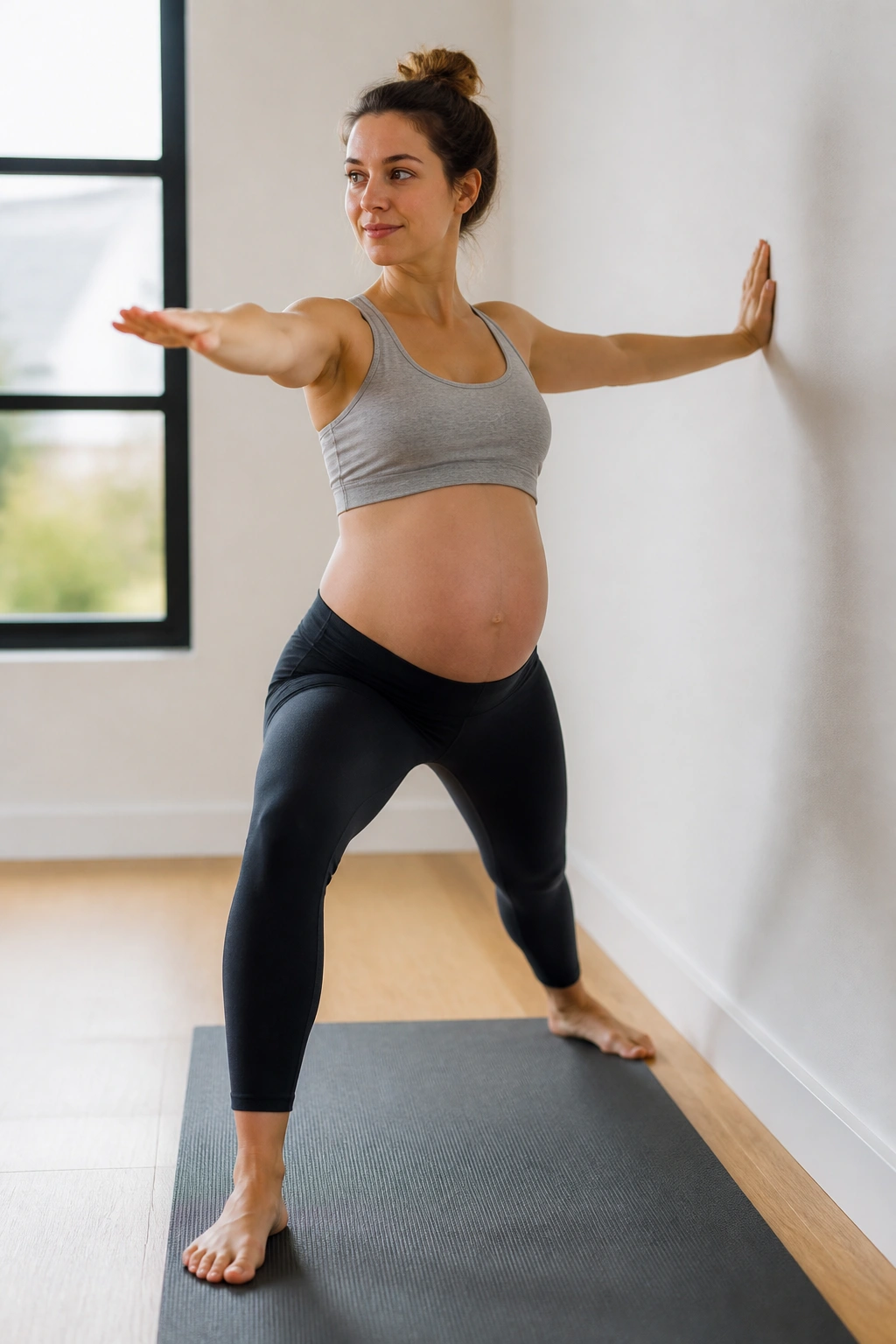
A wall makes Warrior II a lot kinder.
Stand with one side near the wall and press the back hand lightly into it while you step into Warrior II. The wall gives you feedback, which matters when balance starts to wobble and your stance wants to get sloppy. Move into side angle by resting the forearm on the front thigh, not by dropping the torso all the way down.
What makes this different
The usual standing flow can feel big and theatrical. This version is smaller, cleaner, and easier to repeat. You can hold each side for 3 to 5 breaths, then come back to center before switching.
A few people assume wall work is only for beginners. It is not. It keeps the pelvis honest and takes some of the strain out of the front knee and low back. That matters when the belly changes your center of gravity and the hips start doing odd little compensations.
Use a wider stance than you think you need. The pose should feel steady, not heroic.
9. Second-Trimester Bolstered Bound Angle Pose
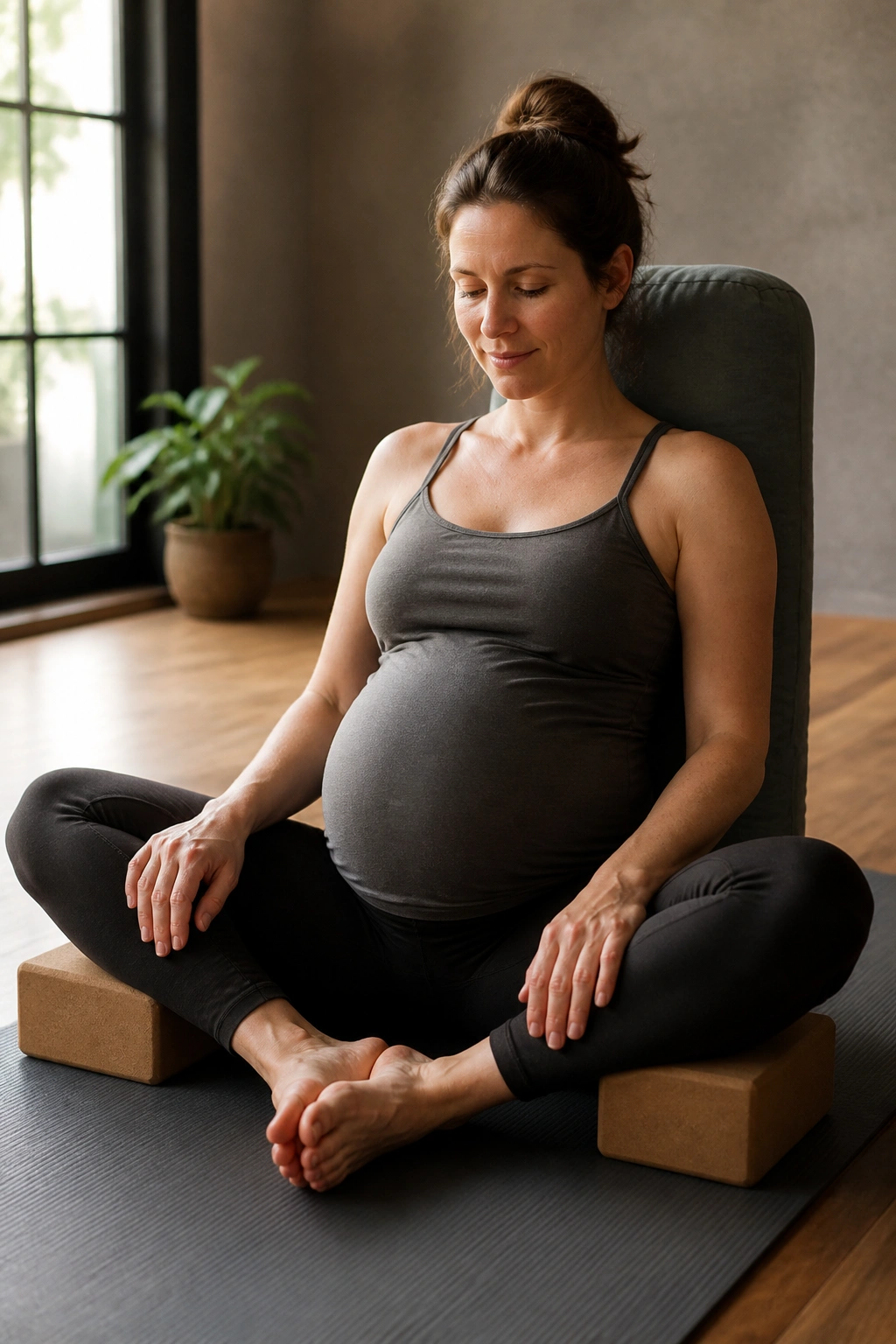
Can a hip opener also be a rest pose? Yes. This one can.
Sit with the soles of your feet together and support each thigh with a block or folded blankets if the knees drift too low. A bolster behind the back changes everything. It lets the chest stay open without making the abdomen work too hard. Stay for 1 to 3 minutes and breathe into the sides of the rib cage.
How to make it comfortable
- Put the bolster lengthwise behind the spine
- Place blocks or rolled blankets under the thighs
- Keep the feet farther away if the groin feels pinchy
- Lift the knees higher if the inner knees complain
This pose is quiet in a good way. It helps with the inner thighs and the low back, and it gives you a moment to sit still without collapsing. Some days that is enough. Some days it feels like the only useful thing on the mat.
If your knees ache, come out sooner. That is not failure. That is useful information.
10. Second-Trimester Tabletop Tilts and Hip Circles
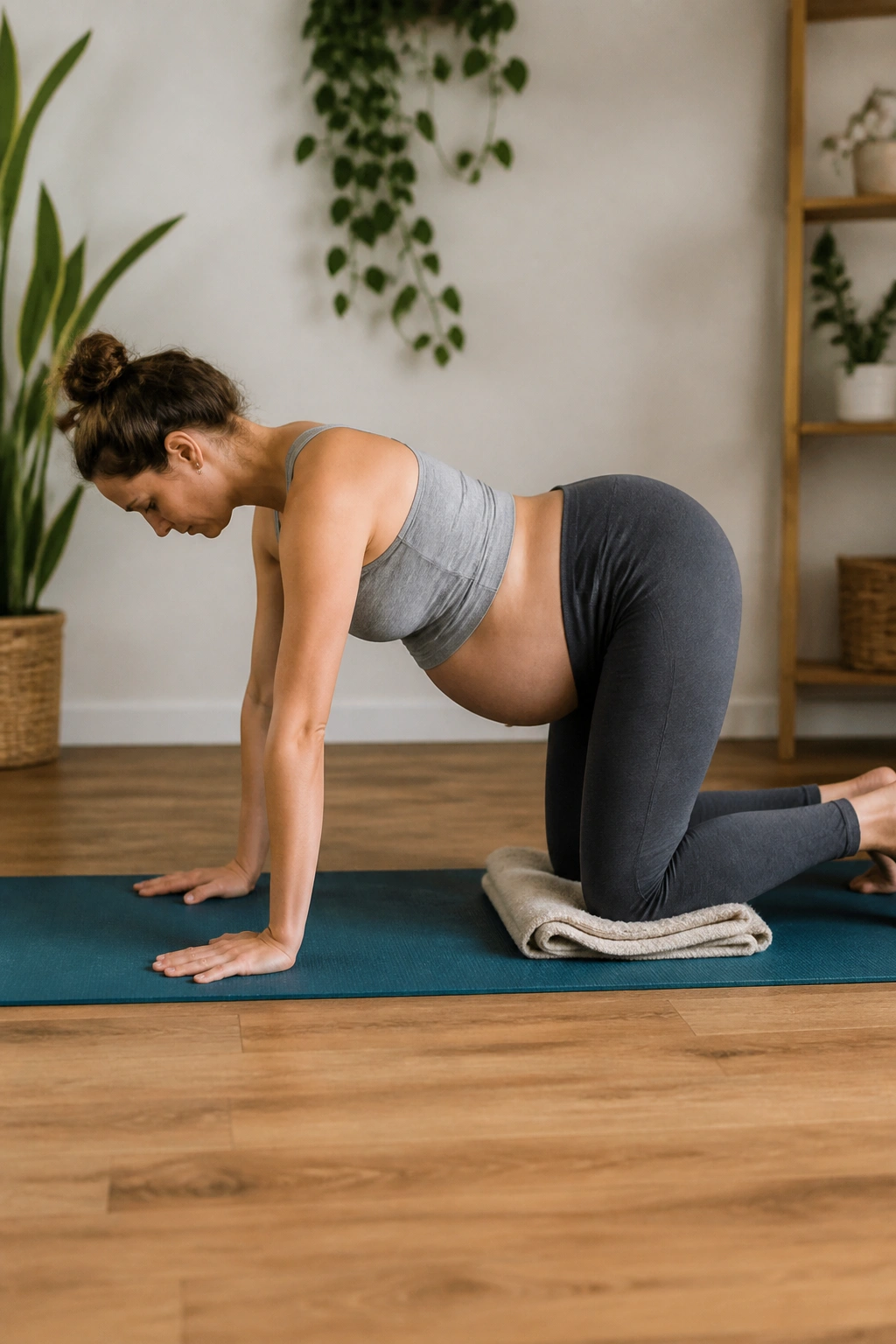
Tabletop looks plain from the outside. Inside the body, it can be a small miracle.
Get on hands and knees with blankets under the knees. Gently tuck and untuck the pelvis on the exhale and inhale. Then circle the hips in one direction for 5 slow rounds, switch, and rock the torso back an inch or two, just enough to feel the hips loosen.
The point is not to stretch hard. The point is to wake up the joints that are carrying more load now.
A simple pattern
- 5 pelvic tilts
- 5 hip circles each direction
- 6 gentle rocks back and forward
- 3 slow cat-cow rounds
This kind of movement often feels especially good after sitting too long. The belly has room, the spine moves without pressure, and the body gets a break from standing.
A little boredom is fine here. Boring and useful beats fancy and painful.
11. Second-Trimester Low Lunge With Blocks
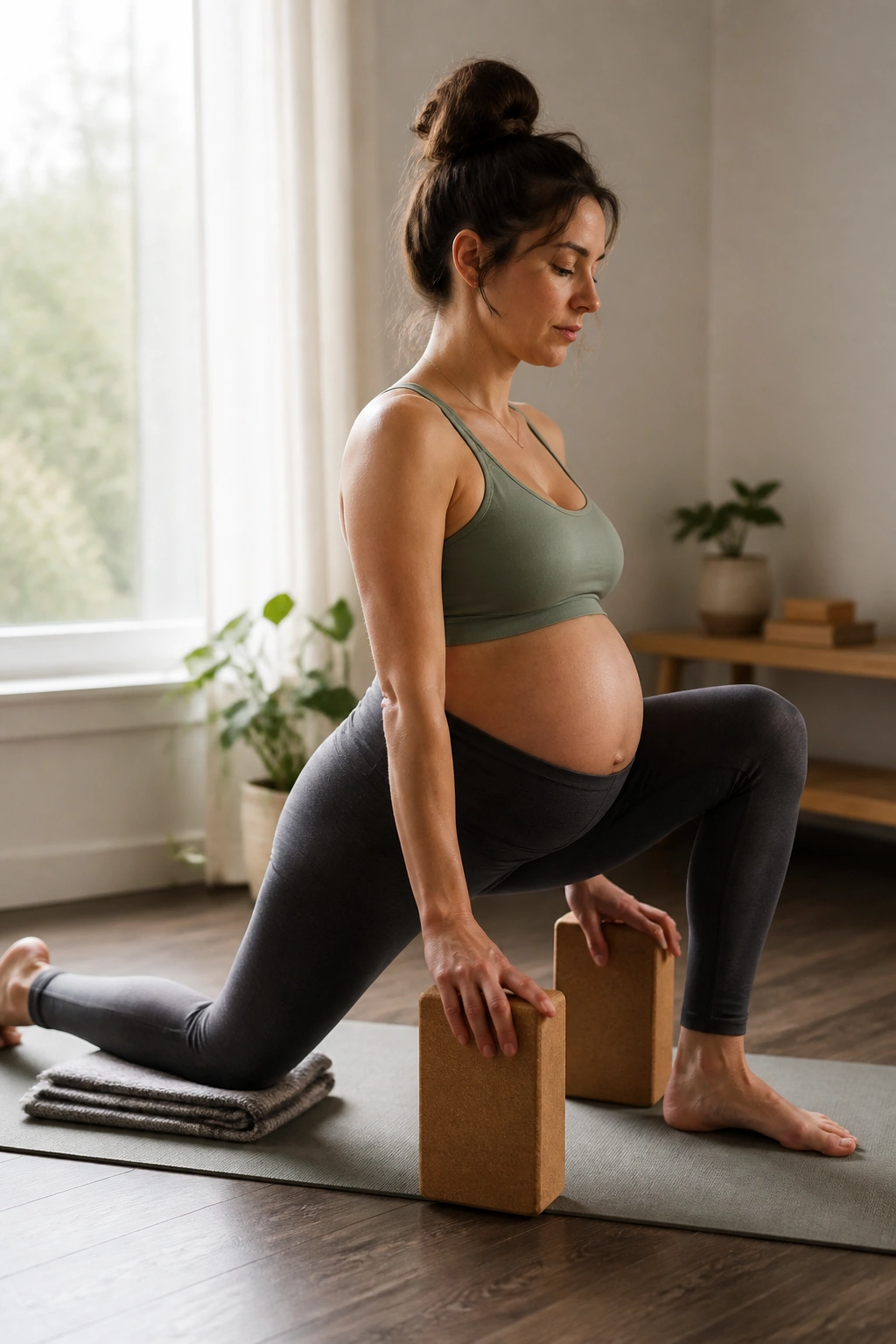
A low lunge is one of those poses that looks simple and turns out to be picky. The trick is keeping it small and supported.
Step one foot forward from tabletop and bring the back knee to a folded blanket. Place both hands on blocks, not the floor, unless the floor feels effortless. Then nudge the pelvis forward only a little until you feel the front of the hip wake up. Stay for 3 to 5 breaths, then switch sides.
If the back hip feels cranky, shorten the stance. If the front knee feels stuffed, move the foot a little farther out. The pose should feel like a stretch across the front of the thigh, not a tug in the knee.
One sentence matters here: do not sink and hang. A hanging lunge can turn into a sloppy backbend, and that is usually where the trouble starts.
12. Second-Trimester Soft Chest Opener on a Bolster
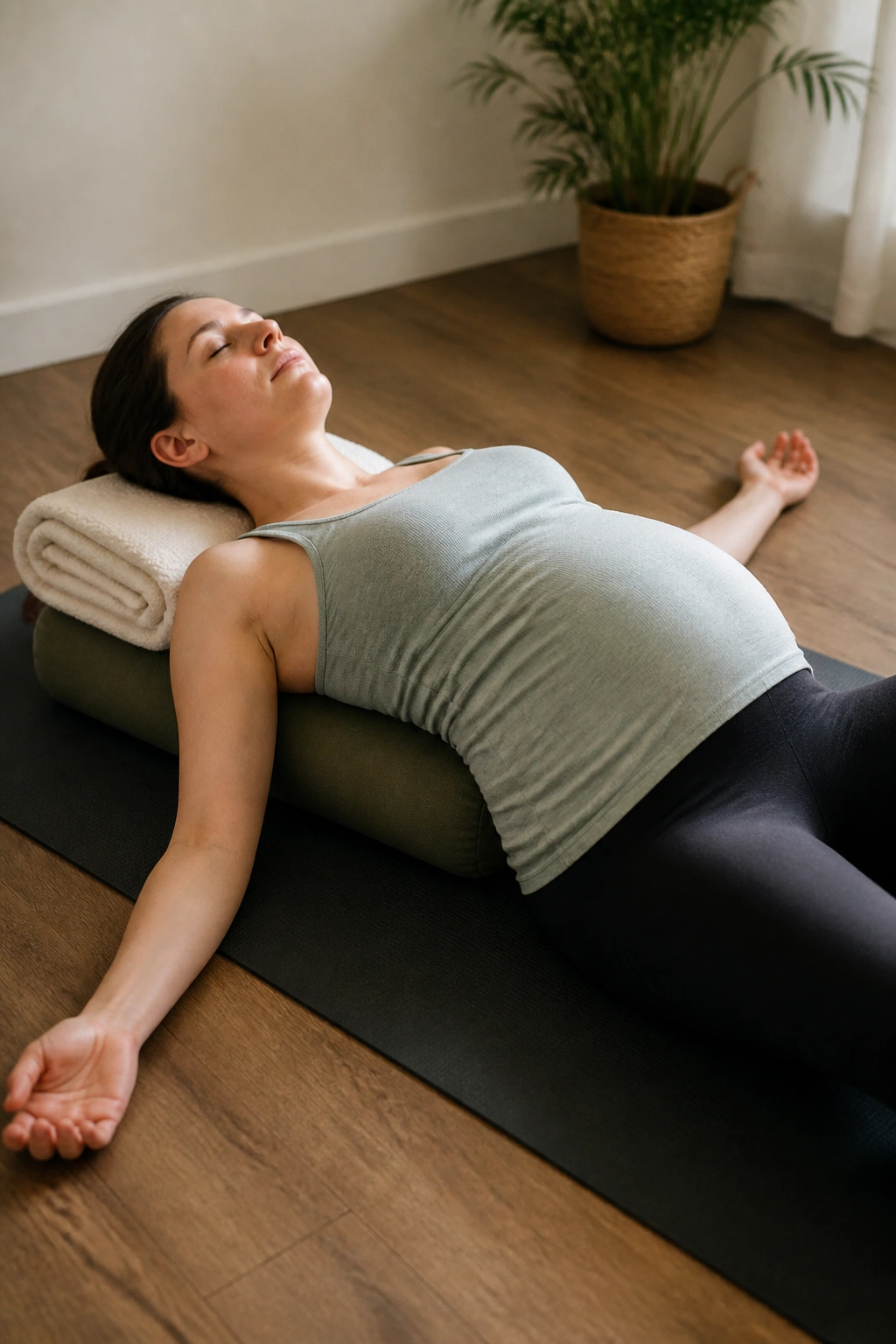
This is gentler than a deep backbend and easier on the lower back too.
Lie with a bolster under the upper back or under the ribs, head supported by a folded blanket, and let the arms fall open in a cactus shape. If full recline feels strange, place the bolster against a wall and sit into it instead. Stay for 2 to 5 minutes and let the front of the body widen on the inhale.
Best for
- Rounded shoulders
- Desk fatigue
- A chest that feels closed after long days
- A need for rest without sleeping
I prefer this kind of opener to a dramatic bridge pose in pregnancy because it asks less of the abdomen and usually feels calmer in the jaw and neck. It also gives the rib cage a little room, which can be welcome once breathing starts to feel shallower.
If heartburn or pressure shows up, come out earlier. No need to prove anything.
13. Third-Trimester Chair Yoga for Heavy Legs
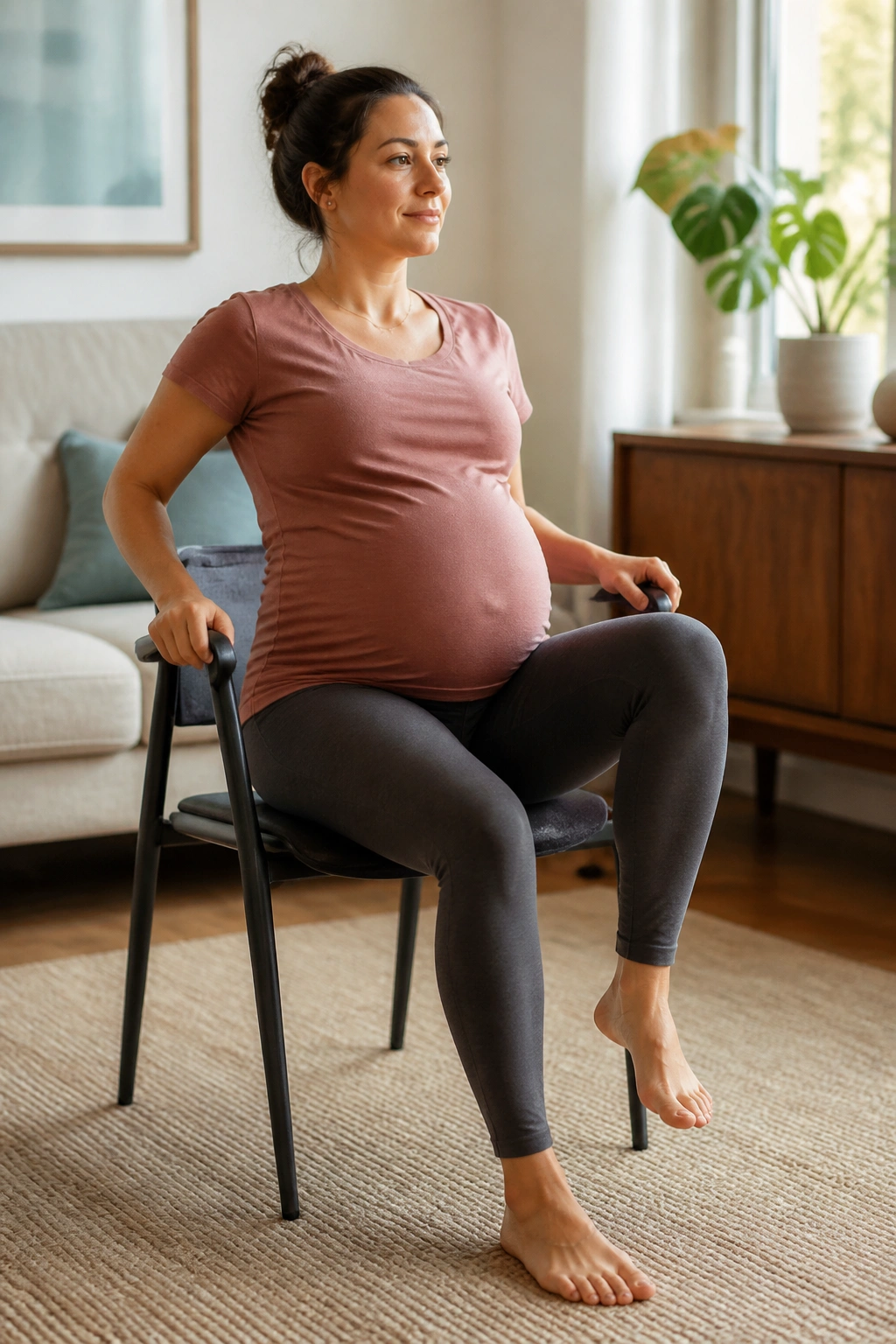
By the third trimester, a chair can become your best prop. Honestly, it should be used more often.
Sit near the front edge of the chair with your feet flat and your spine tall. March one knee at a time, circle the ankles, then rise to stand with help from the chair arms or the seat. Add a side bend by reaching one arm overhead and keeping the seat grounded. Everything stays small, but the effect can be surprisingly good.
First five minutes
- 10 seated marches
- 8 ankle circles each side
- 5 slow sit-to-stands
- 3 side bends per side
The chair keeps the practice from feeling like a balancing act. That matters when the belly is heavy, the pelvis is tired, and the idea of getting down to the floor sounds like a lot.
There is no shame in this version. None.
It is sturdy, it is accessible, and it respects a body that is doing a lot already.
14. Third-Trimester Side-Lying Hip Release
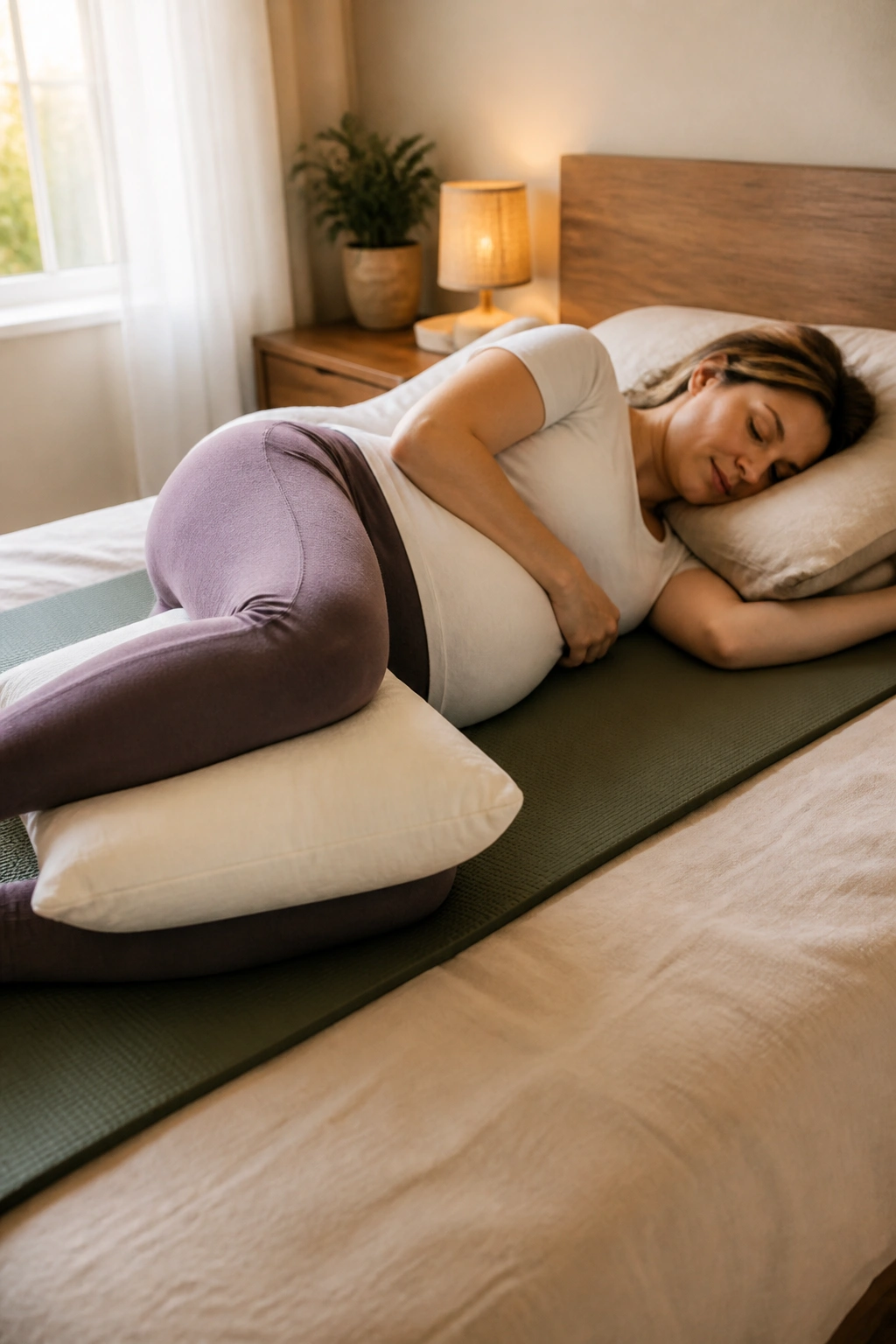
Some stretches get better when you take the floor out of them. This is one of them.
Lie on your side with a pillow between your knees and another under your head. Bend the top knee and rest it on a block or bolster if the hip wants more space. If figure-four feels comfortable, keep it tiny. If it does not, skip it and stay with the supported side-lying shape.
The goal is to ease the outer hip and low back without forcing a long stretch. A lot of people notice the pelvis settles faster this way than in a seated stretch, probably because the lower body can stop bracing.
Use this after walking, after standing, or after a night of broken sleep. It is a good reset, and it does not ask for much. No pushing into the knee. That is the rule.
15. Third-Trimester Rocking Tabletop Sequence
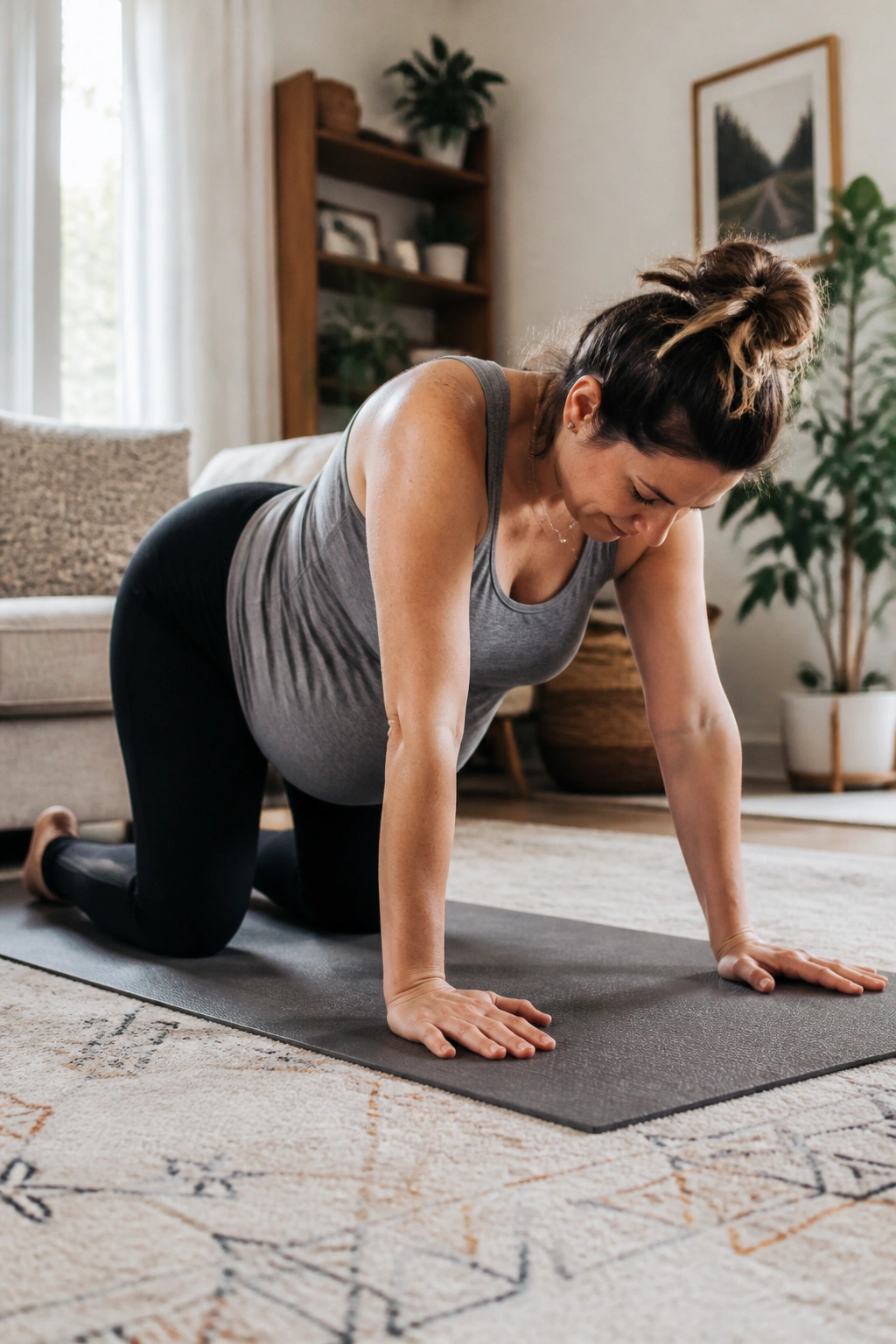
Why does rocking on hands and knees feel so good late in pregnancy? Because it gives the spine a way to move without carrying the full load of gravity.
Get into tabletop with the knees wide enough to make room for the belly. Rock back an inch or two, then forward, then circle the hips. Keep the elbows soft and the neck long. If wrists are a problem, come down onto forearms or place the hands on blocks.
How to do it
- Rock back and forth 6 to 8 times
- Add 5 circles each direction
- Pause in neutral and breathe 3 times
- Repeat once if it still feels nice
This can ease a sore low back and give the pelvis a little rhythm, which often feels better than static stretching. Some people even use this sequence in labor. That may be a little too much promise for a yoga article, but the comfort piece is real.
It’s also one of the few poses where being slightly unglamorous is a plus. Rocking is honest. It works.
16. Third-Trimester Wall Squats and Calf Stretch
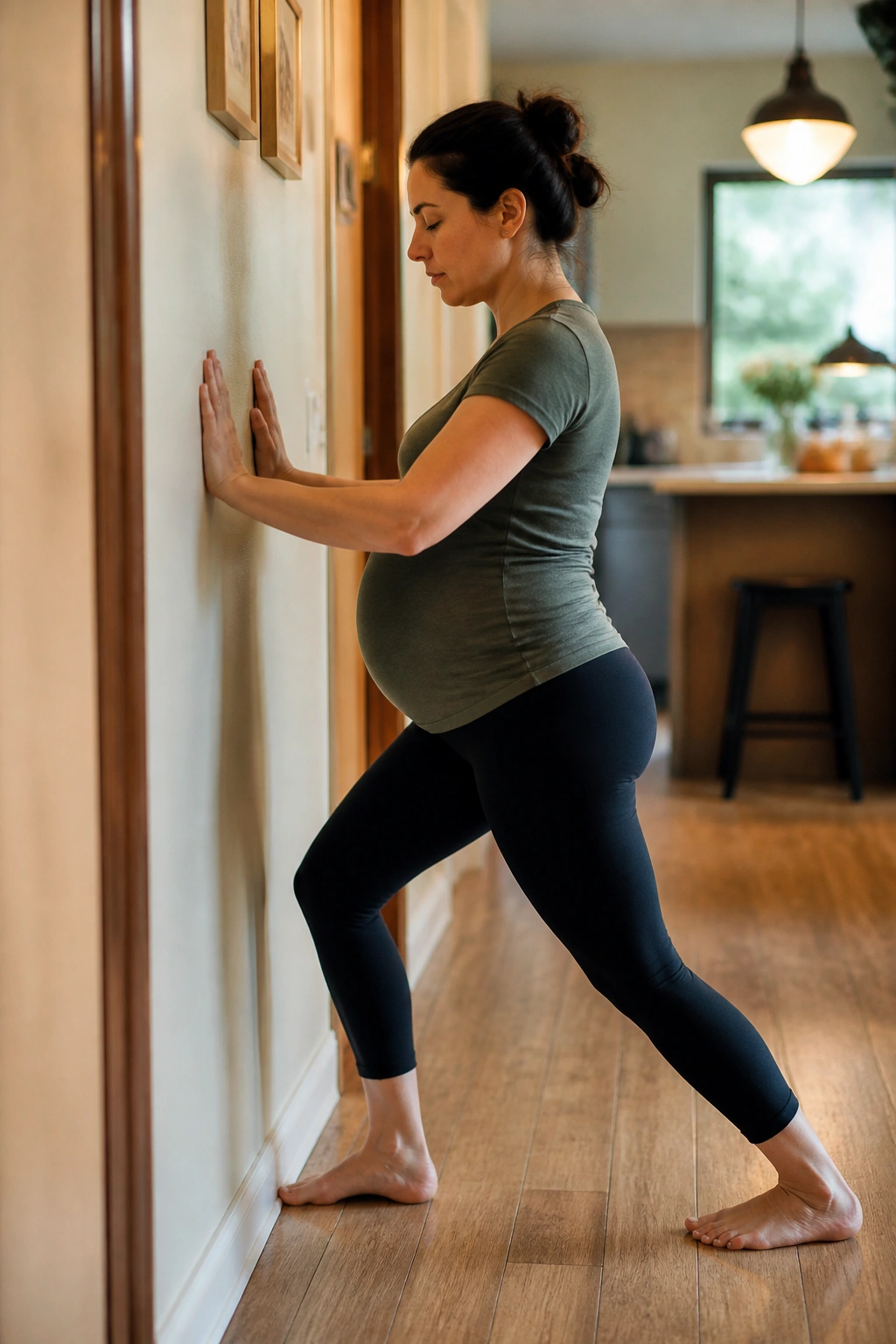
A wall squat late in pregnancy is less about strength and more about staying mobile without strain.
Stand with your back against the wall and slide down just a little. Hold for 2 or 3 breaths, then come up. After that, step one foot back into a calf stretch with both hands on the wall. Repeat on both sides. The whole thing should take less than 5 minutes.
What to keep in mind
- Keep the squat shallow
- Hold the wall if balance feels unsteady
- Don’t force the knees lower than comfortable
- Keep the breath smooth
This combo helps with stairs, standing from low chairs, and all those tiny movements that become weirdly effortful late in pregnancy. Calves get tight, ankles get puffy, and the body starts asking for support in plain terms.
A deep squat is not the point here. A workable squat is.
17. Third-Trimester Wide-Knee Child’s Pose Support
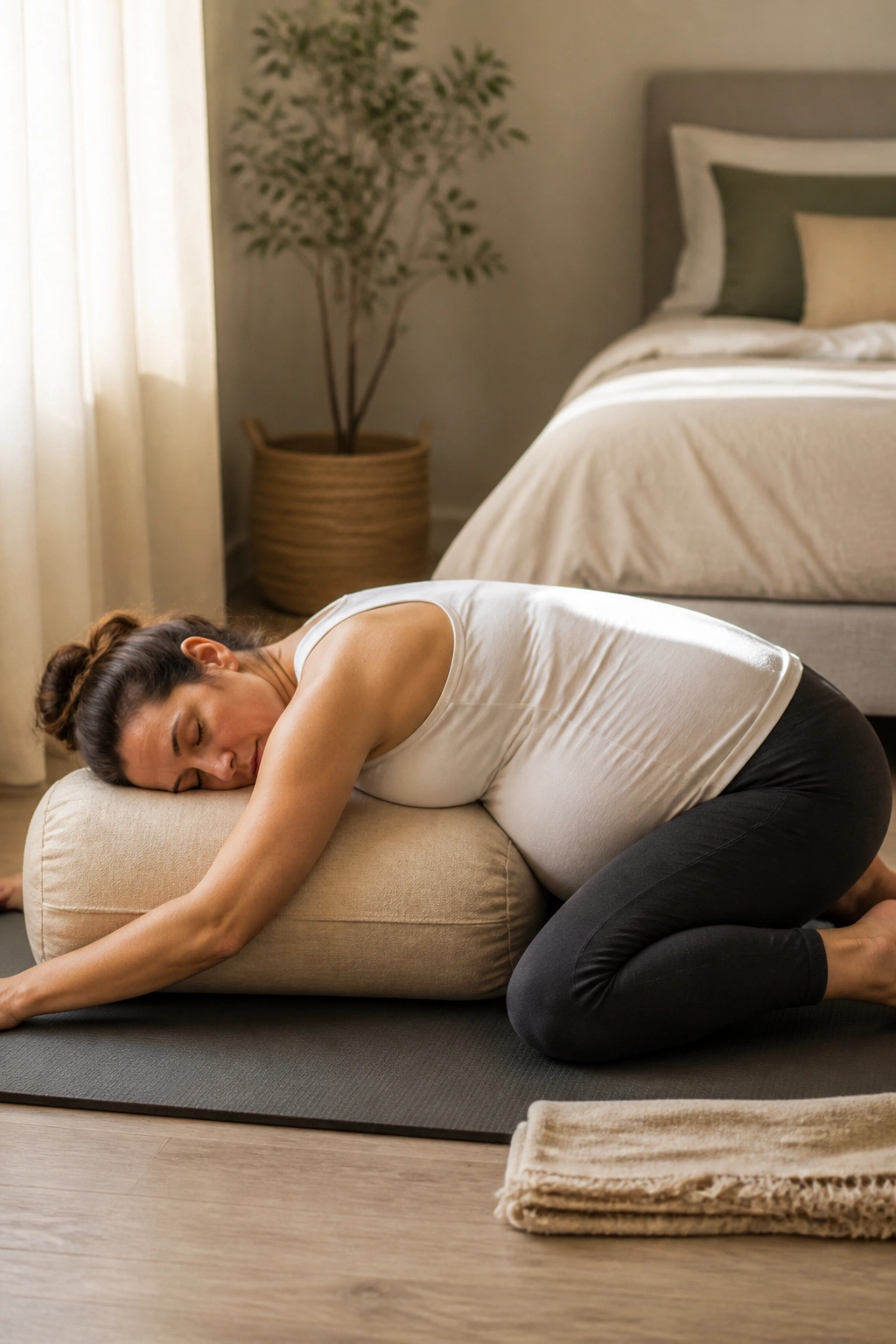
Child’s pose can still belong in pregnancy, but it usually needs help.
Open the knees wide enough to make room for the belly, place a bolster or stacked pillows under the chest, and turn the head to one side or rest it on a folded blanket. If the floor feels too low, do the whole thing on a bed or couch. Stay for 5 to 10 breaths, then switch the head position.
This is one of the best places to let the back body widen. The hips can sink, the ribs can soften, and the belly does not feel trapped. That combination is hard to beat on a tired day.
Try it when
- Your back feels compressed
- You want rest without lying flat
- The pelvis feels busy
- You need a break from standing
If the knees or ankles complain, come out. A pose that creates new joint pain is not helping.
18. Third-Trimester Left-Side Rest and Breath Scan
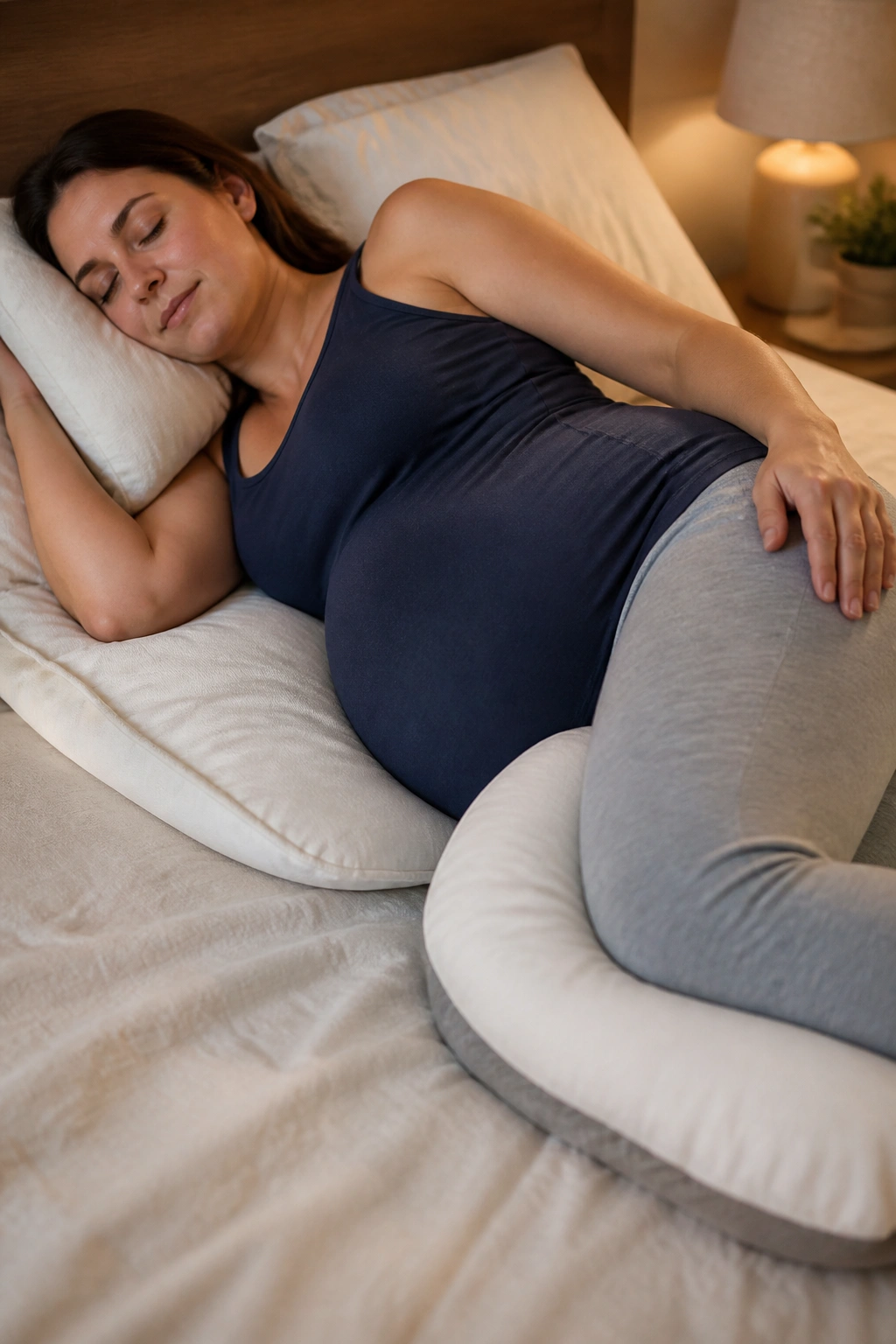
A lot of people treat rest like the thing that happens after the real work. I don’t. Late pregnancy often makes rest the real work.
Lie on your left side with a pillow under your head, one between your knees, and another under the bump if you need it. Let the top shoulder roll forward slightly so the chest stays easy. Then scan the breath from nose to ribs to belly and lengthen the exhale just a touch.
This is the quietest routine on the list, and maybe the most useful one. It gives the body a chance to stop bracing. It also keeps pressure off the back and makes it easier to notice whether you are tired, hungry, thirsty, or just done with the day.
A final five minutes like this can change how the rest of the evening feels. Not dramatically. Just enough.
And that is often what prenatal yoga does best: not grand gestures, not impossible poses, but small shifts that make the body feel more livable. If you build your practice around support, breath, and plain comfort, it will meet you better in every trimester — and it won’t ask you to pretend you feel the same in all three.
