



There is a specific, quiet frustration that comes from staring at a calendar that offers zero margin for error. You have a meeting at nine, a deadline by noon, and a list of responsibilities that seems to grow the moment you cross something off. The idea of driving to a gym, waiting for a locker, and spending an hour wandering between machines feels like a logistical impossibility. You end up skipping the exercise entirely because you assume it requires a massive block of time that you simply do not have.
This is a mistake. The assumption that quality exercise requires sixty to ninety minutes is a leftover relic from an era when we thought duration was the only metric that mattered. Research has shown that density—not duration—is what drives cardiovascular adaptation and metabolic health. If you can commit to thirty minutes of focused, high-intensity effort, you can generate a physiological response that equals or outperforms the aimless hour spent jogging on a treadmill while watching the clock.
The key to short workouts is eliminating the transition time and the “fluff.” You do not have time for a twenty-minute warm-up or lengthy breaks between sets. You need a structure that demands your attention from the first second to the last. When you remove the downtime, you find that thirty minutes is actually an eternity. It is enough time to push your heart rate into a zone that forces change, burns energy, and leaves you feeling genuinely worked. You just need the right framework to keep the intensity high without needing a coach to stand over you.
1. The HIIT Ladder Workout
This workout is built on a simple descending ladder structure. It is psychologically easier to tackle because the repetitions decrease as you get more fatigued. You will need a timer, but you do not need any external weights or equipment. The goal is to finish the entire ladder as fast as possible while maintaining perfect form.
Why the Ladder Format Works
When you start with a high number of repetitions, you are fresh. As you fatigue, the repetition count drops, which allows you to maintain speed even when your lungs are burning. It turns the workout into a game against the clock, which keeps your brain engaged and prevents you from drifting into a low-effort steady state.
The Ladder Protocol
Set your timer and complete the following exercises as a continuous circuit. Do the first round for 10 reps of each move, the second round for 8, then 6, 4, and 2.
- Bodyweight Squats: Focus on depth and keeping the chest upright.
- Push-ups: Keep your core tight and elbows tucked close to your sides.
- Mountain Climbers: Count every knee drive as one rep; do both sides to complete the set.
- Burpees: Ensure your chest touches the floor and your jump at the top is explosive.
Pro tip: If you finish the ladder faster than 30 minutes, go back up the ladder (2, 4, 6, 8, 10). This ensures you get the full 30 minutes of work regardless of your fitness level.
2. High-Intensity Jump Rope Circuit
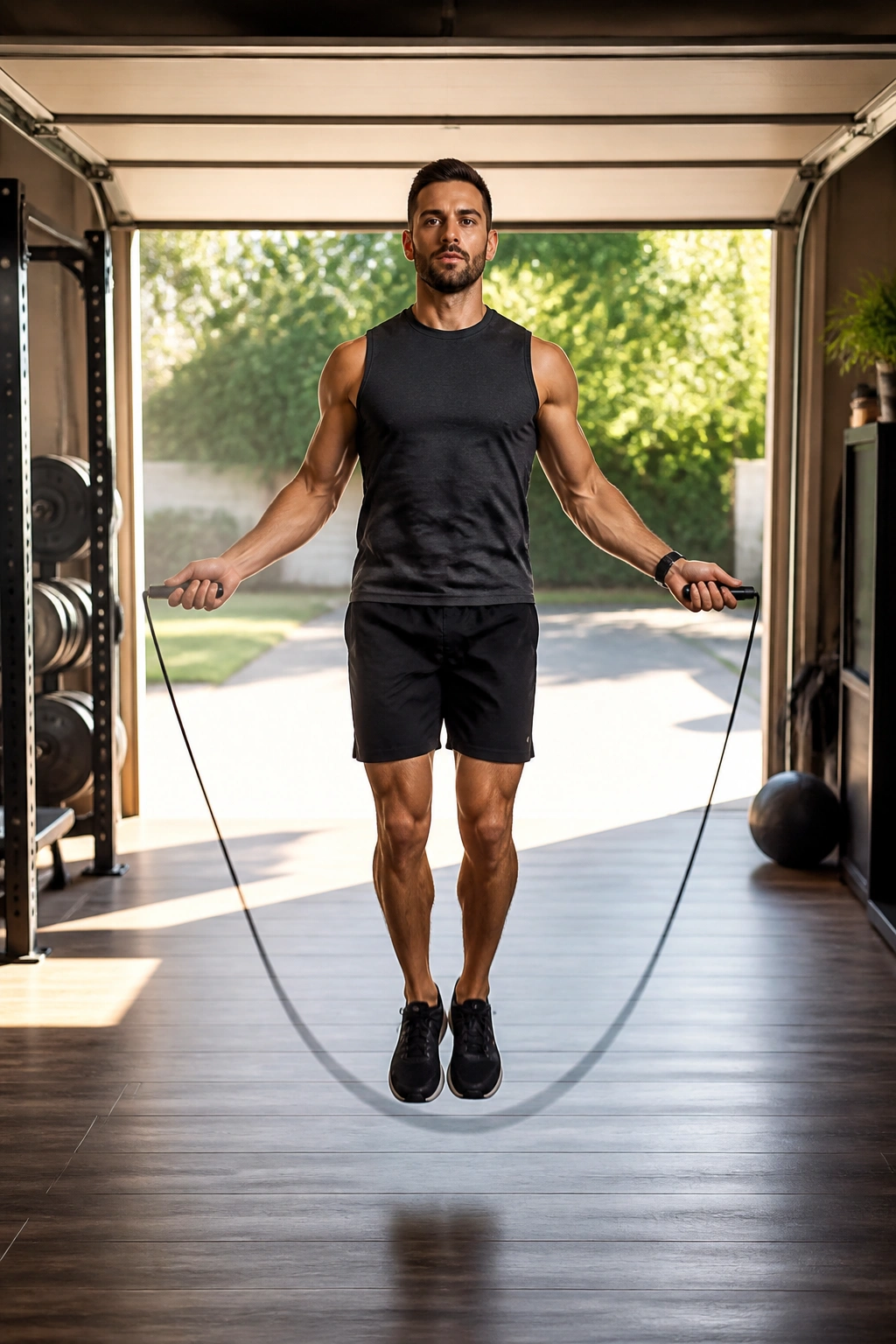
Jumping rope is, pound for pound, the most efficient cardiovascular tool available. It requires full-body coordination, builds ankle stability, and forces your core to engage constantly. It is cheap, portable, and aggressive. If you have thirty minutes, you can get a world-class workout in your living room or driveway.
Most people underestimate the toll jumping rope takes on the nervous system. You are not just doing cardio; you are performing hundreds of small, plyometric contractions. This is why you should focus on short, sharp bursts of speed rather than trying to jump steadily for thirty minutes straight.
Your circuit should look like this: 45 seconds of fast-paced jumping followed by 15 seconds of rest. Repeat this block 20 times. For the remaining ten minutes of your window, perform three rounds of bodyweight lunges and plank holds to give your calves and ankles a brief recovery while keeping the heart rate elevated. If you trip, do not reset the timer; just keep moving. The stumble is part of the rhythm.
3. The Tabata Protocol

Tabata is not a suggestion; it is a rigid scientific protocol that demands 100% effort. The structure is 20 seconds of maximum effort followed by 10 seconds of rest. Doing this eight times completes one four-minute round. When you have thirty minutes, you are looking at roughly six full Tabata blocks with enough time for short transitions.
Why does this work? The short rest period is not enough to fully recover, which forces your body to work in an oxygen-deprived state. This is exactly what improves your VO2 max. You aren’t pacing yourself here. You are going as hard as you possibly can for that 20-second window.
Choose four movements: one for upper body (push-ups), one for lower body (air squats), one for core (crunches or hollow holds), and one for explosive cardio (high knees). Perform two rounds of each. If you are breathing properly and pushing the pace, you will find it nearly impossible to hold a conversation by the fourth block. That is the point.
4. Hill Repeats or Stair Climbers

If you have access to a steep hill or a long flight of stairs, you have everything you need. This is the “old school” method of building an engine. There is no trickery here; it is just gravity versus your willpower. The incline forces you to use your posterior chain—glutes and hamstrings—much more than flat-ground running, which burns significantly more calories in less time.
Find a hill or staircase that takes about 45 to 60 seconds to climb at a hard pace. Walk or jog back down to recover. This recovery phase is non-negotiable; your heart rate needs to drop slightly so you can hit the next interval with maximum power. Repeat this cycle for 25 minutes.
Use the final 5 minutes to walk on flat ground. Do not rush the cooldown. Your legs will feel heavy, and your lungs will be burning, but the feeling of accomplishment after a solid block of hill repeats is unmatched. It is a simple, primal way to stress the cardiovascular system.
5. EMOM (Every Minute on the Minute)

The EMOM format is built on the pressure of the clock. You have a set amount of work to do within each minute. Whatever time remains after you finish the work is your rest. If you finish in 40 seconds, you get 20 seconds of rest. If you finish in 55 seconds, you get 5 seconds of rest.
This system is self-regulating. If you pick a rep count that is too high, your rest disappears. If you pick one that is too low, you rest too much. Start with a target of 45 seconds of work per minute. This leaves you enough recovery to perform well in the next minute.
Try this mix:
- Minutes 1, 4, 7, 10, 13, 16, 19, 22, 25, 28: 15 Burpees.
- Minutes 2, 5, 8, 11, 14, 17, 20, 23, 26, 29: 20 Kettlebell swings or weighted squats.
- Minutes 3, 6, 9, 12, 15, 18, 21, 24, 27, 30: 20 Mountain climbers.
The constant changing of movements keeps you mentally sharp, while the clock forces you to maintain intensity.
6. No-Equipment AMRAP

AMRAP stands for “As Many Rounds As Possible.” This is the ultimate test of work capacity. You define the circuit, you set the timer for 30 minutes, and you do not stop until the timer beeps. There are no scheduled breaks; the only recovery you get is what you force yourself to take when your muscles literally cannot move another inch.
The challenge with AMRAP is pacing. Beginners often sprint the first five minutes and then crawl for the remaining twenty-five. You need to find a sustainable, “uncomfortable” pace—a speed where you are breathing hard but don’t need to stop for a minute-long break.
Try a simple triplet: 10 push-ups, 20 jumping lunges, and 30 bicycle crunches. Cycle through these indefinitely for the half-hour. Keep a tally on a piece of paper or a whiteboard. Knowing how many rounds you completed adds a layer of competitive drive. Next time you do this exact workout, you will have a baseline to beat.
7. Power Walking Intervals

People tend to dismiss walking as “not a real workout,” which is a mistake. If you turn a walk into a series of power intervals, you can absolutely fry your legs and lungs without the joint impact of running. This is the ideal option for days when you feel beat up or need a lower-impact session.
Find a route with some undulation. Walk at a brisk, purposeful pace—the kind where you cannot talk easily. Every 3 minutes, switch to “power walking” for 60 seconds. During this minute, drive your arms hard and take shorter, faster steps, focusing on contracting your glutes with every stride.
If you are on a treadmill, set the incline to 5% or higher. Do not hold onto the handrails. That is a common habit that ruins the effectiveness of the incline. Let your arms swing naturally. The burn in your calves and glutes will surprise you within ten minutes.
8. Dumbbell Metabolic Circuit

If you have a pair of dumbbells, you can combine strength training with cardio. The key here is to choose a weight that is heavy enough to challenge you but light enough that you can maintain a constant, fluid tempo. You aren’t doing heavy powerlifting; you are moving iron to keep your heart rate up.
Perform 12 reps of each movement, moving directly from one to the next without putting the weights down.
- Dumbbell Goblet Squats: Hold one weight at your chest.
- Overhead Press: Keep the core tight to protect your lower back.
- Dumbbell Rows: Keep the back flat and pull toward your hip.
- Dumbbell Deadlifts: Hinge at the hips, keeping the weights close to your shins.
After one full round of these four, rest for 60 seconds. Repeat for the duration of your 30-minute block. The weight adds resistance, which increases your heart rate more than bodyweight movements alone.
9. Shadow Boxing Drills

Shadow boxing is a fantastic way to train coordination, speed, and endurance. You do not need to be a fighter to use boxing movements for fitness. Throwing punches—especially if you do it with intent and speed—requires a tremendous amount of rotational power from the core and sustained effort from the shoulders.
Set your timer for 3-minute rounds, followed by 1 minute of active recovery (marching in place or light jumping). Do 8 rounds. In the active rounds, don’t just wave your arms; extend your punches fully and snap them back. Move your feet constantly. Stay light on your toes.
If you feel uncoordinated, start simple: 1-2 (jab-cross) combos. Add a hook once you get the rhythm. The mental focus required to “fight” an invisible opponent makes the time pass significantly faster than staring at a wall while running.
10. Rowing Machine Intervals

If you have access to a rowing machine, you possess one of the most brutal cardiovascular tools in existence. It works every major muscle group in the body, but it is notoriously difficult to pace. A 30-minute steady row can become incredibly monotonous, which is why intervals are the superior choice.
Try a 500-meter sprint followed by 90 seconds of light rowing. Repeat this as many times as you can within your thirty minutes. The 500-meter sprint is long enough to hurt, but short enough that you can push really hard.
Focus on your leg drive. Most people make the mistake of using their arms too much. The power should come from your legs pushing against the footplates. Your arms are just the cables connecting your torso to the handle. If your lower back starts to ache, re-evaluate your form; you should be hinging at the hips, not rounding your spine.
11. Kettlebell Flow

A kettlebell flow involves linking several different movements together without setting the bell down. It is an “everything” workout: strength, stability, grip endurance, and cardio. It feels less like a structured routine and more like a dance.
Start with a simple flow: 5 swings, 5 cleans, 5 overhead presses, 5 squats. Do this on the right side, then immediately switch to the left side without resting. Rest for 60 seconds after completing both sides. Continue this for 30 minutes.
The weight forces you to focus on your breathing, and the transitions force you to stay balanced. It is difficult to rush this, which is good. The intensity comes from the continuous movement, not from sprinting. You will find your grip strength becomes the limiting factor quickly, which is a great indicator that you are pushing hard.
12. Bodyweight Cardio Pyramids

A pyramid workout is mathematically elegant and physically demanding. You start with low reps, climb to a peak, and then descend back down. It manages your fatigue perfectly.
Try a pyramid of 10-20-30-20-10 for three exercises: Jump Squats, Push-ups, and Sit-ups.
- Do 10 reps of each.
- Do 20 reps of each.
- Do 30 reps of each.
- Back to 20 reps of each.
- Back to 10 reps of each.
If you finish a full pyramid in under 15 minutes, rest for two minutes and start over. The mental aspect of “climbing” the pyramid forces you to dig deep during the 30-rep set, and the “descent” gives you a sense of relief that pushes you to move faster.
13. Stationary Bike Sprint Intervals

The stationary bike is often viewed as the “lazy” cardio option, but only if you use it that way. If you use the resistance settings and treat the bike like a sprint tool, it is devastatingly effective. It is also the safest option if your joints are feeling inflamed or if you are recovering from a minor tweak.
Set the resistance to a level where you can pedal hard but not “spin out.” Do 30 seconds of all-out, maximum-effort pedaling followed by 30 seconds of very light, slow pedaling. Repeat this for the full 30 minutes.
Do not cheat the rest intervals. The reason this works is the contrast between the sprint and the recovery. If you pedal at a medium pace the whole time, you aren’t doing intervals; you are just doing steady-state cardio. You need to hit that sprint intensity where your legs feel like they are flooding with lactic acid, then rely on the recovery to clear it.
14. Battle Rope Conditioning

Battle ropes are fantastic for upper-body conditioning, which is often neglected in cardio routines. Most cardio is leg-dominant (running, biking, rowing). The ropes shift the demand to your shoulders, lats, and core.
Use 30-second intervals:
- Double Waves: Both arms up and down together.
- Alternating Waves: Left arm up, right arm down.
- Slams: Bring the ropes high overhead and smash them down.
- Circles: Move the ropes in outward circles.
Perform 30 seconds of work followed by 30 seconds of rest. Cycle through the four movements, then repeat. You will find that your shoulders burn out long before your lungs do. This is a humbling workout. If you do not have access to real battle ropes, you can simulate this with resistance bands attached to a sturdy post, though it requires a bit more focus to keep the tension consistent.
15. The “Deck of Cards” Game

This is the best workout for when you are bored. Take a standard deck of cards, shuffle it, and assign a movement to each suit. You flip a card, perform the corresponding exercise for the number of reps on the card (face cards are 10, Aces are 11 or 1), and move to the next.
For example:
- Hearts: Burpees
- Diamonds: Mountain climbers
- Spades: Squats
- Clubs: Push-ups
You work through the deck for 30 minutes. It is entirely random. Sometimes you get a string of low cards, and you get a mini-break. Sometimes you pull three face cards of burpees in a row, and your heart rate spikes to the ceiling. This randomness prevents your body from adapting to a set pattern and keeps the workout fun. It is hard to quit a workout when you are curious about what the next card will be.
Final Thoughts

The greatest barrier to fitness is not a lack of time; it is a lack of flexibility. We often wait for the perfect hour-long window that never arrives, so we end up doing nothing at all. You have to stop viewing these thirty-minute sessions as “lesser” workouts. They are, in many ways, superior because they demand a level of focus and intensity that a longer, slower session simply doesn’t require.
Consistency is built on these small, manageable victories. If you have a busy day, you don’t need to sacrifice your health; you just need to shift your strategy. Pick one of the routines above, set your timer, and commit to the intensity. Thirty minutes of honest effort is more than enough to maintain your momentum, improve your cardiovascular health, and clear your head for the rest of your day. The time is there if you are willing to take it.
