



High-intensity interval training, or HIIT, often gets pigeonholed as a strictly lower-body affair. People imagine endless sprints, burpees, and jump squats, leaving the arms and back to fend for themselves during “upper body days” that usually involve slow, heavy lifting. While traditional hypertrophy training has its place, you can absolutely achieve a shredded, muscular upper body by applying the principles of HIIT to your arm and back routines. When you ramp up the intensity and slash the rest periods, you force your muscles to work under metabolic stress, which drives both calorie burn and the type of vascular, toned look that heavy sets of twelve just cannot replicate.
The goal here is not necessarily to pack on massive bulk, but to build functional, lean muscle while keeping your heart rate high enough to burn stubborn fat. You are essentially doing double duty: building the aesthetic definition in your biceps, triceps, and lats, while simultaneously improving your cardiovascular conditioning. It is a grueling way to train, but for anyone tired of spending hours in the gym without seeing the definition they crave, it is one of the most efficient tools available. Forget the long, steady-state cardio sessions; let’s look at how to structure your upper body sessions to maximize muscle engagement and fat loss.
Before you begin, realize that form is the casualty of high intensity. In a standard set, you have time to reset your posture. In a HIIT circuit, that luxury vanishes. You must prioritize the integrity of your shoulder blades—keeping them retracted and depressed—even when your lungs are screaming and your muscles are burning. If you cannot maintain proper technique, pause for five seconds, reset, and jump back in. No workout is worth a rotator cuff injury.
1. The Push-Up and Plank Pyramid
This routine focuses on the chest and core, which are the anchors of your upper body aesthetics. You aren’t just doing push-ups; you are using the pyramid method to force adaptation. Start with 10 repetitions of standard push-ups, immediately transition into a 30-second high plank, then perform 9 push-ups, followed by another 30-second plank. Work your way down to one repetition.
Why It Works for Toned Arms
The constant tension in your triceps during the push-up phase, combined with the isometric stability required for the plank, keeps your arms under load for the entire duration of the circuit. This eliminates the “rest” period between push-ups, which is where many people lose the chance to spike their heart rate.
Pro Tip: Keep your elbows tucked at a 45-degree angle from your torso. Flaring them out wide puts unnecessary pressure on your shoulder joints and shifts the load away from your triceps and chest, where you actually want the toning effect.
2. Medicine Ball Slam and Burpee Superset

This combination targets the lats and shoulders through explosive power. Stand with a medicine ball, raise it fully overhead, and slam it into the ground with maximum force. Immediately follow this with a burpee, keeping your chest open as you stand.
The Metabolic Factor
Explosive movements require significant recruitment of fast-twitch muscle fibers. When you slam the ball, you are engaging the lats to generate force, which builds that “V-taper” look. Because burpees are inherently full-body, your heart rate will skyrocket instantly. Aim for 45 seconds of slams followed by 45 seconds of burpees, resting for only 30 seconds between rounds. Repeat for five cycles.
3. The Renegade Row Burnout

Renegade rows are arguably the gold standard for back and core stability. Assume a high plank position with your hands on a pair of dumbbells. Row one dumbbell toward your hip while stabilizing your entire body with the other arm.
How to Get the Most From It
Most people make the mistake of rocking their hips to get the weight up. That defeats the purpose. Your goal is to keep your torso completely parallel to the ground, squeezing your shoulder blade toward the spine at the peak of the row. Use a moderate weight—heavy enough to challenge you, but light enough that you don’t compromise your form. Perform 10 rows per side, then hold the high plank position for 20 seconds. Repeat this for 10 minutes straight.
4. Shadow Boxing with Light Weights

Pick up a pair of one-to-two-pound dumbbells—do not go heavier; your shoulders will give out before your aerobic system does. Stand in a staggered stance and throw high-volume punches: jabs, crosses, hooks, and uppercuts.
The Shoulder Cap Effect
This constant movement forces your deltoids to fire repeatedly without rest. It creates that “burning” sensation that signals high metabolic demand. Move for two minutes, rest for 30 seconds, and do this for six rounds. By the final round, you will feel your shoulders screaming. It is essential to keep your core tight during this; if your midsection goes soft, your shoulders will start to dump the weight, leading to potential strain.
5. Battle Ropes and TRX Row Combo
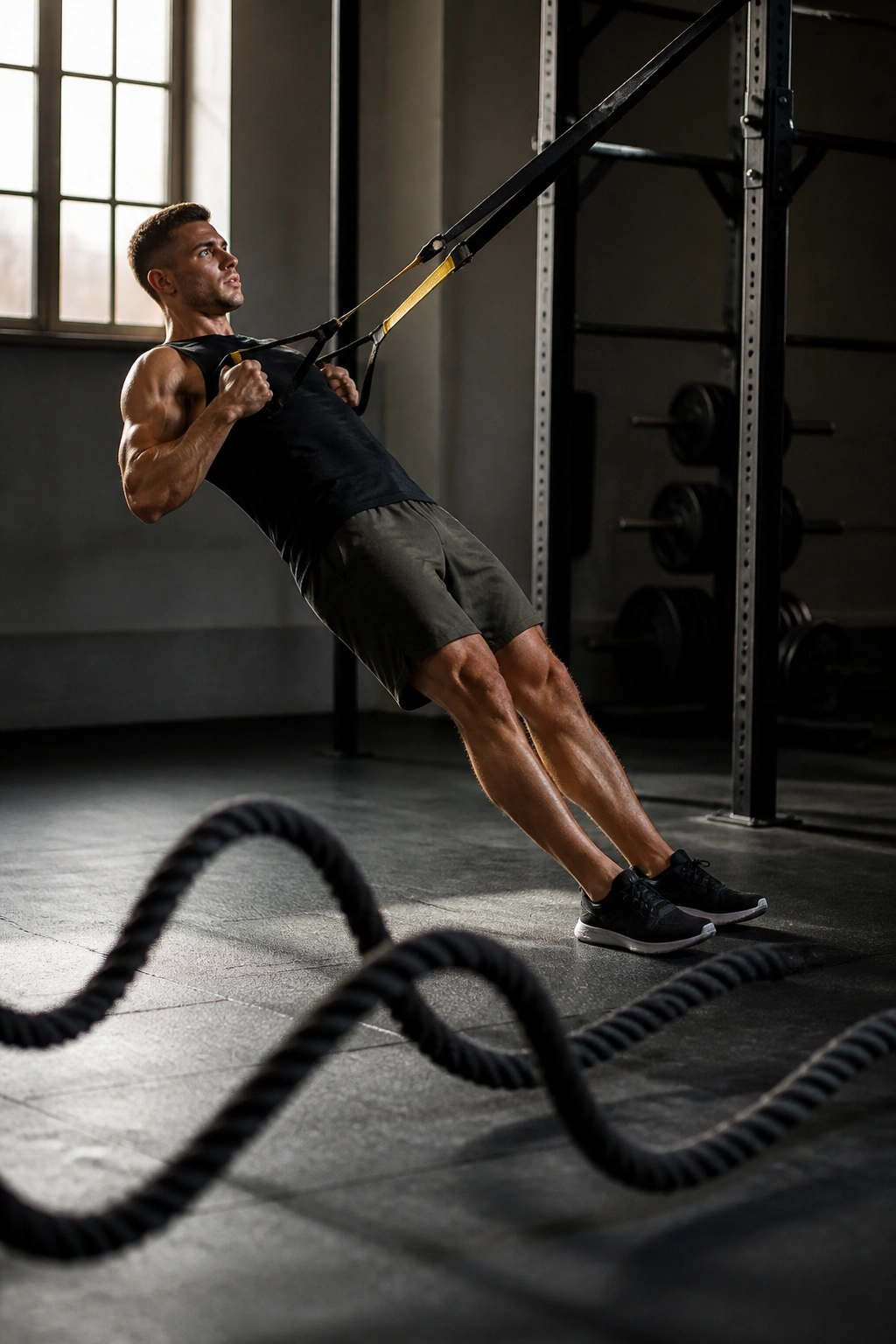
Battle ropes are fantastic for back thickness, while TRX rows target the rear delts and mid-back. This superset keeps your upper body engaged through different planes of motion.
The Execution
Start with 30 seconds of “double waves” with the battle ropes, creating a consistent rhythm that drives your heart rate up. Immediately move to the TRX straps. Perform 15 rows, focusing on a slow, controlled eccentric phase—take three seconds to lower yourself back down. The combination of the explosive power from the ropes and the controlled strength from the rows creates a unique stimulus for the back muscles. Perform this superset for six total rounds.
6. Diamond Push-Up and Tricep Dip Finisher

If you want toned arms, specifically the triceps, you need to isolate them while keeping the intensity high. Diamond push-ups force the triceps to do the heavy lifting for your chest.
Setting Up the Circuit
Perform 15 diamond push-ups (hands forming a diamond shape under your chest) and immediately transition to a bench or chair for 15 tricep dips. Keep your back close to the bench as you descend; dipping too far forward puts undue strain on the shoulders. If you start to fatigue, do not stop. Switch to regular push-ups to finish the set. This specific sequence is brutal but highly effective for defining the back of the arm.
7. The Kettlebell Snatch and Swing

While often viewed as a leg exercise, the kettlebell snatch requires massive upper body recruitment to guide the bell and lock it out overhead. Your lats, traps, and deltoids are the primary stabilizers here.
Why This Matters
The snatch builds shoulder stability and explosive lat strength. Perform 10 snatches per arm, then 20 swings, with zero rest between movements. The swing provides a brief moment of active recovery for the arms, allowing you to hit the snatches hard again in the next round. Do this for 10 minutes. The grip strength you build here is a massive secondary benefit, which will carry over to every other pulling movement you do.
8. Lateral Raise and Front Raise Interval

Dumbbell raises are the most common way to isolate the deltoids. To turn them into a HIIT workout, you need to adjust your tempo.
The Tempo Trick
Perform 10 lateral raises, followed immediately by 10 front raises, then 10 “bent-over” lateral raises to hit the rear delts. Do not rest between these exercises. This “around the world” approach ensures every head of the shoulder is fatigued. After the 30 reps, rest for 45 seconds and repeat the circuit. By the fourth round, you will likely struggle to lift your arms above shoulder height. That is exactly where the muscle shaping happens.
9. Inverted Row and Chin-Up Hold

The chin-up is one of the best moves for back width and bicep definition. For this HIIT circuit, you aren’t doing max reps; you are doing max effort holds and explosive pulls.
The Isometric Hold
Do as many chin-ups as you can with good form, then jump up and hold your chin over the bar for as long as possible. Once you drop, immediately perform 10 inverted rows under a bar or on rings. The transition from the high-tension chin-up to the horizontal row fatigues the lats from two different angles. Repeat for five rounds. Your back will feel “pumped,” which is exactly the signal you want for muscle growth.
10. Resistance Band Face Pulls and Pulldowns

Bands provide constant tension throughout the entire range of motion, which is something free weights cannot replicate. This is ideal for rear-delt health and posture.
Why This Is Different
Attach a resistance band to a high point. Perform 20 face pulls—focusing on pulling the band toward your forehead and pinching your shoulder blades together. Immediately switch to 20 straight-arm pulldowns. Keep your arms straight and feel the contraction in your lats. Do this for four minutes without stopping. You aren’t aiming for heavy resistance here; you are aiming for continuous tension and a massive increase in blood flow to the back muscles.
11. Pike Push-Up and Shoulder Tap

The pike push-up is a variation of the push-up that shifts the weight onto the shoulders, essentially acting as a vertical press.
The Anatomy of the Move
To perform a pike push-up, get into a downward dog position with your hips high in the air. Lower your head toward the floor. To add the HIIT element, perform 10 pike push-ups, then stay in that position and perform 20 shoulder taps (10 per side). The shoulder taps force you to stabilize, which turns the movement into a core-intensive exercise as well. This targets the anterior deltoids and creates a defined shoulder cap.
12. Bicep Curl to Overhead Press Superset

This moves the load vertically, which is a classic builder for the shoulders and arms. The transition between the curl and the press is key.
Maintaining Tension
Use a pair of moderate dumbbells. Perform a bicep curl, but do not drop the weights. Immediately transition them into an overhead press. This is one fluid motion. Because you are using the same weight for both moves, the press will feel much harder than the curl, which is fine. Aim for 45 seconds of continuous work, 15 seconds of rest, and repeat for 10 rounds. This keeps the heart rate high while putting the arms and shoulders under constant metabolic load.
13. Plank Rows and Hover-to-Cobra

This is a slower, more deliberate HIIT movement that emphasizes back mobility and strength. Start in a high plank with dumbbells and perform a row.
Why This Works
After the row, drop to your forearms and slide forward into a “cobra” stretch, feeling your lats lengthen, then pull back into the plank. This combines a strength movement with a mobility-based recovery move. It feels different because you are working the muscles through their full stretch. It is a phenomenal way to burn out the lats without the joint impact of heavy, explosive lifting.
14. Upright Row and High Pull

Upright rows have a bad reputation, but when performed with a slightly wider grip and a focus on keeping the elbows above the wrists, they are excellent for the traps and shoulders.
The High Pull Variation
Combine the upright row with a high pull, where you explode the weight toward your chin. The explosive nature of the high pull is what makes this a HIIT move. Keep the weight light. You are moving fast. Do 20 reps of upright rows, then 20 reps of high pulls. Rest for 30 seconds. Do this for six cycles. The trap definition you get from this will be noticeable within weeks of consistent effort.
15. The “W” and “Y” Raise

Most people focus on the front of their body, ignoring the postural muscles in the back. These raises specifically target the traps, rhomboids, and rear delts.
Posture and Definition
Lie face down on an incline bench or on the floor. Raise your arms in a “W” shape, squeezing your shoulder blades together. Then, transition to a “Y” shape. Do 15 of each. This is not about the amount of weight; it is about the burn. Because these are small muscle groups, they fatigue quickly. The HIIT element comes from the short rest periods—only 15 seconds—between the W and Y sets. It is a humbling exercise that defines the upper back.
16. Push-Up to T-Rotation

This is a classic dynamic movement. Perform a push-up, and as you come up, rotate your entire body to one side, extending your arm toward the ceiling.
Why It Builds Definition
The rotation requires significant oblique and shoulder stability. By the time you do 20 reps, your shoulders will be burning from the stabilization requirement. This move is excellent because it forces the serratus anterior—the muscles on the side of your ribs—to fire. These muscles are often neglected but are essential for that “shredded” look.
17. The Plank-to-Push-Up “Inchworm”

Start in a standing position, bend over to touch the floor, walk your hands out to a plank, perform a push-up, and walk your hands back to your feet.
Continuous Motion
This is a full-body HIIT move that keeps the arms under tension for the entire duration. Because you are constantly moving, your heart rate never drops. If you want to make it harder, add a renegade row before walking your hands back. Do this for 60 seconds, rest for 20, and repeat for 10 rounds. You will be breathless, and your arms will be fatigued by the third round.
18. The Arm-Back Finisher

This is the final assault. You need to combine everything you have learned. Start with 30 seconds of high-intensity dumbbell rows, 30 seconds of tricep push-ups, 30 seconds of lateral raises, and 30 seconds of burpees.
The Strategy
Do not rest between these exercises. This is a four-minute round. Rest for one full minute after the four minutes of work. Repeat this four-minute block three times. This is the ultimate test of upper body endurance. By the end of this, your muscles will be engorged with blood, and your nervous system will be fully taxed. It is the perfect end to any upper body workout.
Final Thoughts

Achieving a toned upper body does not require you to abandon the intensity of HIIT in favor of light weights and infinite repetitions. By strategically selecting movements that target the lats, shoulders, and arms and forcing them to operate under metabolic fatigue, you can build definition while simultaneously improving your conditioning. The key is maintaining the integrity of your form, even when the burn becomes intense.
Remember, these circuits are designed to be demanding. If you find your form breaking down, reduce the weight rather than quitting the movement. Consistency with these high-intensity protocols will yield results in both strength and aesthetics. Choose two or three of these workouts per week, rotate them, and focus on pushing your intensity threshold a little higher every time you step into the gym. The definition you are looking for is hiding just behind that next, harder set.
